



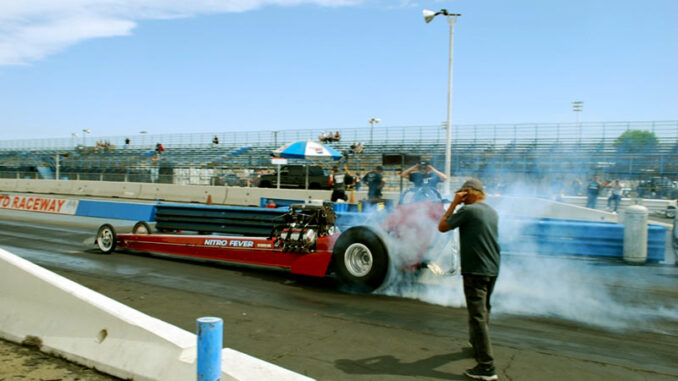
Air Density Online brings their latest advice on the how to navigate the nitrogen ratio is the air/fuel mix for racing.
An often-used term in motorsports tuning is air/fuel ratio. This is the ratio of the amount of air to the amount of fuel. It is useful as a measure to create the right amount of combustion in an engine. However, this is a slightly misleading term. The air in the air/fuel ratio value is primarily composed of nitrogen with only a little over 20% oxygen. Only the oxygen is used in creating the combustion. The nitrogen from the air is a ‘pass-through’. It is inert to combustion and power making.
We live within the nitrogen in the atmosphere. In reality, it helps to dilute the oxygen. Biological life evolved in a favorable combination of an oxygen/nitrogen atmosphere. Motorsports evolved in this combination as well. However, in motorsports, the presence of this large amount of nitrogen from the air is a cumbersome handicap to power making.
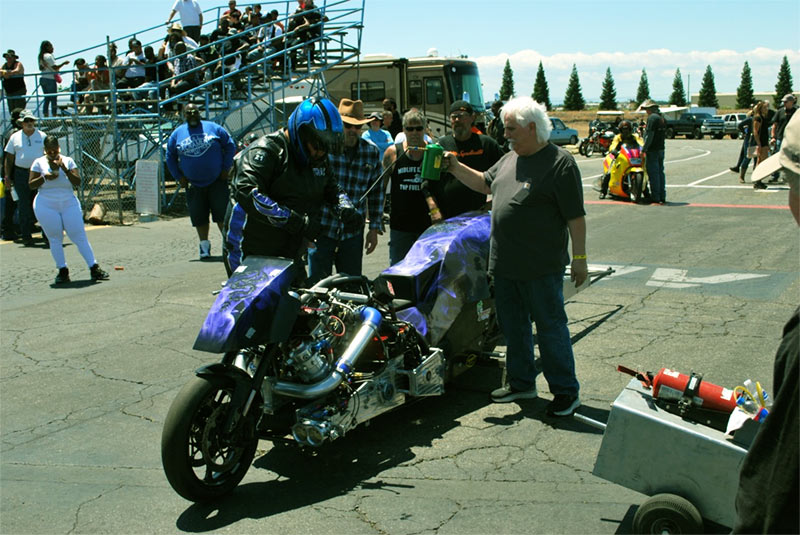
COMBUSTION
Engine combustion occurs between molecular oxygen in the air and the molecular carbon and hydrogen part of fuel: gasoline, ethanol, or methanol. For nitromethane powered motorsports, nitrogen compounds are in the fuel that burns as well. These nitrogen compounds are in a different chemical state than the nitrogen from the air. The nitrogen compounds in the fuel contribute to combustion — nitrogen from the air does not. The latter is chemically separate. It is inert to power making combustion.
COMBUSTION TEMPERATURES
Potential combustion temperatures for common racing fuels — gasoline, ethanol or methanol — with oxygen alone are in the 4,000 to 5,000 deg F range according to NASA data. That is enough to melt just about any of the materials used to make internal combustion engines.
Why do engines not melt? Combustion from these fuels can occur over a range of temperatures. The engine can be operated at a lower combustion temperature than at the maximum combustion heat. Excess heat is absorbed away that lowers the combustion temperature.
• ENGINE METALS ABSORB COMBUSTION HEAT — The engine itself absorbs heat through the cylinder walls, cylinder head, and piston domes. That all contributes to lower operating temperatures.
These cooler surfaces within the engine quench a boundary layer of air and fuel mixture. That forms an added heat barrier between combustion heat and the engine parts. That allows a small tolerance to higher combustion temperatures but not enough by itself.
• NITROGEN FROM THE AIR ABSORBS COMBUSTION HEAT — Significant heat absorption occurs with nitrogen from the air. Making up almost 80% of the air. The pesky nitrogen absorbs combustion heat. It helps a lot at lowering combustion temperatures below the melting point of the metals that the engine is made from.
According to NASA data in Ref. 1 for these fuels, peak combustion temperatures in air with the nitrogen are lowered about 1500 deg F from their potential max levels without nitrogen from the air.
• AIR/FUEL RATIO EFFECTS ON ENGINE TEMPERATURE — The remainder of the operating temperature level is controlled by air/fuel ratios. Rich, optimum, or lean air/fuel ratios affect the engine temperature. That is in addition to the other causes.
EFFECT ON AIR/FUEL RATIO FROM AIR DENSITY
The air/fuel ratio range is important. Air density changes can run the air/fuel ratio up or down without appropriate fuel system adjustments. In mechanical fuel injection, air density changes can be compensated for with jetting changes. Our websites, Air Density Online and MFI Calc, are examples of sources for air density reference values for fuel system tuning.
With the combination of the first two heat absorbers plus good air/fuel ratio tuning, the racing engine can be better run at a high-performance level without melting.
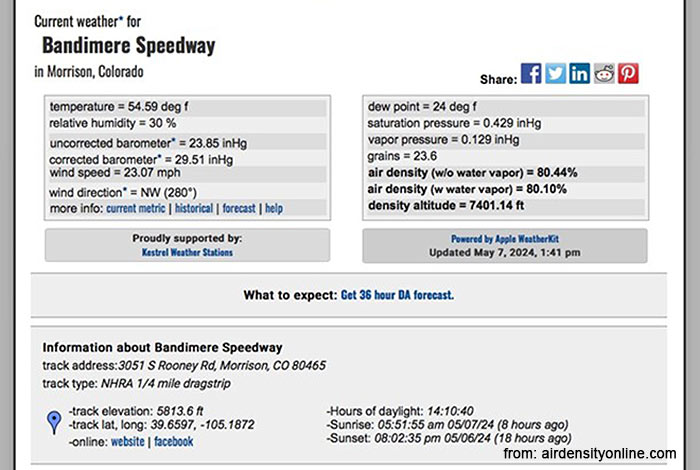
An extensive weather data summary from the website is shown here for motorsports tuning. That includes the altitude of 5,814 feet, quite ‘high in the sky’. Air density, as a result, is lower. A value of 80% is shown for this moderate May afternoon weather. For hotter, summer days, air density would be down in the 70% range. That is relatively low and presents a tuning challenge for racers who may compete at other racing facilities. Many of those facilities are at lower altitudes with higher air density, often over 90%. Tuning for both low and high altitudes is a challenge. Air density differences reflect a corresponding difference in power and fuel system adjustment needs. Performance effects occur because of nitrogen from the air. That would be amplified corresponding to air density changes.

NOSTALGIA NITRO DRAG RACING
Nostalgia Nitro Top Fuel drag racing is an example where tuning is often maxed out. Tune-ups are frequently run on the edge of pre-ignition/detonation limits. Tuners produce maximum power in their engines that barely survive a racing round.
ENGINE DAMAGE RISK
If the tune-up gets out of control, engine damage can occur. When a mistake is made, engine parts can melt, causing a failure. That is nothing more than the fuel mixture being in a ‘happy state’, burning hotter, more towards its natural higher temperature capacity. Unfortunately, the metals used to make the engine cannot survive these high temperatures.
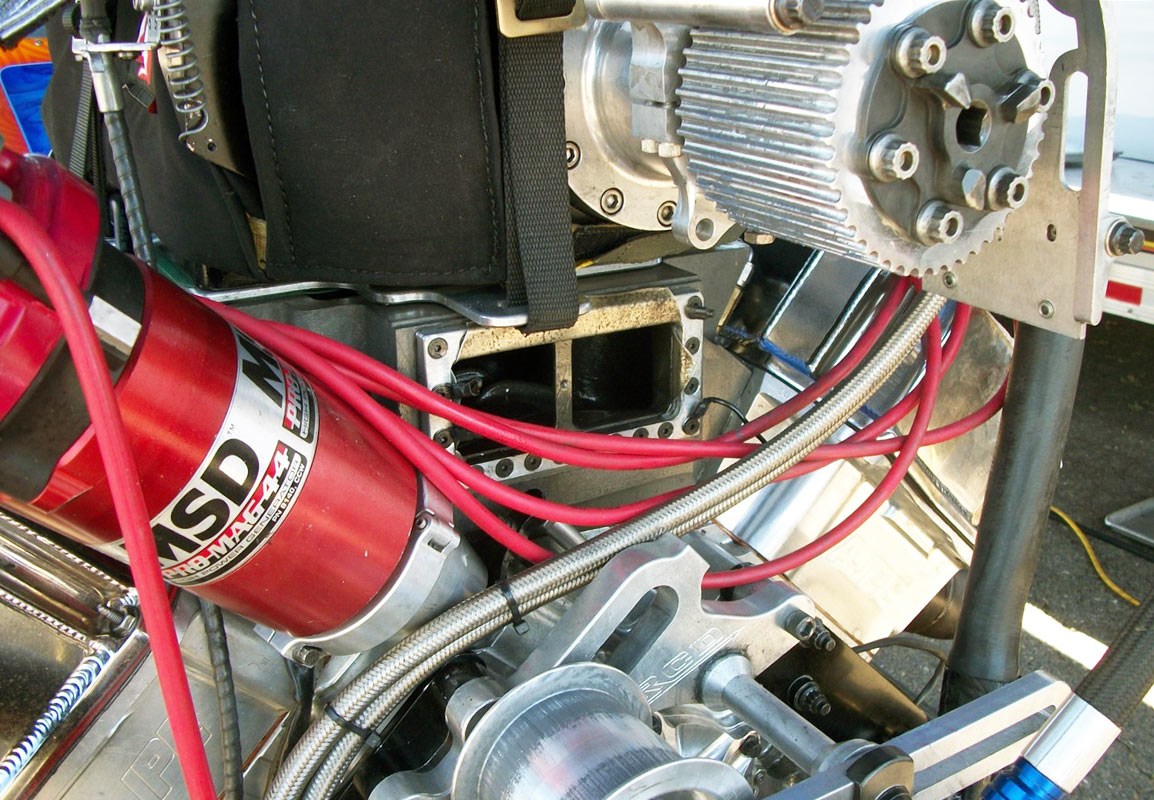
NITROGEN IN THE AIR
The air around us is 78%, nitrogen. It is in the molecular form of N2. This is a really low energy state of a molecule. It takes energy input to use it in any other chemical or combustion form. As a result, it doesn’t burn through the entire combustion process.
Nitrogen in the air is basically in the way of combustion.
A small amount or that nitrogen from the air may combine with combustion byproducts to form smog, but it is not any significant contributor to combustion energy, the air/fuel ratio tuning characteristic, or power making.
THE BLOWER (SUPERCHARGER)
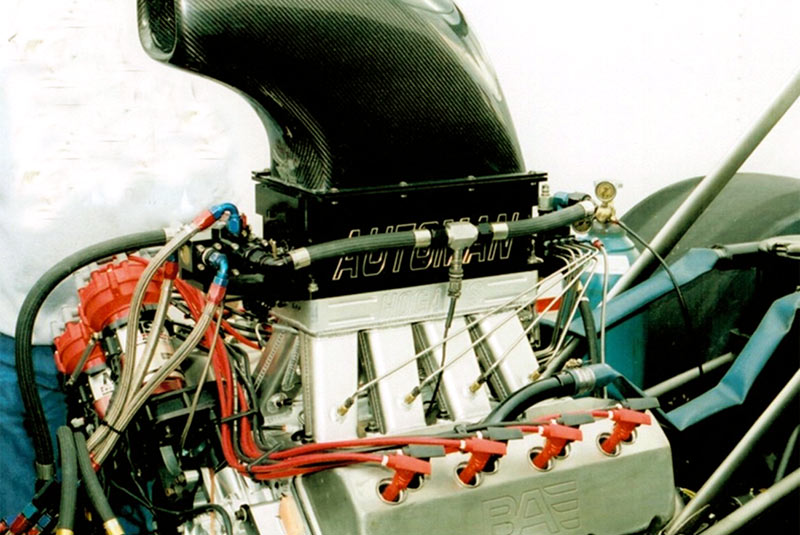
A blower is used in Nostalgia Nitro Blown Top Fuel drag racing. The blower pumps 2 to 2.5 times more air into the engine than what the engine would pass without a blower.
Only 23% of that extra air is oxygen that is targeted to make extra power. The blower also pumps 2 to 2.5 times more nitrogen from the air into the engine.
BLOWER POWER CONSUMPTION
In the Nostalgia Nitro Blown Top Fuel engine, the blower takes about 400 horsepower from the engine just to drive the blower. You can literally consider that about 300 of that horsepower is doing nothing but compressing nitrogen from the air. It’s not contributing to making power. So significant power is consumed driving the blower to compress nitrogen from the air, which is an anchor. It is always hanging around, subtracting from the net power output.
LOW STATIC COMPRESSION NECESSARY WITH A BLOWER
In addition, Nostalgia Nitro Blown Top Fuel engines most often are set up with relatively low static compression, typically 6 to 1. That combines with blower boost to make ‘running compression ratios’ over 14 to 1. With air/fuel ratio enrichment, that is about as high as possible to avoid pre-ignition/detonation with the amount of nitro fuel that the engine runs on.
To bring a lot of oxygen into the mixture, high +85% nitromethane/methanol fuel mixtures are customary. The lower static compression is necessary in this combination. It is to reduce adiabatic heating. That occurs from the compression stroke. Additional adiabatic heating has already occurred from boost. The total additional heating must be reduced with a lower compression ratio to avoid pre-ignition/detonation damage.
As a result of that low static compression, everything else has to be turned up to make more power: more blower speed, more fuel, more ignition timing, & more engine speed.
COMPRESSING THE NITROGEN FROM THE AIR AS WELL
There’s a pumping loss of power due to compressing the inert nitrogen from the air. It is pushing against the piston all during the engine cycle. Especially during the compression stroke, the added pressure from it is in a direction opposite the piston movement, causing further power reduction.
HEATING THE NITROGEN IN THE AIR
As combustion occurs, the inert nitrogen from the air absorbs combustion heat. That reduces pressure in the cylinder from combustion heat. That reduces force on the piston and the power output. So, the presence of inert nitrogen from the air, especially extra nitrogen from the blower, shows up as an anchor to combustion.
NITROGEN FROM THE AIR DURING THE POWER STROKE
After the mixture explodes, the piston is driven down. A significant amount of nitrogen from the air is present. Again, that is absorbing heat of combustion, reducing power. The tune-up is adjusted to accommodate this overlooked anchor: more boost, more RPM, etc.
NITROGEN FROM THE AIR DURING THE EXHAUST STROKE
That significant amount of nitrogen from the air is now occupying a portion of the volume that has to be vacated from the engine. Now the piston reverses its direction, pushing the mixture out the exhaust. That nitrogen from the air is still there. Now, it’s got to be pushed out the exhaust, all through that area between the exhaust valve and valve seat. That is also during the short time that the exhaust valve is open. So, it’s occupying volume in the exhaust, throughout the pathway into the exhaust port and exhaust pipe. That further adds to the pumping loss in an engine.
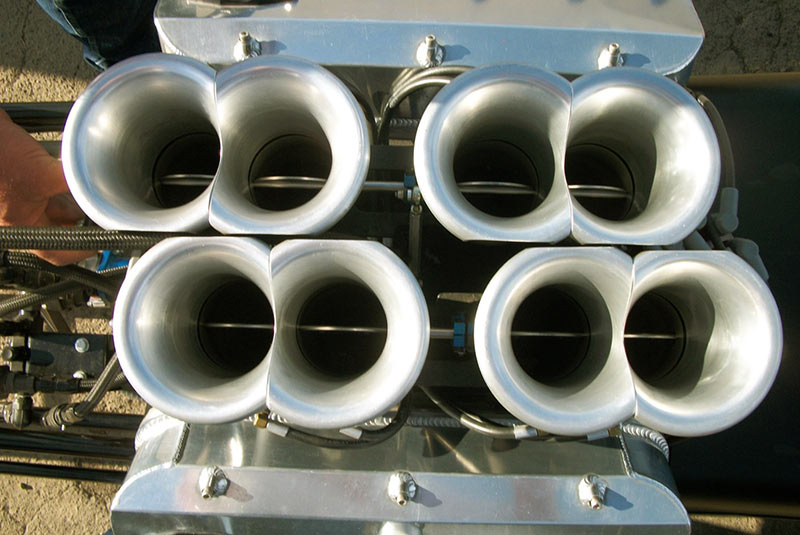
NOSTALGIA NITRO A-FUEL RACING WITH NO BLOWER
Nostalgia Nitro A-Fuel is another class of drag racing. A blower is not used with the nitromethane fuel. FYI: Static compression is a lot higher, close to 11 to 1. This makes up for some of the power loss that occurs without added oxygen from a blower.
SIGNIFICANCE OF FUEL PUMP SIZE
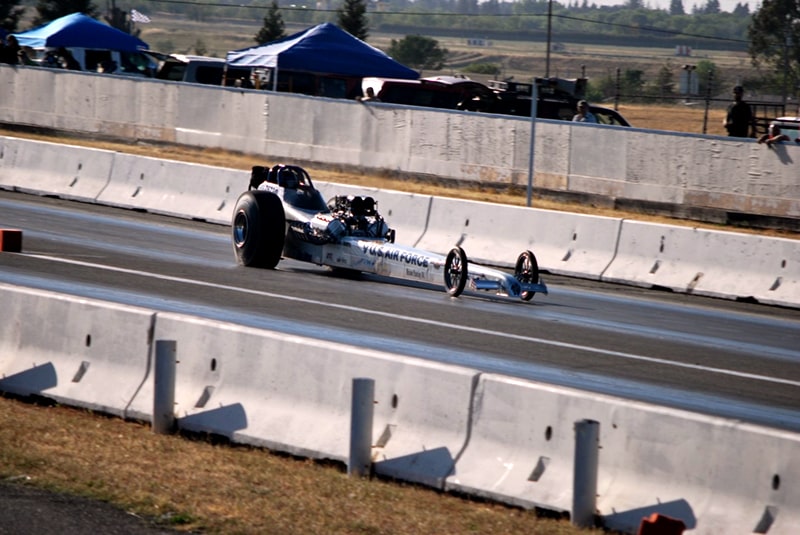
The Nostalgia Nitro A-Fuel class is limited to a relatively small fuel pump, now less than 11 GPM. For comparison, the Nostalgia Nitro Top Fuel class uses a lot larger fuel pump at 20 GPM. That is in addition to the blower. The volume of nitro fuel affects power. More nitro, more power!
The Nostalgia Nitro A-Fuel racecars are running 5.9 quarter mile racing ETs at 230 MPH. In comparison, the Nostalgia Nitro Blown Top Fuel racecars are running 5.60 quarter mile racing ETs at 250 miles an hour, not that much quicker for all the extra engine provisions.
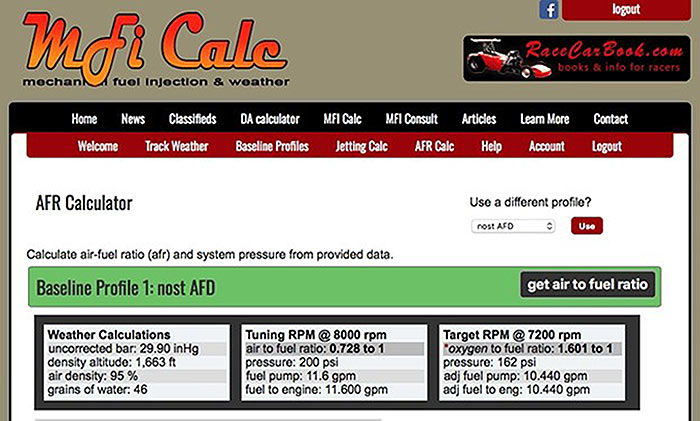
The air/fuel ratio is shown at 0.728 pounds of air to 1 pound of fuel. Our calculator also shows a chemical oxygen to fuel ratio of 1.601 pounds of oxygen to 1 pound of total H, C, and N-compounds from the fuel liquid. This ratio excludes all of the inert nitrogen from the air.
Oxygen to fuel ratio (OFR) is particularly revealing for nitro burning engine tuning. In that case, the oxygen part of the ratio can change from the nitro percentage, the fuel system, and/or the air density. For a blown (supercharged) engine, the oxygen part of the ratio is also affected by the amount of blower: size and drive speed. The fuel part of the ratio can be changed by the nitro percentage and/or the fuel system. The calculator keeps track of all of these values from a tune-up. Note the difference in magnitude. The air/fuel ratio is diluted by the nitrogen from the air. OFR is not. OFR is a more sensitive measure of tuning changes.
UNBLOWN RACECAR ENGINE WITH TOP FUEL NITRO PUMP
What would happen if a Nostalgia Nitro A-Fuel dragster used a much larger 20 GPM fuel pump, conceivably to run the Nostalgia Top Fuel class? According to our analysis from info in Ref 2, that alone could bump as much as 1,000 horsepower over the current A-Fuel level.
Our analysis from Ref. 3 looks like a low 5 second ET dragster in a quarter mile race, potentially faster than the ones with a blower. Minus the blower, the same amount of nitromethane is delivered without the blower losses from extra inert nitrogen from the air.
LESS BLOWER, MORE POWER FROM LESS NITROGEN FROM THE AIR?
If a blower requirement is maintained in the Nostalgia Top Fuel drag racing class, running less blower overdrive with more static compression may be better. The whole target is attacking the burden from 78% nitrogen in the air by reducing that amount. You are trying to spend less power loss compressing less inert nitrogen from the air and exhaust it.
The same logic may apply to professional Blown Top Fuel drag racers running +300 MPH. Looking at the professional normally aspirated A-Fuel drag racers running 280 MPH, a similar comparison could be made. That would be to examine the reduction or removal of the blower. That would allow higher compression ratio. All of that would be to reduce the burden from the nitrogen from the air.
CONCLUSION
While it is often overlooked, nitrogen in the atmosphere causes an aspect of engine tuning that can get in the way of an otherwise good tune-up. Being aware of potential issues such as inert nitrogen from the air, one can help motorsports tuning challenges as they arise. Awareness of tracking atmospheric content and variables is one way to achieve that.
Ref 1: 5000 Horsepower on Methanol, racecarebook.com, p. 214
Ref 2: Blown Nitro Racing on a Budget, racecarbook.com, p. 146-147
Ref 3: Fuel Injection Racing Secrets, racecarbook.com, p. 126-127
Leave a Reply