



![[Gallery] Mecum Kissimmee Auction 2026](https://www.racingjunk.com/news/wp-content/uploads/2026/03/DSC_0717-e1774629242515-376x206.jpg)
![[Gallery] Cruisin’ One Daytona](https://www.racingjunk.com/news/wp-content/uploads/2026/03/DSC_0538-e1774027057404-376x206.jpg)


Inside Smith Racecraft’s Advanced Hi-Tech Assassin Traction Bar, Part 2
Click Here to Begin Slideshow
Last issue, we started our examination of the Smith Racecraft Assassin traction bar. If you recall, we dug into the basic history of bolt-on traction devices, ranging from the very first Traction Masters through the slapper bar era all the way up to what is likely the most sophisticated bolt on traction bar available today, the Assassin from Smith Racecraft.
Fair enough, but just what is Smith Racecraft? It was founded by Kim Smith in 1982. Over the years (and amongst other pro and sportsman race car builds) Smith campaigned his own Pro Stock truck. Success with that truck led Smith to become the in-house Pro Stock Truck chassis builder for Victor Cagnazzi Racing. If you recall, these guys were top shelf competitors in both Pro Stock Truck as well as Pro Stock, and they did everything from building their own engines to building their own race cars and trucks. Another big notch in Kim’s belt was the construction of Hurley Blakeney’s “Silent Thunder” twin turbo-charged Ford Thunderbird. If you’re a student of drag racing, you’ll know that creation was one of the most potent NHRA legal door slammers of the era. To make it work, Smith came up with a dual frame rail setup for the innovative car. Although the car was complex, it wasn’t portly. Even with the mass of plumbing for the twin turbocharged V8, the T-Bird tipped the scales at a “featherly” 2370 pounds (with driver and ballast). After running numerous 200+ MPH “laps,” Hurley eventually sold the car to Northwest Ford heavy-hitter Mark Wolfe. Wolfe campaigned the Thunderbird in NHRA AA/AT and also ran it in Pro Street at non-NHRA sanctioned races. Wolfe’s best with the Smith-built T-Bird was a 6.38 second pass at 228 MPH(!). As you can see, Smith Racecraft definitely has credentials, and we’ve only scratched the surface.
On that note, let’s get back to the Assassin traction bars:
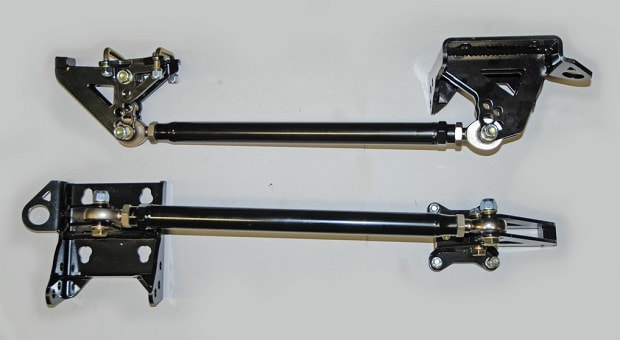
When you examine the bars, you’ll note that the way they work is by way of a rocker assembly engineered to contact the front spring eye under load. The front segment of the traction bar is physically bolted to the forward section of the leaf spring. This forward section is actually pinned directly to the leaf spring by a bolt; this anchors it. Smith Racecraft supplies a special 5/16-inch drill bit that allows you to drill the spring (after positioning the bar on the spring and tightening the pair of front u-bolts). Smith notes that during the initial setup, and before the spring is drilled, the car should be on the ground at ride height and “race” weight. The driver should be in the car (or matching weight should be placed on/around the driver seat). Next up, the rocker stop should be centered under the front spring eye. At that point, you can physically clamp down on the forward segment and drill the spring. With the forward section of the bar securely pinned and fastened, the rocker is allowed to move as the car is under power. The more power you apply to the suspension system, the harder the rocker presses on the front spring eye.
What about the back of the bar? As you can see in the photos, the back of the Assassin bar bolts directly to the spring perch by way of conventional U-bolts (Smith offers an uber-cool perch configuration that doesn’t require U-bolts, but we’ll leave that for another day). The spring mount on the Assassin traction bar is nicely welded and, as you can see in the photos, it offers multiple shock absorber locations, ahead of and behind the rear axle. This allows the bar to fit staggered shock combinations or custom shock locations (where you’ve moved the shocks to clear the tires). Having the ability to move the shock upward (from the stock location) is a big bonus in tire-restricted applications. Why? Simple. This means the lower shock body (on the outboard side) can be moved out of the way of the wheel rim; this is usually where contact with the wheel and tire is first made in cars like first generation Camaros. It also allows for the shock to be centered in its travel on cars where the ride height is increased over stock.
Finally, Smith includes a neat tie down bracket at the rear of each of the spring mounts. With this setup, when tying down the car, it’s easy to reach because the mount is conveniently located. Clever.
Even cleverer is the simple way to adjust the bar, but we’ll hold off with the rest of the setup until the next issue. In the meantime, check out the accompanying close-up photos of the Assassin traction bar. This is an outstanding development in terms of hook technology and to top it off, it’s extremely well made. Stay tuned for more.
Last issue, we started our examination of the Smith Racecraft Assassin traction bar. If you recall, we dug into the basic history of bolt-on traction devices, ranging from the very first Traction Masters through the slapper bar era all the way up to what is likely the most sophisticated bolt on traction bar available today, the Assassin from Smith Racecraft.
Fair enough, but just what is Smith Racecraft? It was founded by Kim Smith in 1982. Over the years (and amongst other pro and sportsman race car builds) Smith campaigned his own Pro Stock truck. Success with that truck led Smith to become the in-house Pro Stock Truck chassis builder for Victor Cagnazzi Racing. If you recall, these guys were top shelf competitors in both Pro Stock Truck as well as Pro Stock, and they did everything from building their own engines to building their own race cars and trucks. Another big notch in Kim’s belt was the construction of Hurley Blakeney’s “Silent Thunder” twin turbo-charged Ford Thunderbird. If you’re a student of drag racing, you’ll know that creation was one of the most potent NHRA legal door slammers of the era. To make it work, Smith came up with a dual frame rail setup for the innovative car. Although the car was complex, it wasn’t portly. Even with the mass of plumbing for the twin turbocharged V8, the T-Bird tipped the scales at a “featherly” 2370 pounds (with driver and ballast). After running numerous 200+ MPH “laps,” Hurley eventually sold the car to Northwest Ford heavy-hitter Mark Wolfe. Wolfe campaigned the Thunderbird in NHRA AA/AT and also ran it in Pro Street at non-NHRA sanctioned races. Wolfe’s best with the Smith-built T-Bird was a 6.38 second pass at 228 MPH(!). As you can see, Smith Racecraft definitely has credentials, and we’ve only scratched the surface.
On that note, let’s get back to the Assassin traction bars:
When you examine the bars, you’ll note that the way they work is by way of a rocker assembly engineered to contact the front spring eye under load. The front segment of the traction bar is physically bolted to the forward section of the leaf spring. This forward section is actually pinned directly to the leaf spring by a bolt; this anchors it. Smith Racecraft supplies a special 5/16-inch drill bit that allows you to drill the spring (after positioning the bar on the spring and tightening the pair of front u-bolts). Smith notes that during the initial setup, and before the spring is drilled, the car should be on the ground at ride height and “race” weight. The driver should be in the car (or matching weight should be placed on/around the driver seat). Next up, the rocker stop should be centered under the front spring eye. At that point, you can physically clamp down on the forward segment and drill the spring. With the forward section of the bar securely pinned and fastened, the rocker is allowed to move as the car is under power. The more power you apply to the suspension system, the harder the rocker presses on the front spring eye.
What about the back of the bar? As you can see in the photos, the back of the Assassin bar bolts directly to the spring perch by way of conventional U-bolts (Smith offers an uber-cool perch configuration that doesn’t require U-bolts, but we’ll leave that for another day). The spring mount on the Assassin traction bar is nicely welded and, as you can see in the photos, it offers multiple shock absorber locations, ahead of and behind the rear axle. This allows the bar to fit staggered shock combinations or custom shock locations (where you’ve moved the shocks to clear the tires). Having the ability to move the shock upward (from the stock location) is a big bonus in tire-restricted applications. Why? Simple. This means the lower shock body (on the outboard side) can be moved out of the way of the wheel rim; this is usually where contact with the wheel and tire is first made in cars like first generation Camaros. It also allows for the shock to be centered in its travel on cars where the ride height is increased over stock.
Finally, Smith includes a neat tie down bracket at the rear of each of the spring mounts. With this setup, when tying down the car, it’s easy to reach because the mount is conveniently located. Clever.
Even cleverer is the simple way to adjust the bar, but we’ll hold off with the rest of the setup until the next issue. In the meantime, check out the accompanying close-up photos of the Assassin traction bar. This is an outstanding development in terms of hook technology and to top it off, it’s extremely well made. Stay tuned for more.
Leave a Reply