



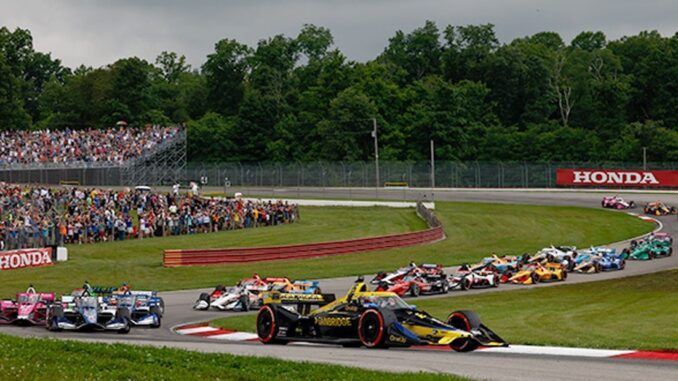

This time it really might happen. INDYCAR announced its NTT INDYCAR SERIES will, after a full-field test of settings and parameters on The Milwaukee Mile oval June 11, adopt hybrid engines in time for the Honda Indy 200 on the 2.258-mile, 13-corner Mid-Ohio Sports Car Course July 5-7.
This has taken a long time and the hybrid equipment has gone through many iterations before this announcement was made. The series, its engine manufacturers – Chevrolet and Honda – have worked together to develop the 2.2-liter, twin-turbocharged V-6 engine that is the basis for the internal hybrid system. It was initially paired and tested with hybrid power on August 16 last year on the Sebring International Raceway road/airport course. Including that test, a total of 23,518 miles have been successfully completed by 28 NTT INDYCAR SERIES drivers over these past seven months.
INDYCAR president Jay Frye noted, in announcing the commencement of hybridization, “The strength of this uncharted partnership between Chevrolet and Honda has pushed this innovative project to the grid in 2024. The INDYCAR-specific hybrid power unit will bring a new and exciting element to the NTT INDYCAR SERIES with additional energy and overtake options,” he stated. “We cannot wait to see the start of this new era at Mid-Ohio.”
With the hybrid system installed in the Dallara cars’ bellhousings, both Chevy and Honda engines are expected to produce added overtake options with the Push to Pass system, giving drivers more choices and more control, together with enhancing on-track competition.
The innovative hybrid system is made up of a low voltage (48V) Motor Generator Unit (MGU) and Energy Storage System (ESS) – consisting of 20 ultracapacitors – both of which fit inside the bellhousing, located between the Chevrolet and Honda INDYCAR SERIES internal combustion engine (ICE) and the gearbox. During regeneration, acting on the clutch shaft, the MGU builds power to be stored in the ESS. The additional horsepower is deployed through the same motor generator on driver demand.
This type of regenerative system has been in use for other series but none of them are utilizing the bellhousing for MGU and ESS. Some of the safety elements of this new system include the low voltage system and the ability for drivers to restart the car by themselves following a spin-and-stall, thereby avoiding the need for INDYCAR’s AMR Safety Team deployment. This should add to more green-flag action in races.
Both Eric Warren, General Motors’ executive director for motorsports competition, and Honda Racing Corporation (HRC) USA president David Salters are relieved to see the system finally come online. “The introduction of hybrid technology provides an opportunity to integrate electrification technologies,” into the series, Warren said. “We support INDYCAR’s decisions throughout this process to study testing data carefully and make sure that, when the hybrid technology is integrated, the operation and performance are exactly what is expected.”
Salters understands that “hybrid technology is playing an ever-increasing role in both our racing programs and the production vehicles created by Honda and Acura.” While there have been challenges in ramping up this system, “We (at HRC USA) have stepped in with our competitors to help INDYCAR make the hybrid system compact enough, powerful enough, light enough and reliable enough to work within the highly restricted confines of an INDYCAR chassis. We look forward to hybrid tech adding another dimension to the great racing spectacle,” Salters concluded.
Testing has taken place at Sebring, as earlier noted, as well as Barber Motorsports Park, Homestead-Miami Speedway’s road course, both the Indianapolis Motor Speedway oval and road course, The Milwaukee Mile, Road America and World Wide Technology Raceway, thereby visiting many tracks used by the series.
By Anne Proffit
Leave a Reply