




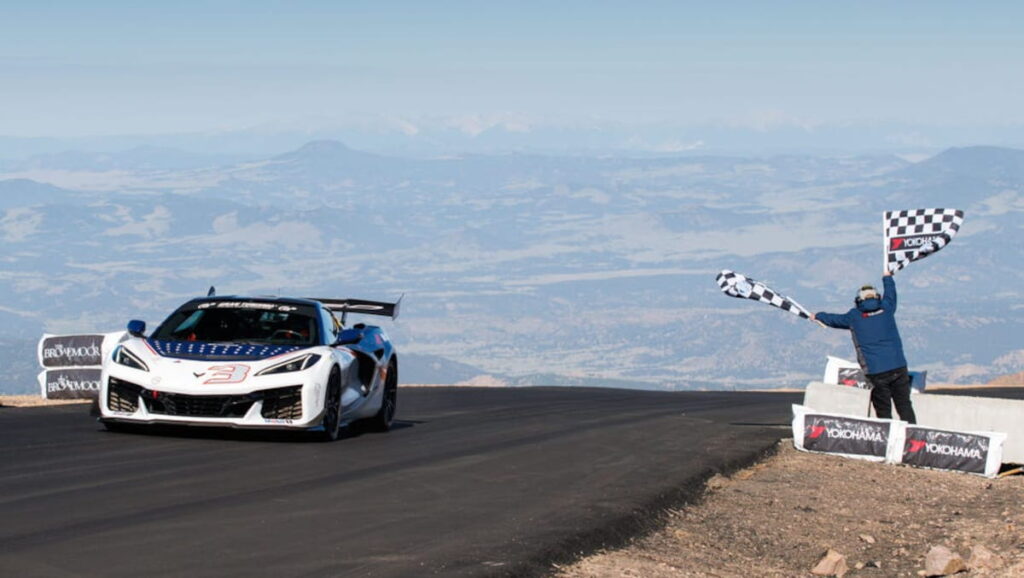
The Pikes Peak International Hill Climb thrives on records. Making it to the top of the mountain isn’t the chore it once was, when parts closer to the pinnacle weren’t paved, but even with the pavement, getting any vehicle around the 156 turns on this 12.42-mile stretch of road, most of it at the upper reaches offering little respite if one puts a wheel wrong. Guardrails, Pikes Peak veterans might say, are for wusses.
There are a myriad of classes in this race to the clouds, which has been in existence since 1916, albeit not held every year. And there are many reasons to try for a record at this race. Not just the fame, but the accomplishment for the driver, for the car and for the manufacturer. With the large number of classes and the change of weather with elevation from the seventh mile to 14,115 feet above sea level, there are many ways to accomplish a new speed record and many ways to destroy it.
This year’s 104th Race to the Clouds had one major revelation: the Chevrolet Corvette ZR1X coupe, driven by 2011 Indianapolis 500 runner-up and Peak veteran JR Hildebrand, broke the Time Attack 1 production-car record by an amazing 23 seconds. Hildebrand’s nine-minute, 30.104-second run to the Peak’s peak opened eyes around the world. It was a drive the racer had been looking to take since 2024, when Chevrolet first considered racing the non-hybrid ZR1 to the Peak.
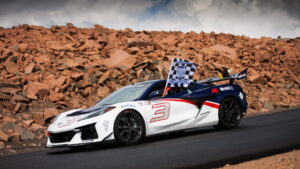
This year’s entry was definitely a production car. The sole amendments this hypercar received were safety-related and regulated by the sanction: roll cage, fuel cell, racing seat belts, fire system and cutoff switches. Beyond that, the ‘Vette was stock. Chevy’s Corvette ZR1X is the most powerful of the two-seat sports car’s model range. It’s powered by the LT7 5.5-liter twin-turbo V8 and paired with a front electric drive unit, delivering a combined 1,250 horsepower (the electrification adds 186 horsepower up front on this mid-engine machine). It uses an eight-speed dual-clutch automatic transmission with shifting capabilities. The hypercar’s all-wheel-drive system with that added front-axle electric motor helped Hildebrand take corner exits quicker and more aggressively.
Corvette’s ZR1X, with its electrification, is more suited to the mountain than the ZR1 might have been. The road to the top is filled with tight hairpins and the all-wheel-drive component of this hypercar provides the kind of traction that can assist with a mid-engine/front-motor machine. Of course, with air density dropping throughout the climb, taking about 40+ percent of the available air away, any internal combustion engine (ICE) can easily choke.
Romain Dumas owns the outright Pikes Peak record of 7 minutes 57.148-seconds, achieved in 2018 with a Volkswagen ID.R, a fully-electric prototype. This year he earned his sixth “King of the Mountain” in a Ford Super Mustang Mach-E EV. There’s no question that electrification is the way to go quickest to the top of the Peak; Hildebrand’s success in this hybrid acknowledged that both the internal combustion engine and hybridization can get the job done.
In testing and practice before the official competition took place, Hildebrand learned how to access the power he needed without stressing either the ICE or the hybrid motor. “Even during practice at 11,000 feet, it was just so in-your-face how powerful the Corvette ZR1X’s front axle was, and how much of a difference that electric motor was making,” Hildebrand said.
Needing to save the battery charge for higher elevations, Hildebrand relied on the turbochargers to push 24 psi of boost through the lower areas of the course. That allowed regenerative braking to enhance the ZR1X’s small 1.9-Kw battery, so that when oxygen starvation set in, he could access the ZR1X’s push-to-pass e-boost button as much as he needed.
The Corvette’s MagneRide suspension was kept in Track mode and Hildebrand even kept the traction control – at an exceptionally low setting – activated.
Hildebrand also had one exceptional assist – the weather was superb. Hildebrand’s run followed that of the former record-holder, David Donner, who was, again, driving a 992.1-generation Porsche Turbo S. Donner landed with a 9:53.740 time and the Corvette engineers became a bit nervous at the start line. When the timing system failed to show his first two sector splits, the nerves went deeper. Finally, the official time of 9:30.104 appeared on the summit’s screen.
Hildebrand and Chevrolet were racing in the Time Attack class because the Race to the Clouds doesn’t have a production category and the group that sanctions the event can’t certify it, considering the hybrid’s complexities. This was actually a pre-production car, with its VIN revealing the final two digits “EX”. Rather than using the Corvette’s original saddleback fuel tank, a 10-gallon fuel cell was mounted in the trunk, adding some pounds needed for traction.
As he held the checkered flag for his accomplishment in the Time Attack class of this 104th Pikes Peak International Hill Climb, JR Hildebrand flashed a big smile and said, “As far as I’m concerned, we’re not just here to eclipse the current number for the fastest production car at Pikes Peak. We’re here to lay down a time that scares other people away from coming after it anytime soon!”
Those comments might put some fear in competitors but it’s more likely than not adding to the desire to topple the time and speed the Chevrolet Corvette ZR1X and JR Hildebrand achieved. Records were made to be broken.
I wish we could have swwn a video of the climb. Congradulations JR!