



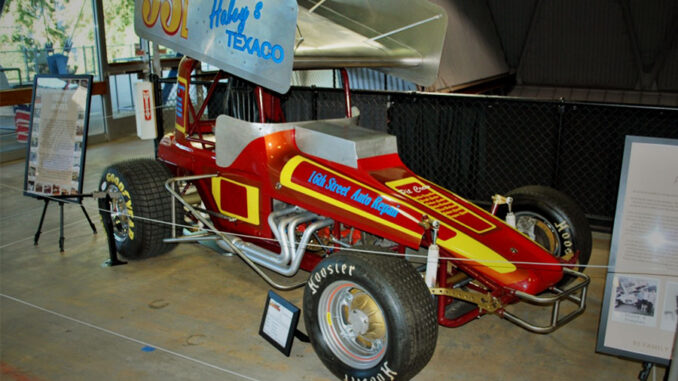
Internal combustion racing engines run on air and fuel. The oxygen in the air combusts with the fuel to provide power for the engine. This concept is the basis for engine tuning. It gets more complicated as various factors are considered. The ambient air that combusts with the fuel can fluctuate and affect the engine tune-up.
Only 23% of the air is oxygen by weight. A lot of air has to go through the engine to get enough oxygen to burn with fuel for power. Consider these recommended air/fuel ratios for various engines:
• Gasoline engines use an air to fuel ratio (AFR) of about 15/1 for an economy highway ratio.
• A richer gasoline AFR of about 12/1 is run for normally aspirated racing engines.
• A gasoline AFR of about 11/1 is even more rich for supercharged racing engines.
• Methanol engines run about 5/1 AFR for the normally aspirated configurations and 4/1 AFR or richer for supercharged configurations.
• Nitro engines can run 1/1 AFR or richer depending on the engine configuration. We saw AFR’s at 0.28/1 for some configurations. That is 0.28 pounds of air for one pound of nitro fuel mix. That is extreme!
With each of these fuels, launch enrichment and high-speed lean out of the fuel is common for fuel management. The amount of oxygen from the air determines the amount of fuel. Methanol and nitro bring added oxygen into the combustion process. That oxygen is within the fuel chemistry. The AFR ratio gets complex as a result. Trial-and-error tuning is a common practice.
Air Density and the Motorsports Standard
Motorsports performance is dependent on the amount of air in a racing location. The common measurement of that amount of air is air density. Several air density standards exist. The ‘motorsports standard’ is one of these. The value of 100% air density occurs from a mathematical computation for an air pressure, air temperature, and humidity combination. The motorsports standard is an air pressure of 29.92 inches of mercury, an air temperature of 60 deg. F., and zero percent humidity. Air density standards vary with other fields of weather such as aircraft. Air density values from other fields may not be the same as values from the ‘motorsports standard’.
Air density is the density of air molecules within a specific volume of atmosphere. Within that volume, moisture, elevation, pollution and other elements displace some of those molecules, making the air density less than 100%. Cooler weather increases air density while warmer weather decreases it. This is a simplified explanation but should be considered when tuning an engine. Sea level altitudes raise air density while higher altitudes lower air density. The amount of power from a racing engine is most often dependent on the air density. High air density makes more power. Lower air density makes less power.
Smog and pollution provide contaminants in the air that displace oxygen and other chemical elements – making the air density less than 100%. These effects are not well reported in the motorsports standard. So, they are not considered in most calculations.
Motorspots Fuel Injection with Open Loop
The fuel system in racing vehicles with carburetors, mechanical fuel injection, and/or many high-performance crate motors must be manually adjusted to compensate for air density changes. As a result, weather and altitude information is needed to determine fuel system adjustments. The fuel system is richened for good air and leaned for bad air. That is in order to maintain the ideal air to fuel ratio for a specific engine and fuel type.
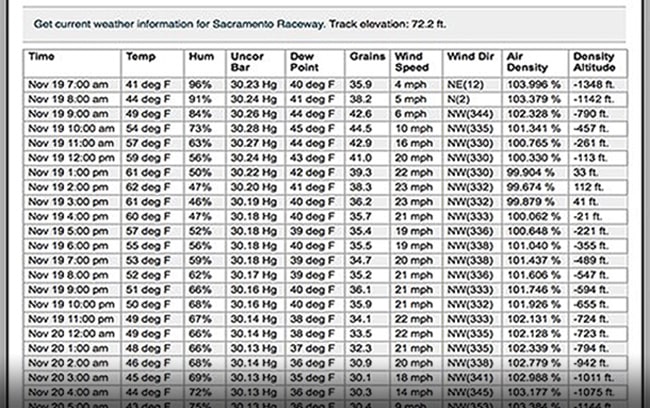
The amount of fuel system adjustment is often an acquired skill. Weather conditions for good or bad air are tracked with information from local weather reports, Internet weather information, or the racer’s portable weather station (if so equipped). The web site, airdensityonline.com, provides current and hourly air density information for over 1,000 motorsports facilities worldwide.
Two methods of compensation for air density can be done. One is to adjust the engine for best power in changing weather conditions. The second option is to tune for the best repeatability of an engine in changing weather conditions.
Race Engine Fuel System Tuning for the Most Power
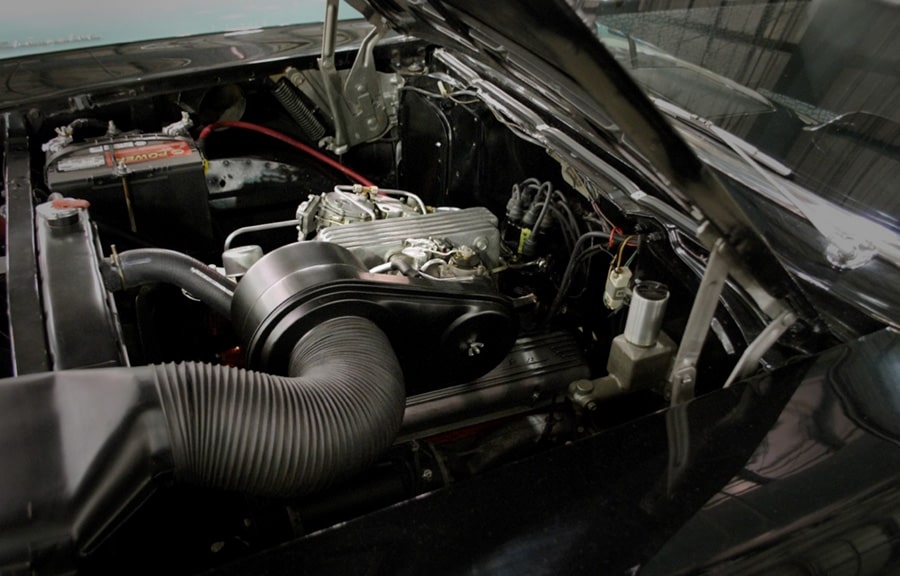
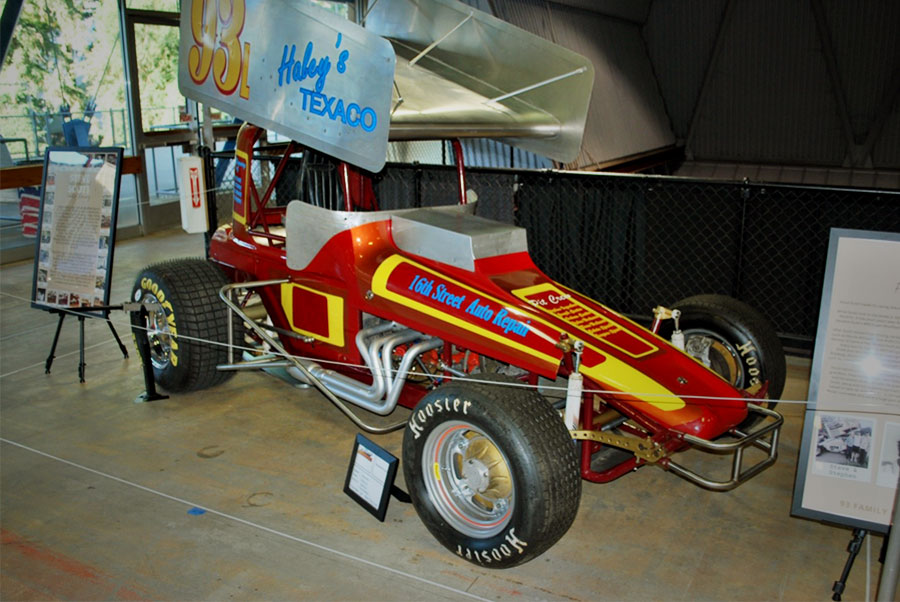
Tuning for best power for the changing weather conditions is ideal in open elapse time classes where there is no breakout. Examples are drag racing Top Fuel, Alcohol Funny Car, Pro Modified, and Pro Stock. Sprint car & boat racing, water or land speed competition, and tractor pulling are other examples. In these categories, the performance will vary for good and bad air. The racer tuners adjust for that. However, everyone in the class has the same handicap from air density changes. Spark plug readings for tuning are all important.
Tuning for Repeatability
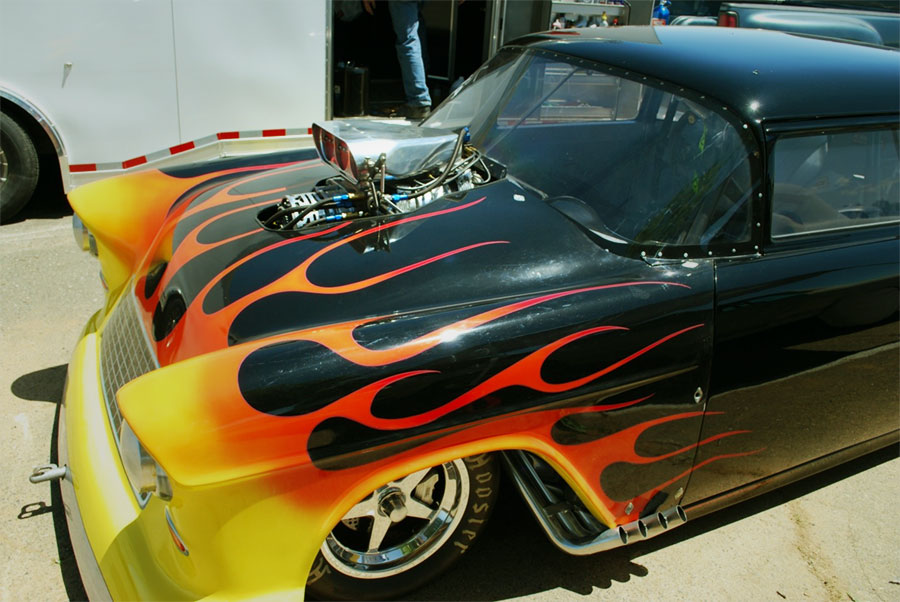
Drag racing bracket classes with a target breakout elapse time are an example that need tuning for repeatability. The racecar or race boat is adjusted to compensate for air density changes to reproduce a bracket elapse time target. The car (or boat) setup is turned down to compensate for good air and turned up to compensate for bad air. One common method for cars is to change the shift point. It is raised for bad air to recover performance. It is lowered for good air to retard performance back to a target. Some race tuners change a throttle stop, the spark advance, or blower overdrive in blown applications. In any of the latter, the intent is to compensate for air density changes where an elapse time target is needed. Spark plug readings are again all important for tuning.
Tracking Weather with a Portable Air Density Meter
One simple method of determination of air density is to use a calibrated air density meter equipped with a mechanism that responds to pressure, temperature, and humidity changes. It produces an air density reading from typically 60% to 110% depending on the characteristics of the air and the elevation. Tuners use the reading from the meter for the previously mentioned tuning routines.
Recalibrate! Often tuners use that meter that they bought a long time ago without recalibration. In the long term, the readings will change. They can also change if it is dropped. In fact, vibrations from storage in the trailer on a long tow may throw it out of calibration. It is one tool you may want to carry in your tow vehicle, on a soft pillow, or wrapped in a large towel on a seat.
Other Air Density Sources: Air density can also be determined from air pressure, temperature, and humidity values from a barometer, thermometer, and humidity meter. With some simple math, these values can be used to determine air density. Airdensityonline.com offers an air density calculator to do the math for racer tuning as well as hourly weather.
Calculating Effects of Pressure & Temperature
The calculation for air density from barometer and temperature data is as follows:
1) First determine the barometric pressure in inches of mercury.
2) This has to be an uncorrected value.
Most local weather reports give barometric pressure in corrected values. These corrected values are adjusted to provide an equivalent standard measurement usually at sea level. The uncorrected value provides the actual barometer reading at the elevation of the reading.
At the Norwalk Raceway, Northern Ohio, USA, a reading of 30.05 inches of mercury from the local weather report is an example of a corrected barometric pressure. Norwalk Raceway altitude is about 700 feet above sea level. The correction for that altitude is about -0.7 inches of mercury. Therefore, the uncorrected barometric pressure is 30.05 – 0.7 = 29.35 inches of mercury.
Local weather reports at high altitude locations, such as Denver, Co, USA, for example, provide corrected values as well. A local corrected value of 30 inches of mercury would actually be closer to an uncorrected value below 25 inches of mercury. The uncorrected value is vital for proper tuning. Correct tuning would not be attainable from local corrected barometer values.
According to Kinsler Fuel Injection, a rule of thumb is a reduction of one inch of mercury for every 1,000 feet of elevation.
3) Next, determine the temperature in deg. F.
4) Next, convert the temperature to absolute. That is done by adding 459.67 to the value.
5) Do the following calculation: Air density % (motorsports standard) =
1,736.86 x uncorrected barometer / absolute temperature
Calculation Example:
(1) Assume a local barometer reading at Norwalk is 30.05
(2) Determine an uncorrected value. In this case, with Norwalk being at approximately 700 feet above sea level, the uncorrected value is 29.35 inHg
(3) Assume a temperature of 90 deg. F
(4) Convert to absolute: 90 deg. F + 459.67 = 549.67 deg. Absolute
(5) Air density % = (1,736.86 x 29.35) / 549.67 = 92.7%
This is a computation of the amount of air available at Norwalk Drag Raceway on a 90-degree F. day with a barometer of 30.05 inches of mercury from a local weather report. It does not account for humidity or smog.
All engines will be running on 92.7% air. Most will have some level of performance reduction from what would otherwise occur from a higher air density setup. It will not be that same percentage amount, but in many setups, it will be a performance change that is at least proportional to the air density change (small air density change, small performance change; big air density change, big performance change). Some supercharged engines can be compensated for an air density cha
Fuel System Record Keeping for Tuning
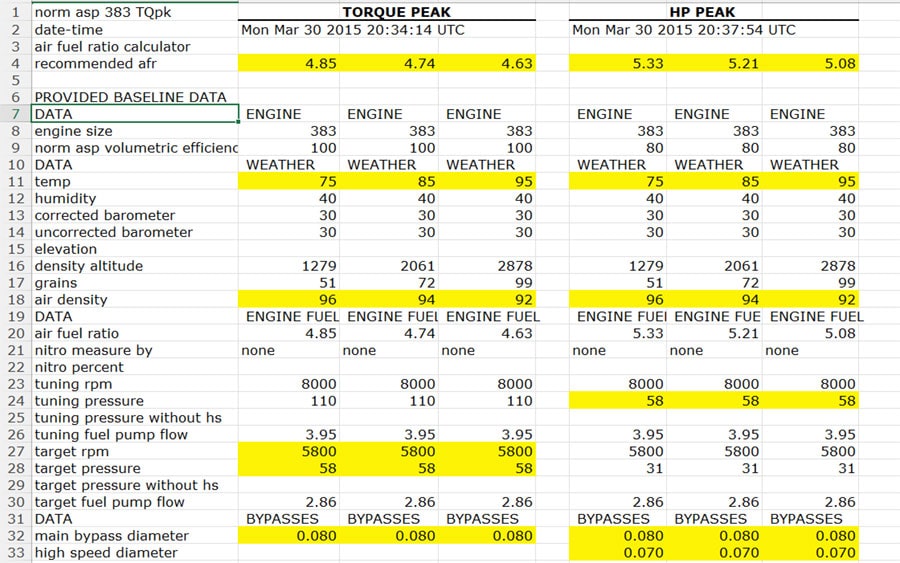
In some drag racing classes, such as Top Sportsman or Top Dragster with an elapse time dial-in, many competitors do not change anything. Experience or records from previous similar air density conditions are used to predict an elapse time. Then that elapse time is used as the target. A faster elapse time dial-in is done for good air, and a slower elapse time dial-in is done for bad air.
REFERENCES
- mficalc.com racing mechanical fuel injection jetting calculator for normally aspirated or forced induction engines; for weather corrections, enrichment or lean out tuning, for 2 or 4 cycle or rotary engines.
- airdensityonline.com source for air density, density altitude, water grains, etc. for over 1,000 motorsports facilities worldwide.
- racecarbook.com source for 6 publications all about racing mechanical fuel injection and racing fuels such as nitro, methanol, alcohol, racing gas, and more recent hybrid racing fuel blends; information about tuning for air density is in all of the publications.