




![[Gallery] 3rd. Annual Father's Day Classic Car Show](https://www.racingjunk.com/news/wp-content/uploads/2026/07/Calistoga-2026-18-scaled-e1783026475349-376x206.jpg)


![[Gallery] Blackhawk Museum Stop Over](https://www.racingjunk.com/news/wp-content/uploads/2026/06/DSC_0918-e1782449621944-376x206.jpg)
Piston Primer Part 2
Click Here to Begin Slideshow
Last issue we began our research into pistons for street and strip applications. In that segment we examined forgings versus castings and various alloys along with piston skirts. This time around, we’ll look at ring lands and ring groove clearance. Although it’s easy enough to gloss over this stuff, it’s actually extremely important in a street and strip combination. Here’s the inside story.
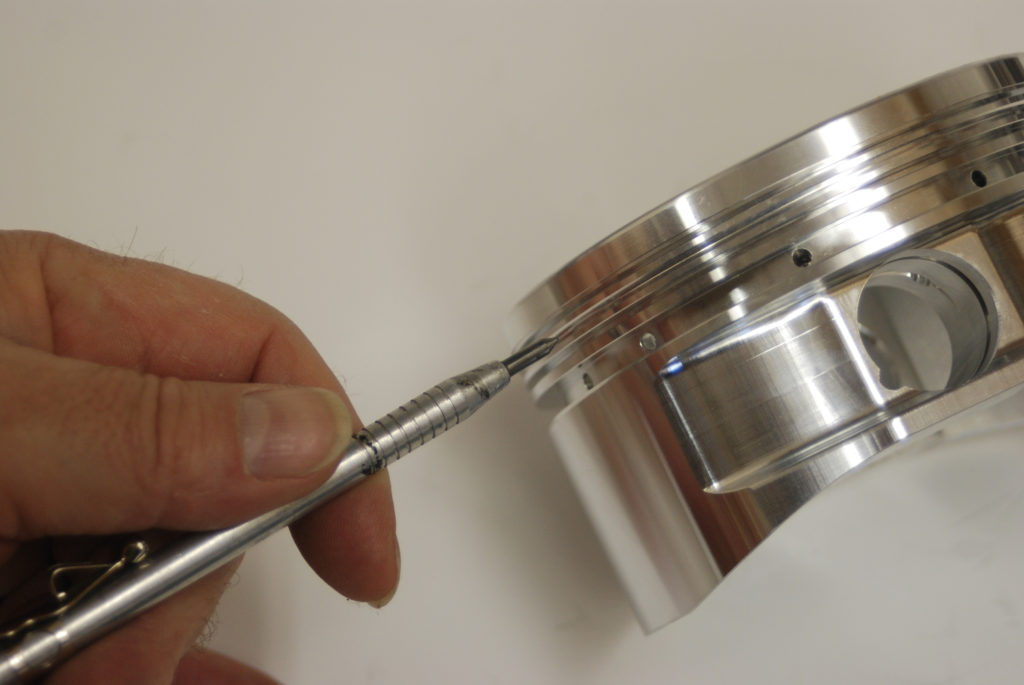
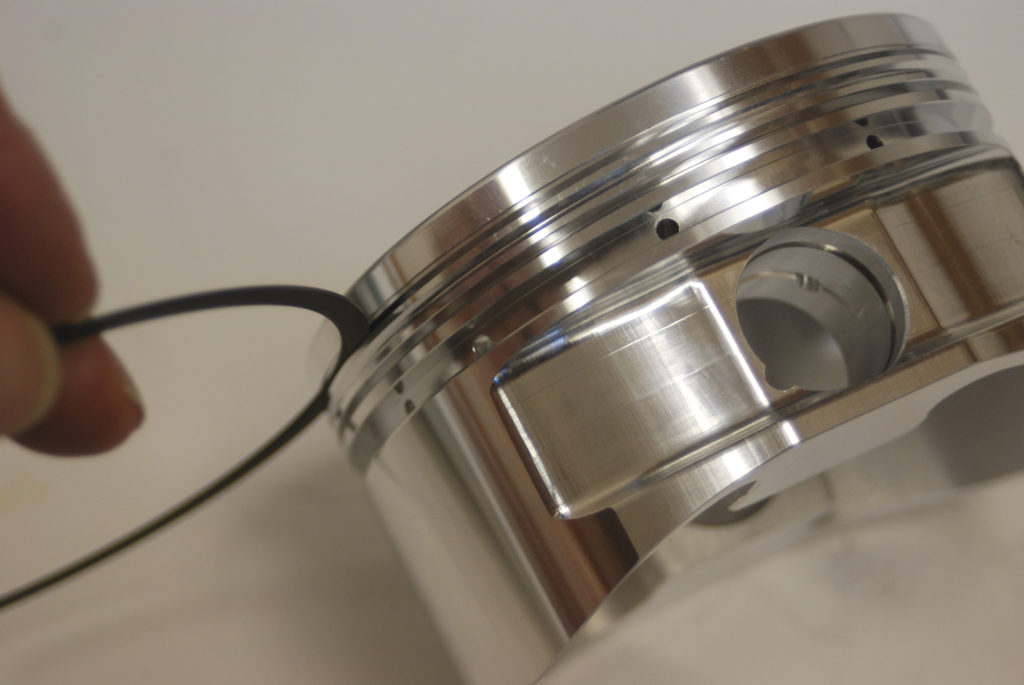
RING LANDS - Just how important are ring lands in a piston? Extremely. The most common piston configuration makes use of three rings - compression, second and oil. Two ring combinations (compression and oil) have seen some success in drag racing, but for cars that see street use, they're the exception rather than the rule. In all applications, the ring land is not barrel or cam ground, even if the skirt has these features. Instead, all ring lands are round (there have been some exotic exceptions over the years, but they're beyond the scope of our series). The overall diameter of the ring land is smaller than that of the piston, and in many cases a small vertical taper is present (see above section on skirts). There's a reason for this size differential: As the piston reaches top dead center, it "rocks" in the bore. If the ring land is the same diameter as the skirt, then the rings would be required to handle the thrust load (which they really don't like to do). Instead, that job is left up to the skirt.
You'll often hear another term when talking about ring lands, and that's "tilt." Many piston companies claim to include it in their pistons, but not all actually have it. According to some manufacturers, the actual ring grooves should have a positive "tilt.” This machining operation tilts the ring package upwards by a very small amount (in this sort of piston, the tilt is in the area of 2 to 3 ten-thousandths of an inch). The tilt is important in that it helps the ring seating. And by the way, the tilt is included in all of the ring grooves (top, second and oil). Some pistons of questionable quality could have a negative tilt, which actually hurts performance more than it helps.
That's not the end of ring land technology, either. The location of the ring grooves is often dictated by the compression height of the piston, the size and depth of the valve notches and, as you might expect, by the overall dimensions of the ring package. Most Detroit-built engines have the top ring 0.300-0.400-inch down from the deck surface. In an endurance racing engine, the top ring is typically 0.125-0.150-inch down while heavily modified race engines (for example, a drag race Pro Stock application) can vary from 0.060-0.100-inch down from the deck (although 0.060-inch is likely cutting things pretty close). Moving the top ring closer to the piston deck offers a number of advantages, not the least of which is minimizing the "dead air" space between the top ring land and the deck. As this space is reduced (by moving the ring up), the amount of trapped combustion gasses is also reduced. In the end, the combustion process is cleaned up considerably when the rings are moved upward. Horsepower increases.
When thinking about ring location, you should also consider how much piston material is found between the rings. While the location of the second ring isn't as critical as the distance from the deck to the top ring, it is important. The second ring doesn't see temperatures anywhere close to those encountered by the top ring, but the land between the top two rings must also support the combustion pressure exerted upon the top ring. Because of this, the width of the first land area is usually between 0.150-0.180-inch in a hi-performance piston and greater in a stock application. As far as the land area between the second and third ring is concerned, many high performance and race pistons incorporate a width of between 0.070-0.125-inch. This is narrower than the first land, but keep in mind that combustion pressures aren't present and overall temperatures are much lower. This is also a good time to mention that some pistons have "stepped" lands. This simply means that the land area between the top and second rings is slightly smaller in diameter than the area between the second and oil rings.
Certain aftermarket high performance and race pistons include a groove that is milled into the land area between the top and second ring (for example some manufacturers ball mill the groove – CP Carillo uses a unique v-shaped groove). This groove is often referred to as an "accumulator groove.” The idea behind it is to reduce pressure buildup between the pairs of rings. Theory has it that the buffer groove will stop the top ring from lifting at the bottom of the groove. The groove effectively maximizes ring seal and increases engine vacuum.
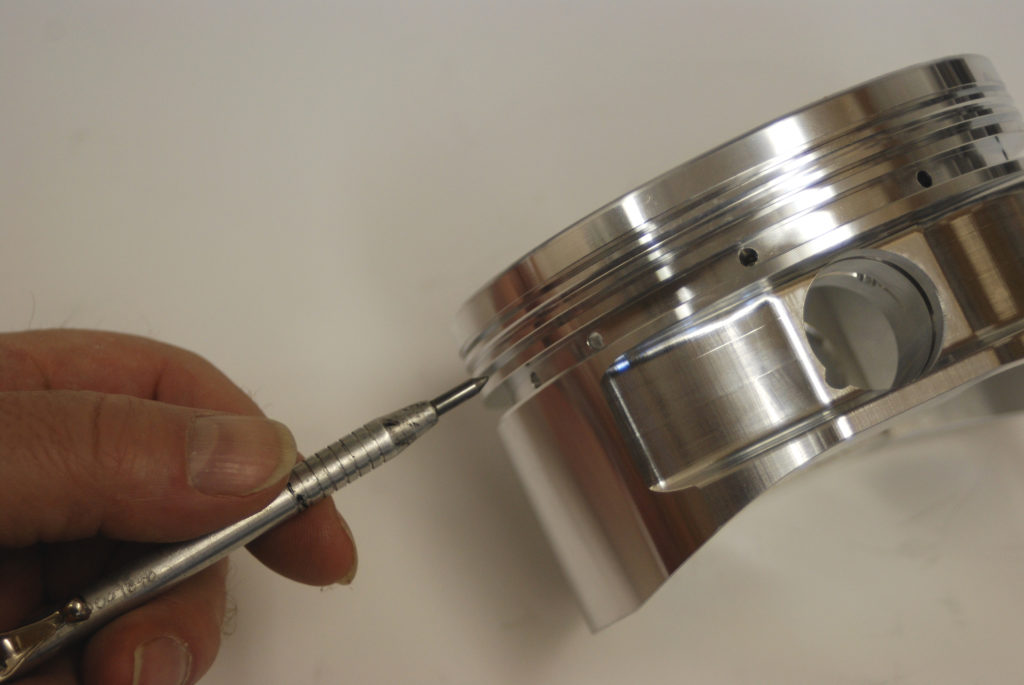
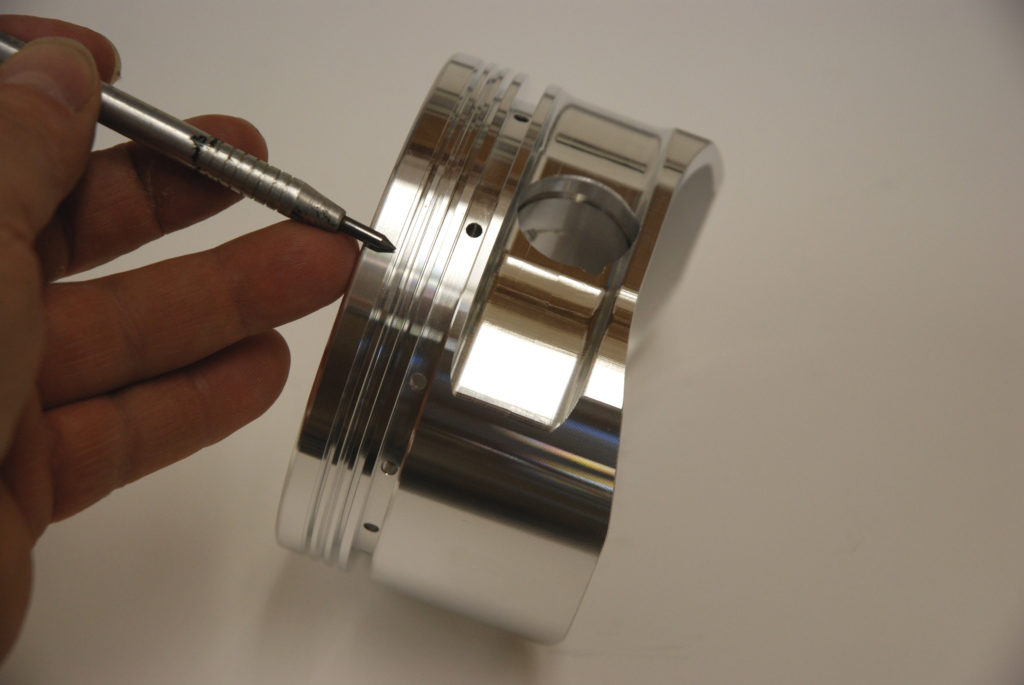
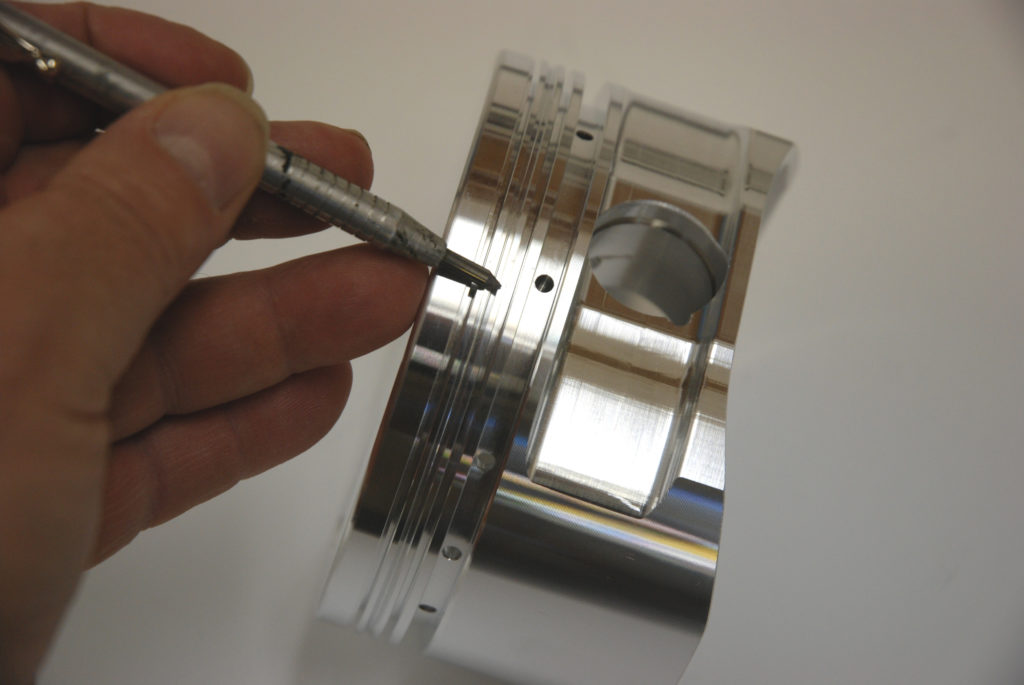
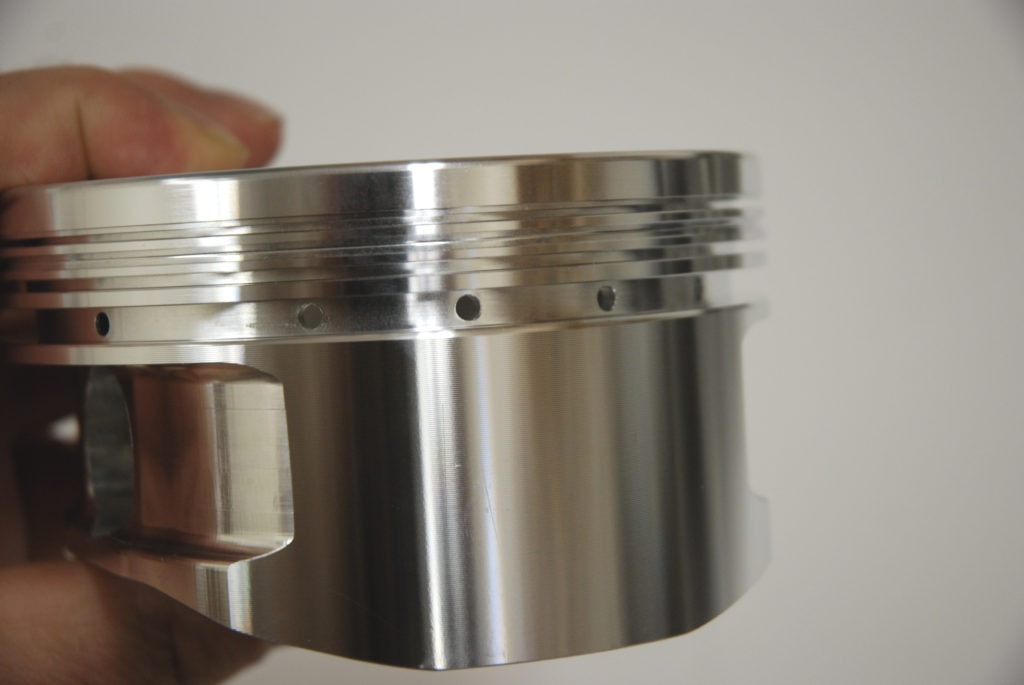
Two different types of oil drain back holes are commonly used: Drilled examples and slotted grooves. In most cases, the drilled format makes for a stronger piston, but it does allow more heat to enter the skirt area. The vast majority of race pistons are constructed with drilled drain back holes. The primary reason is strength, since the slotted system makes for a more flexible skirt.
RING CLEARANCE - How important is ring clearance in the groove? It's critical. Unfortunately, some folks (and that includes plenty of racers) tend to ignore this factor. Basically, the ring grooves must be smooth - and this is especially critical for the compression ring. What makes the clearance so crucial? During the compression stroke, the ring drops to the bottom of the groove, eventually sealing against the machined surface. During the power stroke, the piston moves down in the bore. The ring then moves up in the groove and eventually seals against the top of the machined surface. As you can well imagine, a poor finish in the groove will not allow the ring to seal tightly. Because of this, the pressure will leak past the rear (or back) portion of the ring. Evidence of this leakage can be found in excessive heat discoloration or carbon buildup in the land area between the top and second rings.
One more factor that affects the ring seal is the vertical clearance of the ring. Typically, a race piston never exceeds 0.002-inch vertical clearance (production line street engines often have clearances of between 0.002-0.004-inch). More than that and the ring will leak. Less than that figure and you run the risk of seizing the ring in the groove. A ring that can't turn freely in the groove will not clean carbon out of the groove, and will not be free to expand when combustion pressures enter the groove.
Machining plays a critical role in ring performance. And some of that piston machining capability might surprise you. Over the years, CP Carrillo has concentrated heavily on new machining methods. During the process, the company used highly accurate inspection equipment to determine how machining methods affected the flatness of things such as the ring groove. This investigation ultimately led them to ring machining tolerances (flatness) that are measured to one millionth of an inch — something that had never before been available. As a result, CP Carrillo can machine the ring groove absolutely flat. Coupled with an equally sophisticated ring, engine power goes up and so does ring sealing.
If the piston has tight vertical clearances, the ring back clearance figures become even more important. Gas pressure enters the area behind the ring during combustion. This gas pressure forces the ring out against the cylinder wall. If there is too much back clearance (which in turn creates too much volume for the combustion gasses to fill), it takes too long for the pressure to build and force the ring outward. Naturally, a smaller amount of back clearance will increase the speed and the force at which the ring will exert pressure upon the cylinder wall. Typically, a production line engine piston will have as much as 0.040-0.050-inch of back clearance. In a race or high performance application, the backside clearance figure can be reduced to as little as 0.020-inch (depending upon the ring configuration and the piston design). Of course, the back clearance can't be so small that the ring protrudes past the ring land.
There's one exception when it comes to vertical clearance, and that's when gas ports are used in the piston. The bottom line with gas ports is simple. They provide a method of supplying combustion pressure directly to the backside of the piston ring. Because of that, the ring vertical clearance can be reduced, and ring flutter can be reduced significantly. In the end, ring seal goes up and so does horsepower. Unfortunately, gas ports are only suited for use with engine combinations that see frequent tear downs (and that means gas ports don't see use on engines found in street-driven musclecars). Carbon can plug the gas port holes and because of the nature of a pressurized ring, ring and cylinder wall wear is much faster than with a more conventional set up.
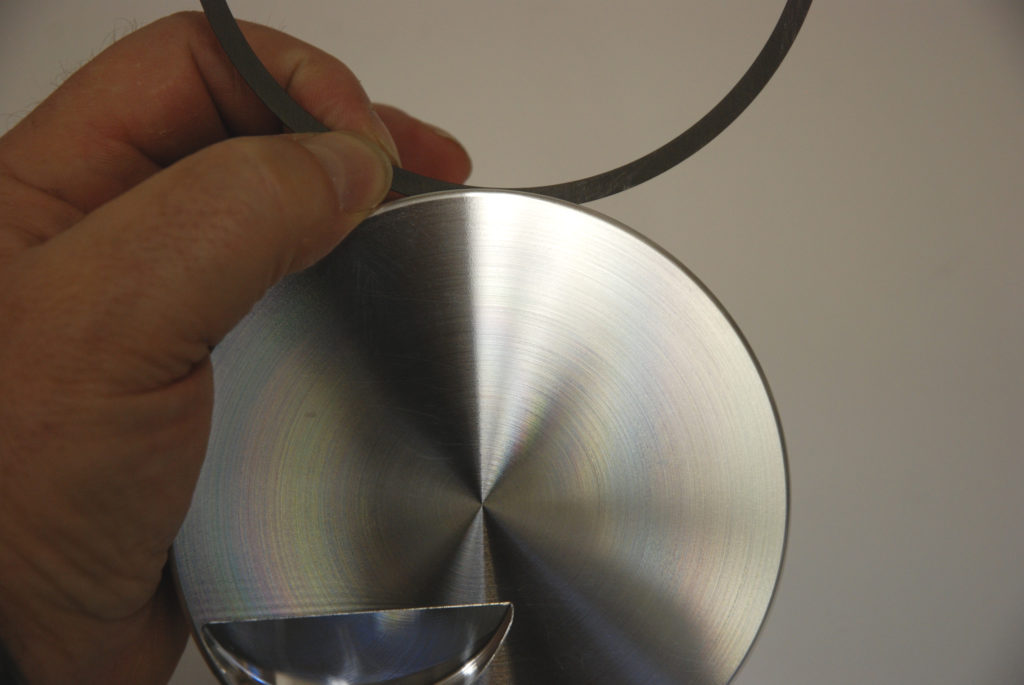
Typically, gas ports consist of twelve to sixteen 0.040-0.060-inch holes drilled vertically through the piston deck that intersect with the backside of the compression ring groove. Keep in mind that gas porting is most advantageous when a narrow face, lightweight piston ring (such as the 0.043-inch ring) is used.
That wraps up this issue's look at pistons. In the next segment, we’ll examine deck and dome surfaces along with compression heights. That info is critical when it comes to the operation of your engine. After that we'll conclude this series with a look at wrist pin bores and the areas and components surrounding them. Watch for it.
Last issue we began our research into pistons for street and strip applications. In that segment we examined forgings versus castings and various alloys along with piston skirts. This time around, we’ll look at ring lands and ring groove clearance. Although it’s easy enough to gloss over this stuff, it’s actually extremely important in a street and strip combination. Here’s the inside story.
RING LANDS - Just how important are ring lands in a piston? Extremely. The most common piston configuration makes use of three rings - compression, second and oil. Two ring combinations (compression and oil) have seen some success in drag racing, but for cars that see street use, they're the exception rather than the rule. In all applications, the ring land is not barrel or cam ground, even if the skirt has these features. Instead, all ring lands are round (there have been some exotic exceptions over the years, but they're beyond the scope of our series). The overall diameter of the ring land is smaller than that of the piston, and in many cases a small vertical taper is present (see above section on skirts). There's a reason for this size differential: As the piston reaches top dead center, it "rocks" in the bore. If the ring land is the same diameter as the skirt, then the rings would be required to handle the thrust load (which they really don't like to do). Instead, that job is left up to the skirt.
You'll often hear another term when talking about ring lands, and that's "tilt." Many piston companies claim to include it in their pistons, but not all actually have it. According to some manufacturers, the actual ring grooves should have a positive "tilt.” This machining operation tilts the ring package upwards by a very small amount (in this sort of piston, the tilt is in the area of 2 to 3 ten-thousandths of an inch). The tilt is important in that it helps the ring seating. And by the way, the tilt is included in all of the ring grooves (top, second and oil). Some pistons of questionable quality could have a negative tilt, which actually hurts performance more than it helps.
That's not the end of ring land technology, either. The location of the ring grooves is often dictated by the compression height of the piston, the size and depth of the valve notches and, as you might expect, by the overall dimensions of the ring package. Most Detroit-built engines have the top ring 0.300-0.400-inch down from the deck surface. In an endurance racing engine, the top ring is typically 0.125-0.150-inch down while heavily modified race engines (for example, a drag race Pro Stock application) can vary from 0.060-0.100-inch down from the deck (although 0.060-inch is likely cutting things pretty close). Moving the top ring closer to the piston deck offers a number of advantages, not the least of which is minimizing the "dead air" space between the top ring land and the deck. As this space is reduced (by moving the ring up), the amount of trapped combustion gasses is also reduced. In the end, the combustion process is cleaned up considerably when the rings are moved upward. Horsepower increases.
When thinking about ring location, you should also consider how much piston material is found between the rings. While the location of the second ring isn't as critical as the distance from the deck to the top ring, it is important. The second ring doesn't see temperatures anywhere close to those encountered by the top ring, but the land between the top two rings must also support the combustion pressure exerted upon the top ring. Because of this, the width of the first land area is usually between 0.150-0.180-inch in a hi-performance piston and greater in a stock application. As far as the land area between the second and third ring is concerned, many high performance and race pistons incorporate a width of between 0.070-0.125-inch. This is narrower than the first land, but keep in mind that combustion pressures aren't present and overall temperatures are much lower. This is also a good time to mention that some pistons have "stepped" lands. This simply means that the land area between the top and second rings is slightly smaller in diameter than the area between the second and oil rings.
Certain aftermarket high performance and race pistons include a groove that is milled into the land area between the top and second ring (for example some manufacturers ball mill the groove – CP Carillo uses a unique v-shaped groove). This groove is often referred to as an "accumulator groove.” The idea behind it is to reduce pressure buildup between the pairs of rings. Theory has it that the buffer groove will stop the top ring from lifting at the bottom of the groove. The groove effectively maximizes ring seal and increases engine vacuum.
Two different types of oil drain back holes are commonly used: Drilled examples and slotted grooves. In most cases, the drilled format makes for a stronger piston, but it does allow more heat to enter the skirt area. The vast majority of race pistons are constructed with drilled drain back holes. The primary reason is strength, since the slotted system makes for a more flexible skirt.
RING CLEARANCE - How important is ring clearance in the groove? It's critical. Unfortunately, some folks (and that includes plenty of racers) tend to ignore this factor. Basically, the ring grooves must be smooth - and this is especially critical for the compression ring. What makes the clearance so crucial? During the compression stroke, the ring drops to the bottom of the groove, eventually sealing against the machined surface. During the power stroke, the piston moves down in the bore. The ring then moves up in the groove and eventually seals against the top of the machined surface. As you can well imagine, a poor finish in the groove will not allow the ring to seal tightly. Because of this, the pressure will leak past the rear (or back) portion of the ring. Evidence of this leakage can be found in excessive heat discoloration or carbon buildup in the land area between the top and second rings.
One more factor that affects the ring seal is the vertical clearance of the ring. Typically, a race piston never exceeds 0.002-inch vertical clearance (production line street engines often have clearances of between 0.002-0.004-inch). More than that and the ring will leak. Less than that figure and you run the risk of seizing the ring in the groove. A ring that can't turn freely in the groove will not clean carbon out of the groove, and will not be free to expand when combustion pressures enter the groove.
Machining plays a critical role in ring performance. And some of that piston machining capability might surprise you. Over the years, CP Carrillo has concentrated heavily on new machining methods. During the process, the company used highly accurate inspection equipment to determine how machining methods affected the flatness of things such as the ring groove. This investigation ultimately led them to ring machining tolerances (flatness) that are measured to one millionth of an inch — something that had never before been available. As a result, CP Carrillo can machine the ring groove absolutely flat. Coupled with an equally sophisticated ring, engine power goes up and so does ring sealing.
If the piston has tight vertical clearances, the ring back clearance figures become even more important. Gas pressure enters the area behind the ring during combustion. This gas pressure forces the ring out against the cylinder wall. If there is too much back clearance (which in turn creates too much volume for the combustion gasses to fill), it takes too long for the pressure to build and force the ring outward. Naturally, a smaller amount of back clearance will increase the speed and the force at which the ring will exert pressure upon the cylinder wall. Typically, a production line engine piston will have as much as 0.040-0.050-inch of back clearance. In a race or high performance application, the backside clearance figure can be reduced to as little as 0.020-inch (depending upon the ring configuration and the piston design). Of course, the back clearance can't be so small that the ring protrudes past the ring land.
There's one exception when it comes to vertical clearance, and that's when gas ports are used in the piston. The bottom line with gas ports is simple. They provide a method of supplying combustion pressure directly to the backside of the piston ring. Because of that, the ring vertical clearance can be reduced, and ring flutter can be reduced significantly. In the end, ring seal goes up and so does horsepower. Unfortunately, gas ports are only suited for use with engine combinations that see frequent tear downs (and that means gas ports don't see use on engines found in street-driven musclecars). Carbon can plug the gas port holes and because of the nature of a pressurized ring, ring and cylinder wall wear is much faster than with a more conventional set up.
Typically, gas ports consist of twelve to sixteen 0.040-0.060-inch holes drilled vertically through the piston deck that intersect with the backside of the compression ring groove. Keep in mind that gas porting is most advantageous when a narrow face, lightweight piston ring (such as the 0.043-inch ring) is used.
That wraps up this issue's look at pistons. In the next segment, we’ll examine deck and dome surfaces along with compression heights. That info is critical when it comes to the operation of your engine. After that we'll conclude this series with a look at wrist pin bores and the areas and components surrounding them. Watch for it.
You mention stepped piston, but do not explain the reasoning or the pros or cons of doing so. The only things that spring to mind are 1) it would be a few grams lighter and 2) it would place more burden on the skirts and rings to stabilize the piston.
I learned a LOT in this article. Never knew about “tilt:” for instance. Very interesting. But to really understand the disign choices to be made, don’t we also need a detailed discussion, including the interplay between the many (approaching myriad) designs of rings currently in vogue (including TS flexi rings with their radial interior grooves).