





The future of sports car racing worldwide is looking healthy, particularly after last weekend’s centennial celebration of the 24 Hours of Le Mans. While IMSA’s WeatherTech SportsCar Championship began its LMDh (GTP) era successfully during the 61st Rolex 24 at Daytona last January, the World Endurance Championship (WEC) began its Hypercar racing a year ago.
It’s taken a while for the latter’s numbers to increase to the point where Hypercars have become a true category, as manufacturing a new style of race car takes time and development, whether virtual or in real time on a real track. Hypothetically, most programs require, at minimum 18 months gestation before they arrive on a grid, so it’s really no surprise that there were three manufacturers for Hypercar’s first 2022 go and six participating in this year’s near-summer twice-around-the-clock classic.
After winning this race five consecutive years, Toyota failed to earn its sixth straight in 2023 because they just couldn’t keep up with the Ferrari 499P Hypercar that appeared first the first time earlier this year. Apparently the Ferrari AF Corse team did their homework and had a bullet-proof prototype race car that could handle itself well through 24 hours of rain, heat, bright and dark skies.Survival is the key to 24-hour racing and Ferrari showed they’d done their homework.
The winning Ferrari 499P made its competitive debut during the FIA’s WEC season starter, the 1000 Miles of Sebring, held a day before IMSA’s second race of its season, the Mobil 1 12 Hours of Sebring, a contest that completes the tour’s 36 hours of Florida. The 499P qualified on pole and finished third, which should have struck fear into the hearts of Toyota, Glickenhaus (the two initial Hypercar entrants), Cadillac, Peugeot and Porsche. As it was, Toyota finished second, less than two minutes shy of the winning Ferrari, followed by the two Cadillacs of Chip Ganassi Racing, the second Ferrari, the two Glickenhaus entries, Peugeot and Porsche.
This year’s race featured three categories and two of them are being obsoleted by the Federation Internationale de l’Automobile (FIA) and the Automobile Club de l’Ouest (ACO) in 2024. Next year there won’t be an LMP2 spec prototype class; next year there won’t be an LMGTE Am manufacturer-based class for sports cars. So for those two it was put up or shut up time when the race began Saturday afternoon at 4PM.
The Hypercar class features hybrid vehicles, much as Formula One and IMSA’s LMDh/GTP class do. These are battery/power unit vehicles that continue to use fossil fuels in their power units, even as battery power runs the motors that are power adders.
But the ACO that manages and promotes Le Mans is extremely interested in having a race with zero emissions, in particular using hydrogen power for the future of the sport. It believes fossil fuels must be phased out of public and motorsports uses in favor of hydrogen. There are, after all, some hydrogen cars on the streets of both European and American cities these days. BMW started their hydrogen programs more than 10 years ago with a 7-series sedan; Toyota’s been leasing and selling its Mirai hydrogen-powered sedan-like vehicle for several years and redrew its body lines in time for the 2022 selling season.
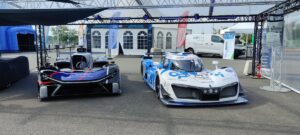
To interest a public that has become accustomed to hybridization, thanks to the hard work first shown on-circuit by Audi, Peugeot and Toyota, and now by the six Hypercar manufacturers, the ACO has a MissionH24 prototype that ran the track prior to this year’s race start, hydrogen-powered shuttles, a dedicated hydrogen village, together with a visit and tour of the circuit by France’s Minister for Sport, the Olympic & Paralympic Games, who rode in that MissionH24 prototype. A special hydrogen-powered class is facing competition introduction at the 2026 24 Hours of Le Mans.
The MissionH2 Village above Le Mans’ pits lured thousands as it promoted training, transport, manufacturing storage uses for hydrogen, energy transformation, education, support for companies making the shift to hydrogen and its sustainable mobility, games, learning initiatives and, primarily, the story of how hydrogen works in racing cars with its fuel cells.
The MissionH24 Village was the site where Toyota revealed its GR H2 Racing concept, with Toyota chairman Akio Toyoda on-hand to present the 2026 concept. This is also where the Phoenix H2 from Solution F – that will run as a GT entry – and the Ligier JS2 RH2 Bosch Engineering GT were revealed. This was in the dedicated racing portion of the MissionH24 Village, where a number of vehicles were on show, including the Alpine Alpenglow, which is expected to be produced as a racing machine.
The ACO has long been a proponent for what some call “green” racing and it was among the first to welcome Ben Bowlby’s creation and Don Panoz’ DeltaWing as a Garage 56 entry in 2012. This year’s Garage 56 was occupied by NASCAR’s Chevrolet Camaro ZL1, which finished the race, something DeltaWing failed to do. It was nearly a decade ago that the ACO began talking about hydrogen racing and now, having had nearly two decades of internal combustion racing with hybridization, the historic French race is preparing for its hydrogen future.
Leave a Reply