



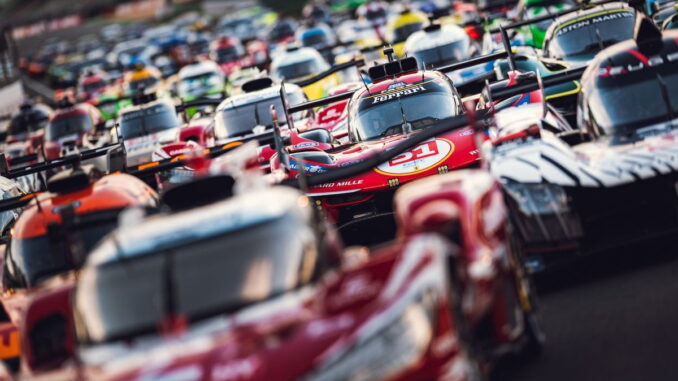
When the International Motor Sports Association (IMSA), the Automobile Club de l’Ouest (ACO) and the Federation Internationale de l’Automobile (FIA) integrated prototype rules that brought forth FIA’s World Endurance Championship (WEC) Hypercars and IMSA’s WeatherTech SportsCar Championship GTPs, allowing both to compete in one another’s competitions – including the world’s most famous 24-hour race in Le Mans, France without effecting massive changes, manufacturers jumped onboard to compete.
Able to transcend one series’ rules into their own, IMSA, WEC and the ACO have managed to compete against one another these past few years on a semi-regular basis. The opportunity to make ongoing adjustments to each series’ rules without major changes has been one of the calling cards of the current sports car prototype landscape.
Prior to this year’s 94th annual 24 Hours of Le Mans, the ACO held its annual Friday press conference delineating changes that will take effect for the WEC and IMSA starting in 2030. The technical regulations to govern the top class in prototype competition were announced during this annual gathering. They will be used in IMSA’s GTP class and for WEC’s Hypercars, shifting towards a single, two-wheel-drive platform for all cars in this class. This change is a marked change from current regulations both series and the ACO are following that now enables both rear-wheel-drive and all-wheel-drive prototypes to compete against one another in the same class.
Using a single two-wheel-drive technical platform, the regulators believe, will enhance visual identity for each brand of vehicle competing, help keep budgets under control to assist in accessibility and should aid in the introduction of the long-awaited hydrogen project, which the ACO has been promoting for several years. The same technical regulations will, as of 2030, apply across the board and constructors will be free to develop their cars – either in-house or enlisting the assistance of a chassis constructor, as in the current LMDh Hypercar model.
Entrants will be able to purchase hybrid systems from a designated supplier or self-develop, so long as they follow the same specifications, as outlined in the new rules. Homologation will be valid for at least five years from 2030, with no performance evolution. These changes, the three entities reveal, are the result of a common FIA, ACO and IMSA vision, enacted on both sides of the Atlantic Ocean.
John Doonan, IMSA president has been exceptionally active in fostering communication and building consensus within the trio of racing organizations. He was one of the strongest proponents of the current regulations and believes, “The current era of prototype racing has demonstrated what’s possible when stakeholders come together with a shared vision. Our responsibility now is to carry that momentum forward and create the conditions for long-term success.
“Having a single, global technical regulation for top-class prototype racing is a win for everyone involved: the sanctioning bodies, manufacturers, teams, drivers, corporate partners, suppliers and, most importantly, the fans.” Doonan has always, since joining IMSA, had his vision firmly planted on taking care of those with whom he works and those who come to enjoy the entertainment they produce. “For manufacturers, it creates a clear pathway to compete at the highest level of endurance racing around the world, under a common set of regulations. For teams, it beings stability and confidence, as they plan and invest for the years ahead. And for the fans, it helps ensure that the world’s leading automotive brands continue to compete head-to-head on some of the biggest stages in motorsport.”
In addition to the homologation items that will change the face of major prototype competition starting in 2030, the Friday pre-race press conference – a tradition at the 24 Hours of Le Mans – accented the ACO’s desire to promote hydrogen fuel for use, both in competition and on the street. The ACO’s Hydrogen Village opened shortly before racing commenced, bringing together manufacturers such as Alpine, Toyota Racing (who won this year’s 94th 24 Hours of Le Mans), Ligier-Bosch-Maserati, together with MissionH24, the collaborative program developed by ACO together with H24Project and a total of nine educational and manufacturing partners.
The ACO has, for a number of years, been looking into hydrogen propulsion and will be welcoming hydrogen-powered race cars in the next group of regulations. The H2 Hypercars will follow the basic 2030 regulations, in terms of powertrain and hybrid system with a few particularities: minimum weight of 1,200 kg, specific tires and an Equivalence of Technology scheme that intends to prevent major differences in performance, without conceding any advantages to H2.
The ACO also announced new 2027 manufacturer entries for the 95th 24 Hours of Le Mans: Ford and McLaren will be joining this great endurance race next year; both Ford’s Mark Rushbrook and Zak Brown from McLaren were on-hand to announce their participation in the world’s greatest summer endurance race.
Leave a Reply