





![[Gallery] Mecum Kissimmee Auction 2026](https://www.racingjunk.com/news/wp-content/uploads/2026/03/DSC_0717-e1774629242515-376x206.jpg)
![[Gallery] Cruisin’ One Daytona](https://www.racingjunk.com/news/wp-content/uploads/2026/03/DSC_0538-e1774027057404-376x206.jpg)
Money Well Spent: Sergio Palumbo's 1971 Plymouth 'Cuda 340
Click Here to Begin Slideshow
I contributed financially in helping my wife to buy a car late last year. A flash of pain ran through my VISA card (and that was only for the downpayment). The year Mrs. Branson last bought a car, a nimble little Honda Fit, the Chicago Cubs won the World Series after a 108-year drought. We decided on purchasing a Mitsubishi KONA, regarded as a smaller version of a SUV. This vehicle is like driving a mobile ipad (and I don’t say that with any relish) that does my accounting, babysitting and co-driving with an overload of A.I. computerization by beeping to me that I’m crossing a median line - literally tugging the steering wheel back; beeping for me to slow down; beeping when cars are too close; beeping how to back-up; how to park; where the police cameras are; when to fart - basi-cally, all the things I don’t need a car to tell me. It beeps more than I blink. Even if you get into a fatal accident, I’m sure a weak beep will be heard from the confines of crum-pled metal. Even though cars are faster today, are more comfortable and are considera-bly safer for the environment, they are grossly bigger now, they weigh like a tank, they’re too complicated, far too costly, and devalue too severely the moment you drive off the dealership floor.
And why do we need such assistance? Apparently to reduce accidents. So, obviously, we need a lot more distractions. I think the driving has become worse. I’ve seen so many pathetically slow drivers unable to make up their minds as to what they’re doing. The re-duced speed limits have only increased the number of irate drivers impatiently making impulsive moves due to the slowness of traffic. I wouldn’t be surprised if there are just as many accidents today as there was a decade ago. The road conditions are horrible, we spend too much time in traffic jams due to poor road designs. Who was the bright spark who thought placing an entrance ramp unto a highway just before an exit ramp was any-thing but an impending disaster? The beeping goes ballistic because it encounters speed cameras are every three blocks nagging like some precocious child. Where’s the fun of driving? Of course, this may be a government ploy to force us to stop driving all together. But that won’t work, for crying out loud, this is Canada, a country too large not to drive. The real reason, I suspect, is that dealerships/manufacturers profit even more on war-ranties and repairs and governments benefit from the taxes. What’s even more concern-ing is how cars are becoming more and more like computers. I cringe that a car will need to be upgraded every three to five years. If you want a car because you enjoy driving, too bad, we are losing that freedom. And forget manual stick shift. Apparently, that’s way too complicated for most people and A.I., from what the salesman told me, can’t com-pletely control a manual gearshift. Instead, you’ll just be another obedient, subservient passenger controlled by yet another questionable product in our omnivorous digital age. But this is to be expected. Too many people simply want to be passengers in life rather than the drivers. Cars are about as distinguished from each other as burkas. My wife re-fers to the human population as “habitual sheep”. Everyone is buying SUVs simply be-cause everyone is buying SUVs. There is a lack of variety, style and panache. This basi-cally applies to almost everything we see and do in life. And I don’t know how anyone can afford a car today? The majority of people must live on credit.
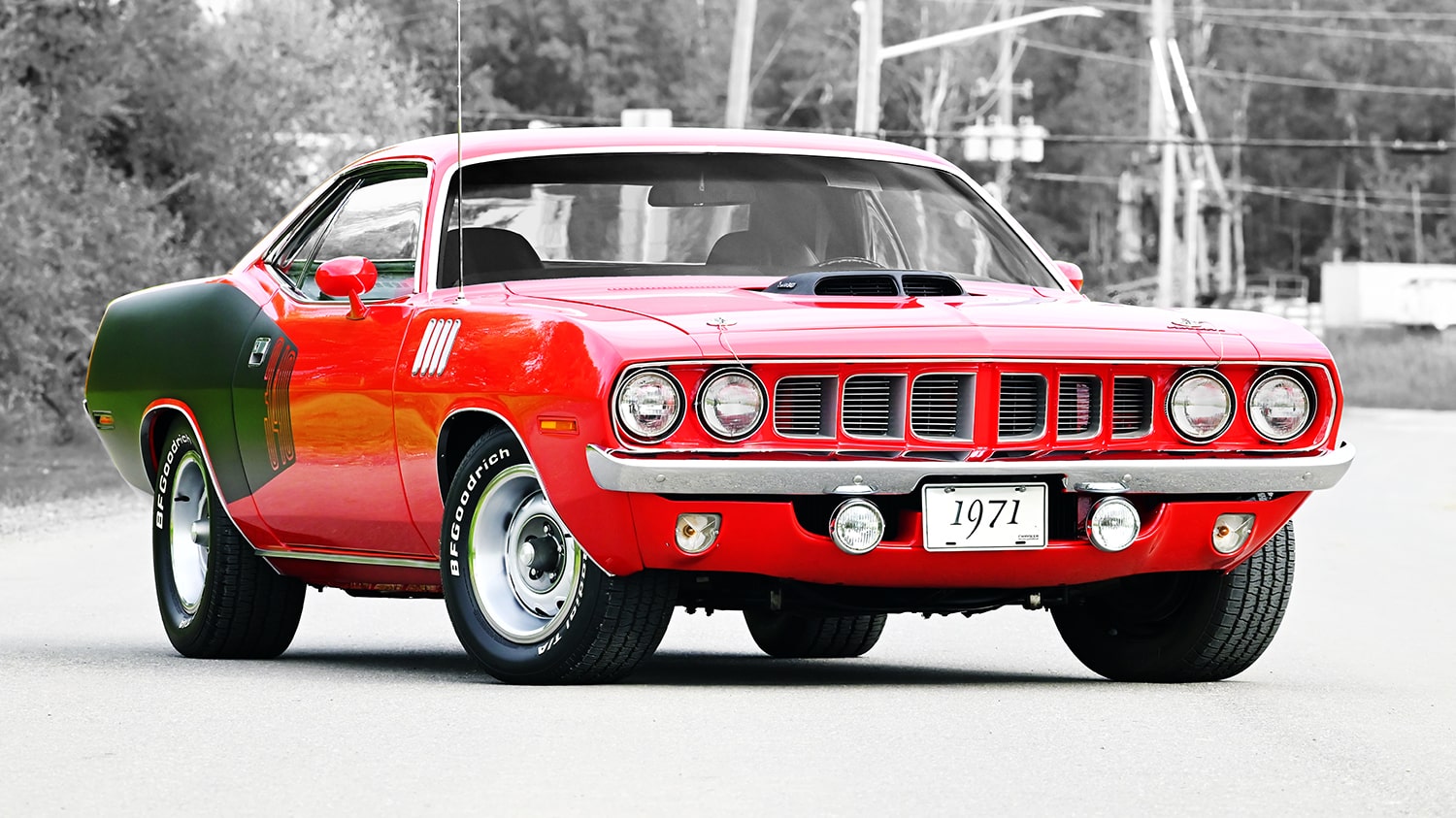
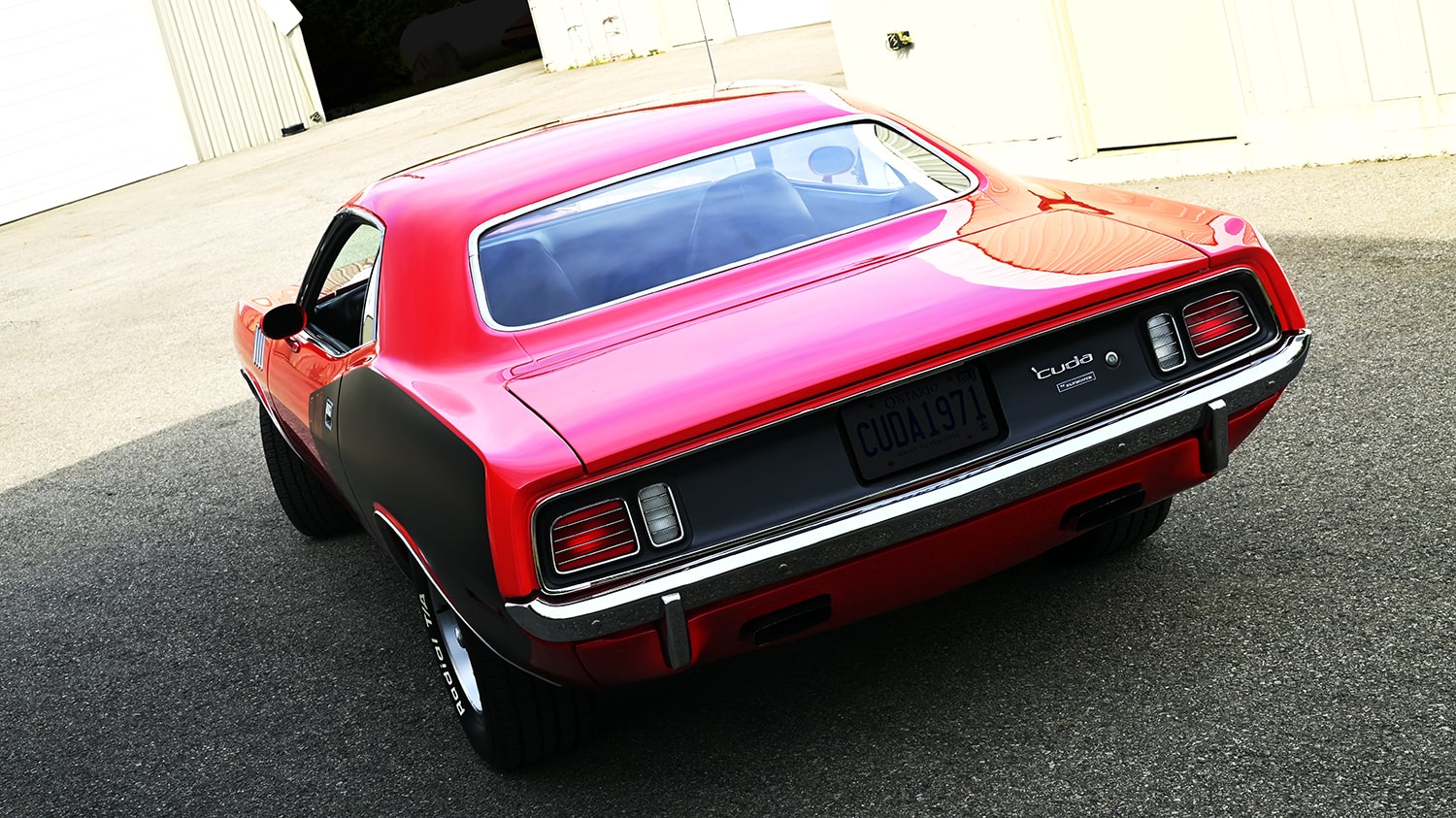
There isn't a beep from Sergio Palumbo’s car. Not even from his horn, which is more like an ocean liner’s blast. Sergio drives a stunning, Rallye-red 1971 Plymouth Cuda 340. There is no computer onboard, no screen, no digital distractions, and no control buttons on the steering wheel. Instead, it is the epitome of a fast car that gives off a prodigious sound like something from the bowel of a female guerrilla who notices that you’re too close to her offspring. If there is a distraction, it’s usually from the tapes of ’70's music blaring throughout the cabin. “It drives very well for a car that’s older than I am,” confirms Sergio. “It accelerates smoothly, brakes well, and the 340 has enough power to make me feel comfortable on a highway’s far left lane. It shifts nicely, steers well, and handles great since it is optioned with front and rear sway bars that are part of the Rallye sus-pension. For me, driving it is a pleasure, but then again, I have been driving great cars since my High School days.” Sergio isn’t coy when it comes to revealing how expensive his passion is. He ensures that the restoration, maintenance, as well as hard-to-find parts, can be extremely expensive when trying to keep it original. “For those who might be interested in buying a classic car or restoring one, ask yourself why you are purchasing such a vehicle? If it’s for the love and passion, it’s money well spent. If purchasing one is for an investment, you better do your research and ensure you have a big budget. If you are not well versed in owning a classic car, you will need expert advice from someone in the field, who is and will be, honest with you,” warns Ser-gio. Like any car, it needs tender loving care. There is no way of avoiding the expens-es if you want a car that will give you years of pleasure.
Sergio’s experience in restoring cars began when he was very young. “I grew up in a working class area of Montreal and didn’t know too many people in the restoration hob-by/business. Coming from humble beginnings, I was unable to hire someone to teach me, so I learned on my own.” He drew his knowledge from individuals who owned mus-cle cars, looked at, and documented, many ‘survivor’ cars, and over the years, frequent-ed those who worked on the auto assembly-lines at the time. “I tend to be very picky about the maintenance, storage and upkeep so you need to budget for it.” Sergio is no stranger to classic cars and has a history of restoring them, both professionally and as a hobby (he owns, Old School Auto, an automotive restoration business in Ottawa. “I’ve had a big pile of collectable cars over the years and still own a few today, but as much as some cars come and go, the 1971 Cuda has a special place in my heart - every since I first laid eyes on one so many years ago. I missed having a ’71 Cuda for years and bought it out West for my 50th birthday on October 27, 2020.” Sergio was fortunate. The Cuda was in excellent condition as it had been properly restored. “Considering the odometer only read 1,500 miles, I did extensive work to improve the car and correct many items with original restored or NOS (New Old Stock) parts.” The restoration was partially completed when purchased, but the remainder of the work he did. As Sergio puts it, “I wanted to raise the level to professional restoration.” Sergio is a very dedicated and meticulous restorer. Nothing escapes his eye. “I like add-ing my personal hard work to my vehicles and make any necessary corrections.”
As far as expenses, it’s no secret that many people have taken to investing in classic cars as a fun way to grow their personal wealth. And while you may have noticed in recent years, how values of particular models, such as Plymouth Cudas which have fetched as much as six-figure sales, the overall market has risen dramatically (usually rare cars in mint condition). Even during COVID, the value of muscle and sports cars has surged substantially. New data, revealed in the Financial Review, found that more affordable classic cars made, on average, a 70 percent return on investment, between 2019 and 2022. Adversely, these rare gems are becoming too financially prohibitive. To give you an example, Jerry Seinfeld placed his 1970 racing car - the iconic, history-making Gulf-Porsche 917 on the block for auction at Mecum. With each bid at $1 million, the hammer came down at an astounding $25 million, but Seinfeld rejected the bid and took the car off the market. Since Seinfeld paid $14 million for the car, I guess the bid wasn’t high enough for an extension to his mansion. “I have no intensions of selling my Cuda. I get asked to sell it all the time, but it is not going anywhere soon,” declares Ser-gio with a defiant nod. “Every time I hear someone saying “classic cars are dying,” or that they have a short life span, another decade goes by where they are more popular and more expensive than ever. I can’t predict the future, but I can say for certain that my time enjoying them will not be over anytime soon. Hopefully this will rub off on the younger generations as time goes on,” muses Sergio. “Muscle cars and classics hold a special place in history, so it would be great to see the torch passed on.”
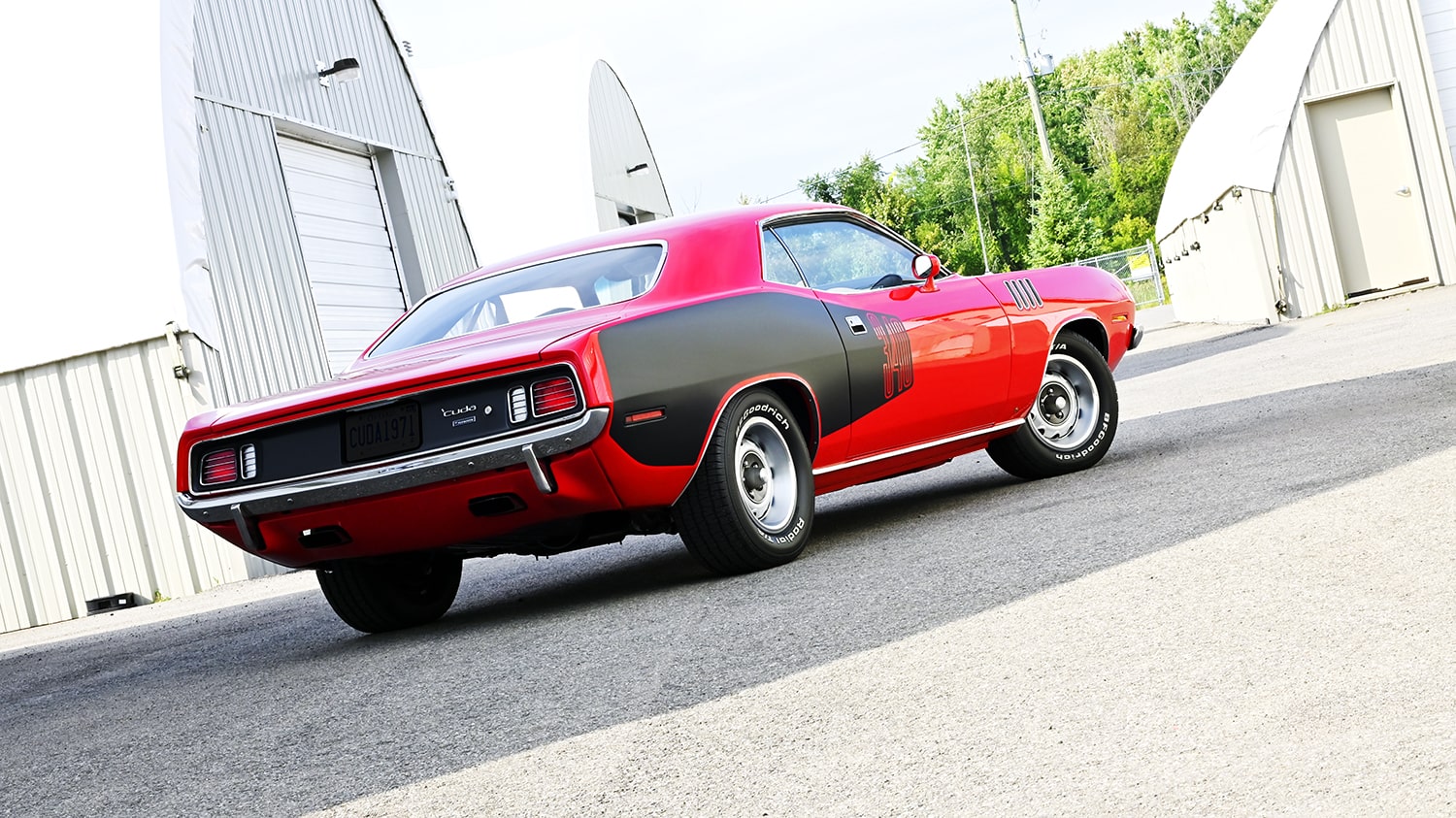
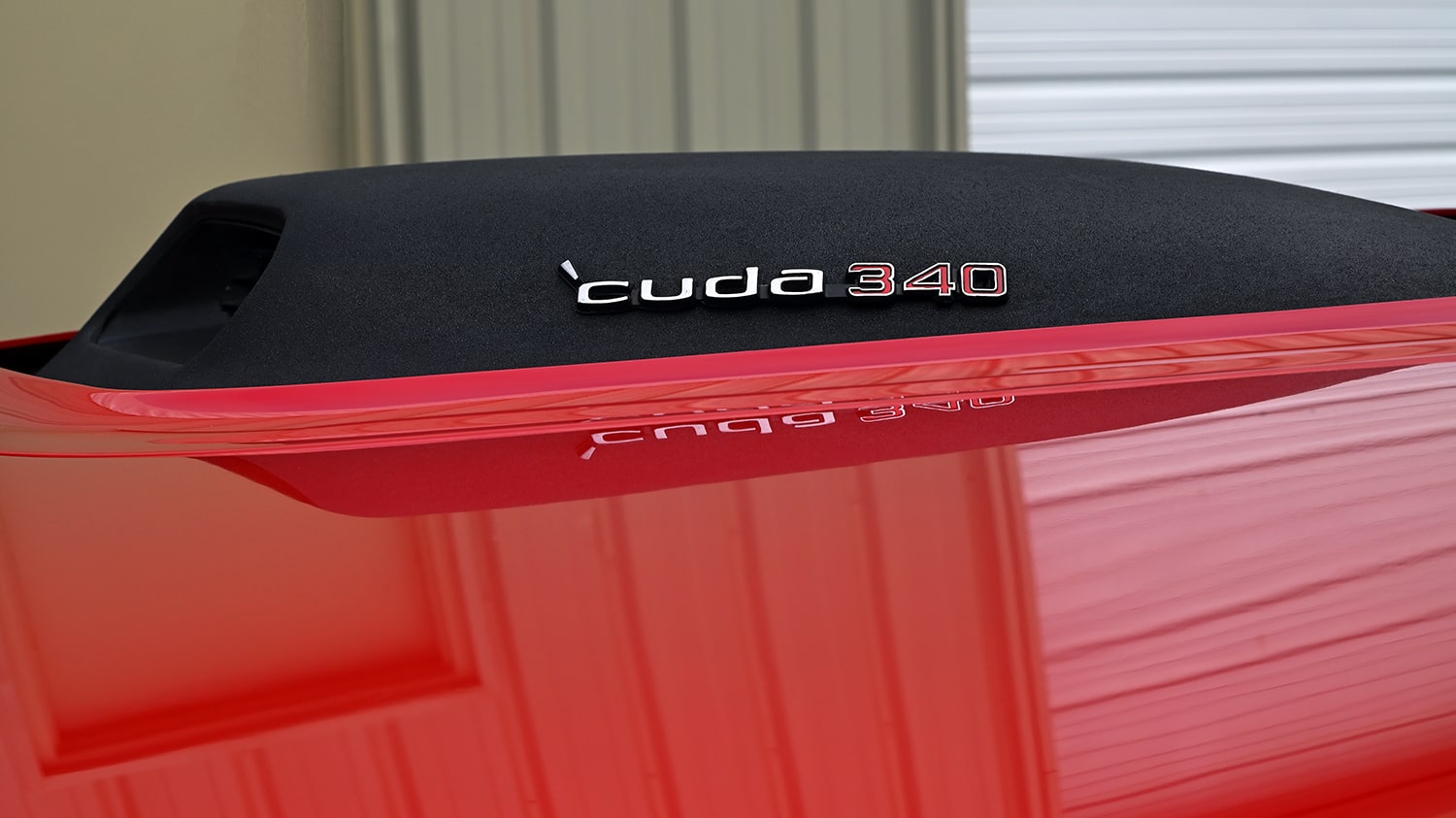
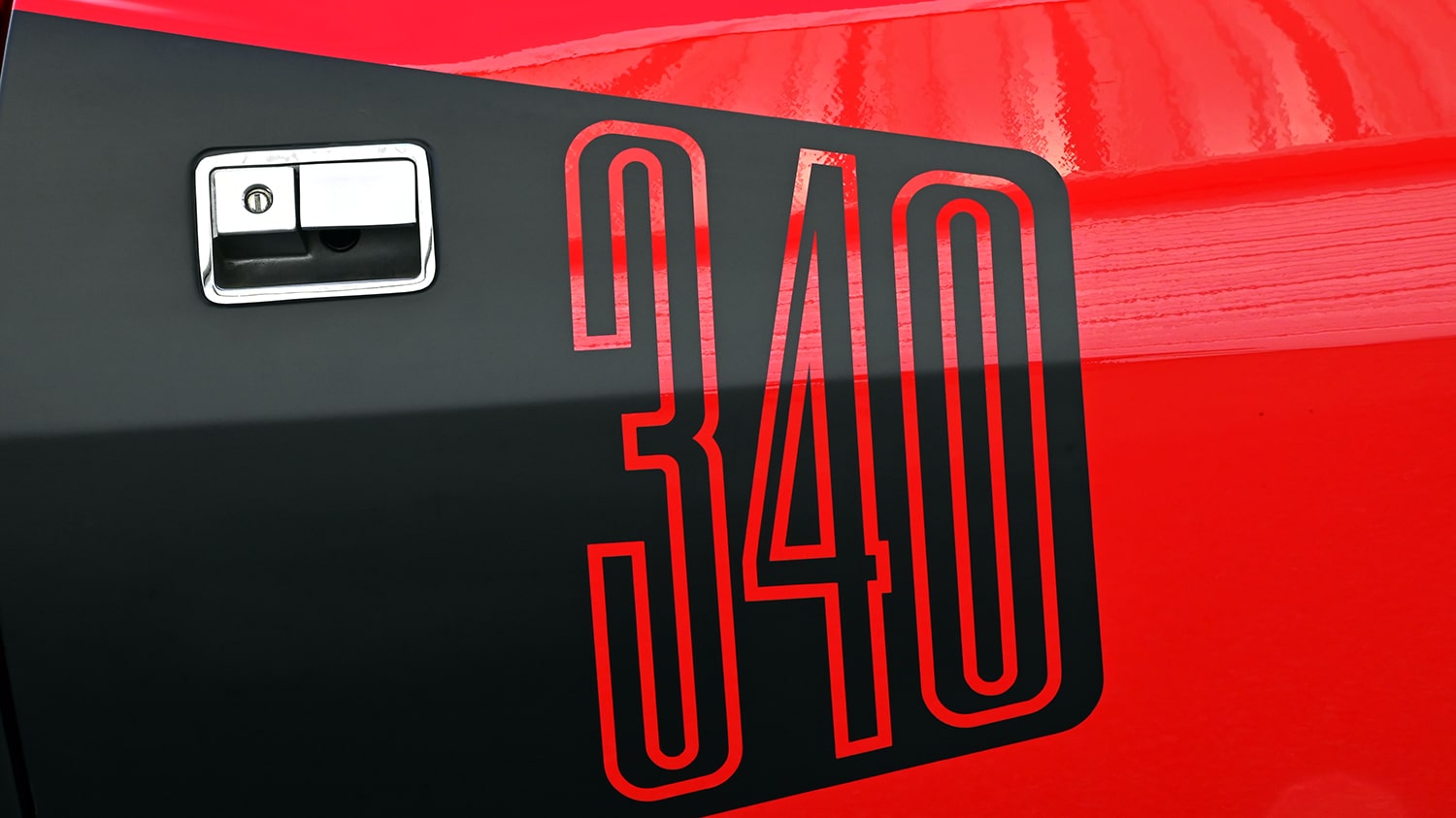
As for the difference between the 1970 and the 1971 Cuda models, most is semantics. Both have the DNA from an E-body platform. It is primarily cosmetic. The brilliant designer, John Eric Herlitz (1942-2008), incorporated into the ’71 version four head lights split by a V-shaped angular grille. Dropped was the ‘hockey stick’ livery for billboard stripes blatantly advertising the engine size. The bucket seats were re-designed and op-tions included rear window louvers, a tail wing and new taillight treatment. It also dis-played six sporty “venturi” air inlets along the side of the car. “My Cuda was born with a matching number 340 cubic inch, small block engine that was built to factory specifica-tions,” verifies Sergio. “Hence the name Cuda 340.” When Sergio sits behind the wheel, it brings him back to his youth. “It brings me happy memories, makes me feel young again, and thankful for having the opportunity to be the next custodian.” The original paint, that has remained on the car, is called FE5 Rallye Red. “As soon as I knew the car was being transported, I pulled out some original restored parts as well as NOS parts from my personal collection. Taking it to the next level was quick and effi-cient,” nods Sergio satisfactorily. “The work I applied only took few weeks to finish.”
Barracuda sales plummeted 66 percent for the model year as the pony car market waned. Tightening government regulations and the rising costs of insurance made big- cube muscle-car ownership an increasingly difficult and expensive proposition. The Hemi, the 440, and the convertible body all disappeared from the ‘Cuda roster after 1971, and the entire Barracuda lineup was dropped after 1974. The 1971 Cudas retain a special mystique in the muscle car world for their “last of a breed” status and their undeniable swagger. They may have stopped manufacturing the Cudas, but those who had them, probably cherished them. Above all, pride in having one is priceless. Just ask Sergio.
Click Here to Begin Slideshow
I contributed financially in helping my wife to buy a car late last year. A flash of pain ran through my VISA card (and that was only for the downpayment). The year Mrs. Branson last bought a car, a nimble little Honda Fit, the Chicago Cubs won the World Series after a 108-year drought. We decided on purchasing a Mitsubishi KONA, regarded as a smaller version of a SUV. This vehicle is like driving a mobile ipad (and I don’t say that with any relish) that does my accounting, babysitting and co-driving with an overload of A.I. computerization by beeping to me that I’m crossing a median line - literally tugging the steering wheel back; beeping for me to slow down; beeping when cars are too close; beeping how to back-up; how to park; where the police cameras are; when to fart - basi-cally, all the things I don’t need a car to tell me. It beeps more than I blink. Even if you get into a fatal accident, I’m sure a weak beep will be heard from the confines of crum-pled metal. Even though cars are faster today, are more comfortable and are considera-bly safer for the environment, they are grossly bigger now, they weigh like a tank, they’re too complicated, far too costly, and devalue too severely the moment you drive off the dealership floor.
And why do we need such assistance? Apparently to reduce accidents. So, obviously, we need a lot more distractions. I think the driving has become worse. I’ve seen so many pathetically slow drivers unable to make up their minds as to what they’re doing. The re-duced speed limits have only increased the number of irate drivers impatiently making impulsive moves due to the slowness of traffic. I wouldn’t be surprised if there are just as many accidents today as there was a decade ago. The road conditions are horrible, we spend too much time in traffic jams due to poor road designs. Who was the bright spark who thought placing an entrance ramp unto a highway just before an exit ramp was any-thing but an impending disaster? The beeping goes ballistic because it encounters speed cameras are every three blocks nagging like some precocious child. Where’s the fun of driving? Of course, this may be a government ploy to force us to stop driving all together. But that won’t work, for crying out loud, this is Canada, a country too large not to drive. The real reason, I suspect, is that dealerships/manufacturers profit even more on war-ranties and repairs and governments benefit from the taxes. What’s even more concern-ing is how cars are becoming more and more like computers. I cringe that a car will need to be upgraded every three to five years. If you want a car because you enjoy driving, too bad, we are losing that freedom. And forget manual stick shift. Apparently, that’s way too complicated for most people and A.I., from what the salesman told me, can’t com-pletely control a manual gearshift. Instead, you’ll just be another obedient, subservient passenger controlled by yet another questionable product in our omnivorous digital age. But this is to be expected. Too many people simply want to be passengers in life rather than the drivers. Cars are about as distinguished from each other as burkas. My wife re-fers to the human population as “habitual sheep”. Everyone is buying SUVs simply be-cause everyone is buying SUVs. There is a lack of variety, style and panache. This basi-cally applies to almost everything we see and do in life. And I don’t know how anyone can afford a car today? The majority of people must live on credit.
There isn't a beep from Sergio Palumbo’s car. Not even from his horn, which is more like an ocean liner’s blast. Sergio drives a stunning, Rallye-red 1971 Plymouth Cuda 340. There is no computer onboard, no screen, no digital distractions, and no control buttons on the steering wheel. Instead, it is the epitome of a fast car that gives off a prodigious sound like something from the bowel of a female guerrilla who notices that you’re too close to her offspring. If there is a distraction, it’s usually from the tapes of ’70's music blaring throughout the cabin. “It drives very well for a car that’s older than I am,” confirms Sergio. “It accelerates smoothly, brakes well, and the 340 has enough power to make me feel comfortable on a highway’s far left lane. It shifts nicely, steers well, and handles great since it is optioned with front and rear sway bars that are part of the Rallye sus-pension. For me, driving it is a pleasure, but then again, I have been driving great cars since my High School days.” Sergio isn’t coy when it comes to revealing how expensive his passion is. He ensures that the restoration, maintenance, as well as hard-to-find parts, can be extremely expensive when trying to keep it original. “For those who might be interested in buying a classic car or restoring one, ask yourself why you are purchasing such a vehicle? If it’s for the love and passion, it’s money well spent. If purchasing one is for an investment, you better do your research and ensure you have a big budget. If you are not well versed in owning a classic car, you will need expert advice from someone in the field, who is and will be, honest with you,” warns Ser-gio. Like any car, it needs tender loving care. There is no way of avoiding the expens-es if you want a car that will give you years of pleasure.
Sergio’s experience in restoring cars began when he was very young. “I grew up in a working class area of Montreal and didn’t know too many people in the restoration hob-by/business. Coming from humble beginnings, I was unable to hire someone to teach me, so I learned on my own.” He drew his knowledge from individuals who owned mus-cle cars, looked at, and documented, many ‘survivor’ cars, and over the years, frequent-ed those who worked on the auto assembly-lines at the time. “I tend to be very picky about the maintenance, storage and upkeep so you need to budget for it.” Sergio is no stranger to classic cars and has a history of restoring them, both professionally and as a hobby (he owns, Old School Auto, an automotive restoration business in Ottawa. “I’ve had a big pile of collectable cars over the years and still own a few today, but as much as some cars come and go, the 1971 Cuda has a special place in my heart - every since I first laid eyes on one so many years ago. I missed having a ’71 Cuda for years and bought it out West for my 50th birthday on October 27, 2020.” Sergio was fortunate. The Cuda was in excellent condition as it had been properly restored. “Considering the odometer only read 1,500 miles, I did extensive work to improve the car and correct many items with original restored or NOS (New Old Stock) parts.” The restoration was partially completed when purchased, but the remainder of the work he did. As Sergio puts it, “I wanted to raise the level to professional restoration.” Sergio is a very dedicated and meticulous restorer. Nothing escapes his eye. “I like add-ing my personal hard work to my vehicles and make any necessary corrections.”
As far as expenses, it’s no secret that many people have taken to investing in classic cars as a fun way to grow their personal wealth. And while you may have noticed in recent years, how values of particular models, such as Plymouth Cudas which have fetched as much as six-figure sales, the overall market has risen dramatically (usually rare cars in mint condition). Even during COVID, the value of muscle and sports cars has surged substantially. New data, revealed in the Financial Review, found that more affordable classic cars made, on average, a 70 percent return on investment, between 2019 and 2022. Adversely, these rare gems are becoming too financially prohibitive. To give you an example, Jerry Seinfeld placed his 1970 racing car - the iconic, history-making Gulf-Porsche 917 on the block for auction at Mecum. With each bid at $1 million, the hammer came down at an astounding $25 million, but Seinfeld rejected the bid and took the car off the market. Since Seinfeld paid $14 million for the car, I guess the bid wasn’t high enough for an extension to his mansion. “I have no intensions of selling my Cuda. I get asked to sell it all the time, but it is not going anywhere soon,” declares Ser-gio with a defiant nod. “Every time I hear someone saying “classic cars are dying,” or that they have a short life span, another decade goes by where they are more popular and more expensive than ever. I can’t predict the future, but I can say for certain that my time enjoying them will not be over anytime soon. Hopefully this will rub off on the younger generations as time goes on,” muses Sergio. “Muscle cars and classics hold a special place in history, so it would be great to see the torch passed on.”
As for the difference between the 1970 and the 1971 Cuda models, most is semantics. Both have the DNA from an E-body platform. It is primarily cosmetic. The brilliant designer, John Eric Herlitz (1942-2008), incorporated into the ’71 version four head lights split by a V-shaped angular grille. Dropped was the ‘hockey stick’ livery for billboard stripes blatantly advertising the engine size. The bucket seats were re-designed and op-tions included rear window louvers, a tail wing and new taillight treatment. It also dis-played six sporty “venturi” air inlets along the side of the car. “My Cuda was born with a matching number 340 cubic inch, small block engine that was built to factory specifica-tions,” verifies Sergio. “Hence the name Cuda 340.” When Sergio sits behind the wheel, it brings him back to his youth. “It brings me happy memories, makes me feel young again, and thankful for having the opportunity to be the next custodian.” The original paint, that has remained on the car, is called FE5 Rallye Red. “As soon as I knew the car was being transported, I pulled out some original restored parts as well as NOS parts from my personal collection. Taking it to the next level was quick and effi-cient,” nods Sergio satisfactorily. “The work I applied only took few weeks to finish.”
Barracuda sales plummeted 66 percent for the model year as the pony car market waned. Tightening government regulations and the rising costs of insurance made big- cube muscle-car ownership an increasingly difficult and expensive proposition. The Hemi, the 440, and the convertible body all disappeared from the ‘Cuda roster after 1971, and the entire Barracuda lineup was dropped after 1974. The 1971 Cudas retain a special mystique in the muscle car world for their “last of a breed” status and their undeniable swagger. They may have stopped manufacturing the Cudas, but those who had them, probably cherished them. Above all, pride in having one is priceless. Just ask Sergio.
Click Here to Begin Slideshow



Leave a Reply