



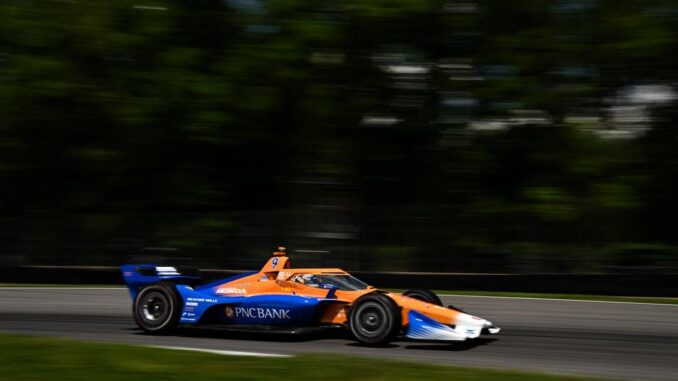

The NTT INDYCAR SERIES now has three race weekends where it can evaluate its new hybrid system, one that was supposed to be used starting with the 2023 season, then for the start of the 2024 season, but went into action during the series’ annual trip to Mid-Ohio Sports Car Course during the July 4th weekend race. Located within the Dallara’s bell housing, the hybrid Energy Recovery System (ERS) is intended to capture energy for use in passing and defending.
Is it working? Well, Mid-Ohio was an unusual place to start with this technology, as it has few passing zones and is a small track, just over two miles in length. Mid-Ohio was resurfaced last year and INDYCAR hoped that work might aid teams and drivers in having their first go with hybridization. Quite a few had already tested the ERS at this track. At the start of this era, six-time champion Scott Dixon of Chip Ganassi Racing had issues with the system that kept him from completing the distance. The Kiwi finished all of 40 laps in the 80-lap Honda Indy 200.
Next were the two Iowa contests on the 7/8-mile short oval. Normally a bastion of overtaking, Iowa had little passing over the course of Saturday evening and Sunday afternoon. Most of the passes – whether for the lead or for position – came in the pits where crews were the masters of going faster in these races. There were some hybrid issues, similar to Dixon’s a week earlier, but none of them had the implication of stopping a competitor from completing distance.
There were ERS activation issues in qualifying when both Jack Harvey, driving for Dale Coyne Racing and Andretti Global’s Colton Herta had issues with their ERS in turning a pair of laps to qualify for both races. The first lap got a driver their Race #1 starting spot, where the second lap designated the Race #2 starting slot. Both drivers’ ERS didn’t work in their first qualifying attempt. Harvey eventually took three tries; Herta’s team decided his two laps were good enough and didn’t go through the qualifying line a second – or third – time.
Before the series’ three-week midsummer break in order to allow broadcast partner NBC Universal the slots it’s paid for to show the Paris Olympics, the third hybrid race was held on the Toronto street course. This was the sole race on a circuit that hadn’t changed its surface since the series last visited. It was hoped that aspect would allow for more positive results, but there was Felix Rosenqvist, who had qualified his Meyer Shank Racing Honda/Dallara in third place, exiting the contest after completing 63 of the scheduled 85 laps, due to an issue with his hybrid system.

It’s obvious to this writer that the best testing for the system is through racing; no matter how many test sessions one has, the sole way to test a new operating system is to use it. Although the current chassis that began service in 2012 was tested extensively before it debuted at St Petersburg that year, the amount of testing for the ERS has been minimal by comparison.
The Formula One World Championship has been using energy recovery systems since 2009. Initially theirs was a Kinetic Energy Recovery System (KERS) that used an inertia flywheel to capture energy and have it produce power on demand. In 2011 F1 switched to batteries that are similar to those used in both pure electric and hybrid vehicles. This is the kind of technology that allows car manufacturers to develop systems they can use on the track and in their production vehicles. Which is why F1 has more manufacturers involved than INDYCAR.
F1 went from V10 engines to V8s and finally to V6 engines with a single turbocharger, where INDYCAR uses twin turbos with its 2.2-liter V6 Chevrolet and Honda engines. F1’s decisions to go to hybridization were driven by environmental concerns and sustainability, cost concerns (which is somewhat ludicrous), relevance to road-going vehicles and the desire to attract more manufacturers to the sport. It’s worked: Ferrari, Honda, Mercedes-Benz and Renault currently compete in Formula 1’s World Championship.
And so, once these three races were completed, it was time to listen to what people deep in the sport had to say about the hybrids in their cars. For the most part the drivers and teams are accepting of INDYCAR’s strictures towards energy regeneration; they’ve been expecting it for a while and most have tested the systems adequately. Still, that doesn’t mean they think the systems are the top of the line and something that should – or must – be used to make added power.
After all, why not do it naturally? Give ‘em more Chevrolet and Honda horsepower from the 2.2-liter, twin-turbocharged engines, rather than tacking on an extra hundred pounds in hybrid technology to the rear of the elderly chassis. It’ s probably old-fashioned to look at technology from that standpoint. After all, not only F1 but US-based IMSA WeatherTech SportsCar Championship and the World Endurance Championship use manufacturer support to designate motive power, and they’ve both had hybridization since beginning the GTP and Hypercar era in 2023 and there have been few, if any hiccups in the power transfer of technology.
INDYCAR went its own way. Initially the hybrid technology was to come from outside partners, including Mahle. Now it’s the two engine makers that are doing the heavy lifting; both Ilmor (working together with Chevrolet) and Honda Racing Corporation US (HRC US) have produced the hybrids. There have been hiccups; there always are.
A Formula 1 insider who follows the US-based open-wheel scene noted that he believes operatives at INDYCAR didn’t understand what they’ve got and doesn’t believe the series did sufficient modeling and simulation work prior to adopting the in-bell housing ERS system. “Otherwise,” he said, “they would have come up with something better. It’s not easy, but you have to be prepared to invest in the engineering up front.”

One team owner, also a driver on the ovals, Ed Carpenter is one of the more vocal critics of the current system. “That’s the most expensive hundred pounds I’ve ever bolted onto a racecar,” he said after the second Iowa race which, once again, he did not finish, coming back to the pits on the hook rather than four wheels.
While parts of the Iowa Speedway oval had been resurfaced, the “tire can only do so much,” with regard to harnessing the power these machines make. Carpenter found it hard to “follow and get around people” during both contests two weeks ago. “The hybrid system asks a lot of the car and I’m not sure,” the veteran said, “we did enough testing.” According to Ed Carpenter, then, “We are making decisions that are hurting our sport,” when a race that once had more than 300 passes for position was down by two-thirds.
The NTT INDYCAR SERIES has been known for its eye-opening oval contests. And not just in its seminal contest, the Indianapolis 500. Ovals have always been the races that separated the wheat from its chaff but the two Iowa contests didn’t do much of that. Here’s hoping the series has better luck with its hybrid solution at World Wide Technology Raceway on August 17th, which begins the four-race stretch run to the championship that concludes September 15th at Nashville Superspeedway, after additional races on the Portland, OR road course and two oval contests at The Milwaukee Mile. Getting it right means enticing current fans to continue with the series and introducing new fans to what has always been exciting racing.
It’s a necessity.
By Anne Proffit
Leave a Reply