



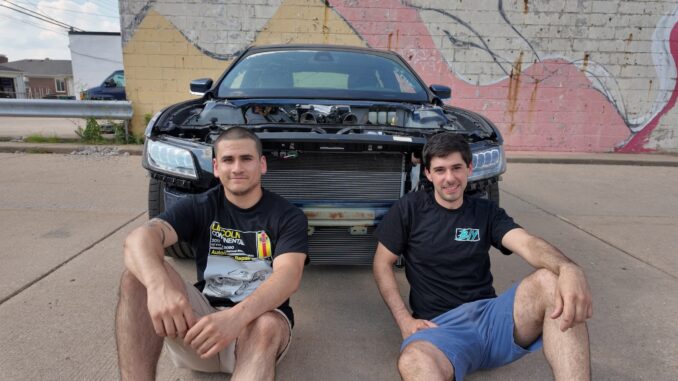
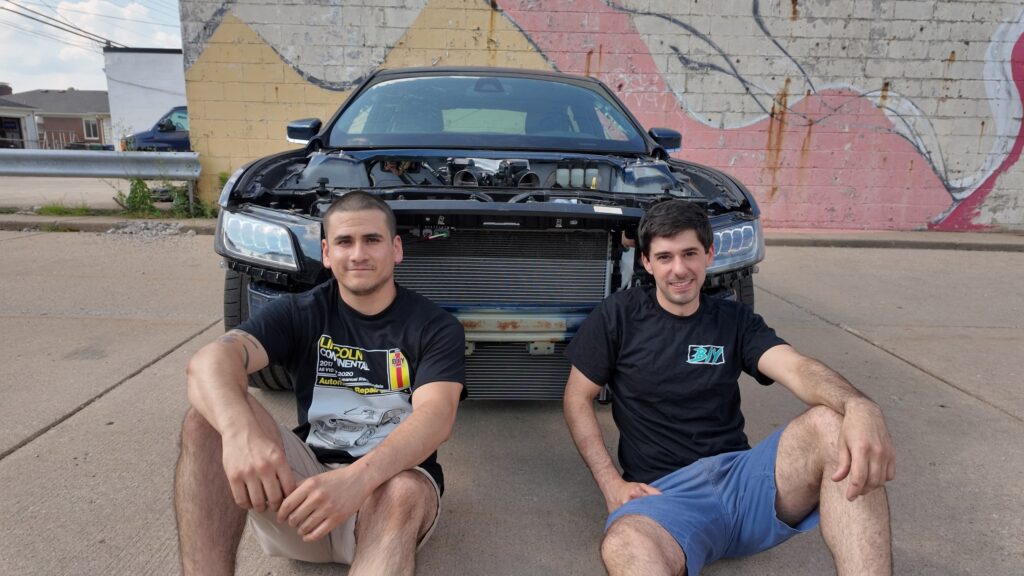
We recently caught up with Build It Yourself, a duo of bad ass builders. When it comes to thinking outside the engine bay, Jack and Diego don’t just raise the bar—they machine a custom one from scratch. From a college Formula SAE team to endurance racing junkyard builds, the duo has always chased projects that blend engineering curiosity with a healthy dose of insanity. Their latest creation? A homebuilt 40-valve V10 stuffed into a rear-wheel-drive–converted Lincoln Continental (yes, you read that correctly). We reached out to them to learn a little more about their roots, the wild engine swap that started as a joke, and what’s next for one of the boldest builds we’ve seen in a long time.
Can you tell us a bit about your backgrounds and how you got into building cars?
Jack: I grew up around cars my whole life. My grandfather and my dad own an auto repair shop, so I was born with a wrench in my mouth. My first car that I started real customization on was a ‘64 Falcon that I bought before I could even drive. I swapped in the 5.0L drivetrain from an Explorer. I still have the car, and it’s still not done.
Diego: I was more of a late bloomer into the car scene. As a kid, I was all about Legos and puzzles — anything hands-on. In high school, games like Gran Turismo and Need for Speed really sparked my interest, and when I turned 18, I bought my first car: a ’99 Saturn SC2. I started with simple stuff like oil changes and bolt-ons… and it just snowballed from there.
We both studied mechanical engineering at UC Davis and met on the Formula SAE team. After graduation, we each landed jobs at an OEM, but started getting bored and wanted a new challenge—so we got into budget endurance racing. We picked up a 1984 VW GTI, prepped it, and raced it in Lemons and ChampCar. Eventually, we swapped the original 1.8L engine for a 2.8L VR6, which completely transformed the car into a rocket. After a few seasons, we were ready for a new challenge and moved on to bigger and better projects.
What inspired you to create a custom 40-valve V10 engine?
It started as a joke. We were fixing our beat-up drift ‘Stang after a cracked block and stripped flywheel bolt, and Diego threw out, ‘Why not swap in a V10?’ We laughed—but the idea stuck. Jack later found a video of a dually F350 with the V10 and custom cams and exhaust. It had that deep cammed-V8 tone but sang like a V10 when he revved it. That was the point when Jack started to take the idea seriously—but only if we could make it rev to 8,000 and, we thought the only way to achieve that was with 4v heads. Ford teased us with a couple versions of DOHC V10s, but they never made it to production. Instead, they only produced 2v and 3v versions that redline around 5,200, nowhere near what we wanted to make a high performing engine that could give V10 supercars a run for their money. At first we thought it was impossible— we started digging into old forum posts and realized no one had actually built custom 4v heads, just talked about it. So we started brainstorming – welded heads have been around for ages, and even though OHC welded heads weren’t really a thing, we figured… Let’s find out. So we went to a junkyard, pulled some V8 heads, and started fabricating. It started as a joke, but turned into one of the most challenging and rewarding things we’ve ever built.
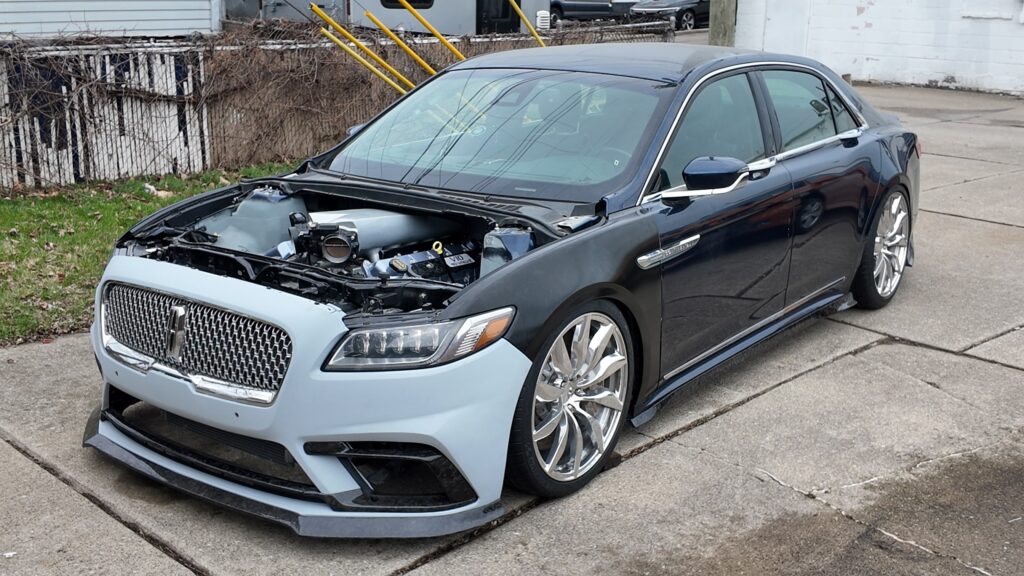
This has to be one of the coolest Lincolns ever — what made you choose a Lincoln over something more common, like a Mustang?
We really appreciate that, we are glad to see everyone else enjoy the build as much as we are. We have put a lot of work into it and it’s been great to see. We always thought Lincoln had the potential to build something truly special. The 10th-gen Continental has a great road presence and a historic nameplate, but being FWD-based, it lacked the soul of an inspiring car.
It really is a shame such a cool looking car didn’t get the love it deserved, especially after concepts like the Ford 427. We thought it would be fun and a great learning experience to “fix” that, kinda like we did with the engine.
With the Continental, we could really push the boundaries of our capabilities, turning a FWD car into RWD, fitting a massive DOHC custom V10 engine, and learn a thing or two along the way. A Mustang might’ve been the easier choice, but that wasn’t really the goal. This was about turning something overlooked into something unforgettable.
What were the biggest challenges during the build? Anything you’d do differently if you had the chance?
Our biggest challenge has been finding shops for the custom work we need, without breaking the bank. Cutting heads, line boring, machining camshafts cores, just to name a few. Most of the time we found ourselves having to learn a new process and go about doing it ourselves. That sometimes meant less-than-ideal methods, but still got the job done.
One of the biggest hurdles was line boring the heads. We ended up having to build a makeshift setup using bar stock and sketchy lathe work to finally get all the cam bores machined. They are working so far (knock on wood), but there is definitely opportunity for improvement.
What’s next for the Lincoln project — or anything else your viewers can look forward to?
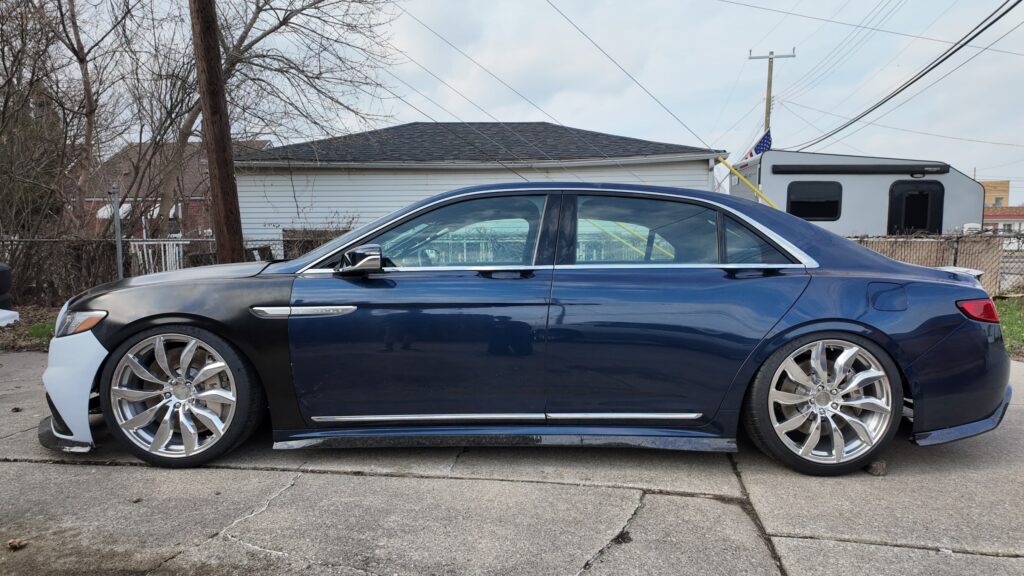
The car’s not quite done yet — we’ve still got bodywork, paint, and plenty of loose ends to wrap up — but we’re pushing to finish it before the weather turns. We’d love to show it at SEMA this year and are actively looking for a company to team up with. Our goal is to hit as many shows as possible so everyone who’s followed the build can finally see — and hear — the Lincoln in person. And as for what’s next? We’ve got a few ideas brewing for a future build that we are sure will turn some heads.
Want to see (and hear) more of the Lincoln V10 project and whatever madness they cook up next? Follow Jack and Diego on YouTube at Build It Yourself for build updates, behind-the-scenes fabrication, and plenty of rev-happy chaos. Trust us—you’re gonna want to subscribe.
I was told Ford built these as experimental for the Ford GT, but decided to go a different direction. It produced somewhere around 700 h.p. On a single four barrel. Never corroborated that info., but I did take Lincoln Navigator heads (D.O.H.C 4-valve), cut them (3+2), and put them on a V-10 block. Ford did the same thing Chevy did turning their V-8 into a V-6, except Ford just turned a V-8 (5.4) into a a V-10. I didn’t like the split pin design crankshaft, and the amount of work involved to make it all happen the way I wanted, so along with many other projects, I put The 40 valve V-10 on the backburner 25 years ago. A 800 h.p. Stroker Cleveland will fit nicely in my “68” fastback and it doesn’t need boost to get there or Heaven forbid the blasphemy of a LS motor. My Chevy’s use Chevy motors. My Dodges use Dodge motors, and my Ford use Fords. They all have their strengths and weaknesses, but their all good.