



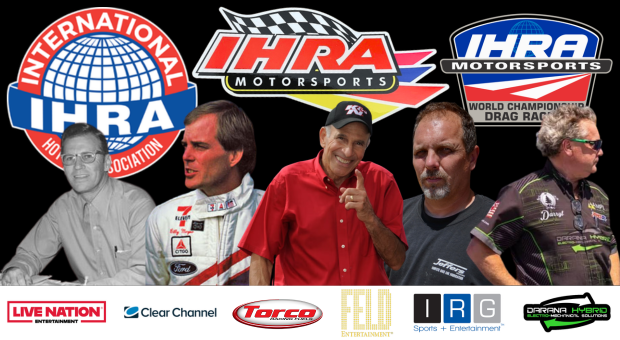
Explore the complete ownership timeline of the International Hot Rod Association, examining how each era influenced the sanctioning body’s direction, growth, challenges and legacy.
 As the International Hot Rod Association (IHRA) experiences another season of high highs and low lows, Tyler West looks back at the history of the organization since it’s founding, owner by owner.
Larry Carrier (1970–1987)
When Larry Carrier founded the International Hot Rod Association in 1970, the organization wasn’t intended to replace the NHRA—it was designed to provide racers and track operators a viable alternative. As the owner of Bristol Dragway, Carrier understood firsthand the challenges facing independent promoters and competitors. He believed racers deserved lower operating costs, greater flexibility for track operators, less bureaucracy, and more regional opportunities to compete.
Carrier’s vision resonated throughout the Southeast, where the IHRA quickly established itself as a legitimate sanctioning body. Under his leadership, the organization expanded into a national series while maintaining a racer-first philosophy. He also proved to be an innovative businessman, securing Winston Cigarettes as one of drag racing’s first major title sponsors and helping establish a commercial model that other motorsports organizations would later emulate.
By the late 1980s, however, professional drag racing had become significantly more expensive to operate. Television production standards were increasing, event purses continued to grow, insurance costs climbed, and remaining competitive with the NHRA required continual financial investment. After nearly two decades of building the IHRA into a nationally recognized organization, Carrier was approaching retirement and recognized that the sport was entering a new era that would require greater financial resources than a privately owned operation could comfortably provide.
Rather than waiting until those challenges became overwhelming, Carrier chose to sell the organization while it remained healthy and growing. His decision is generally viewed as a natural business succession rather than an exit driven by financial distress. Having accomplished his goal of establishing a successful national sanctioning body, Carrier stepped away knowing the IHRA had become a permanent fixture in drag racing.
 Billy Meyer (1987–1998)
Billy Meyer approached IHRA ownership with a dramatically different philosophy than his predecessor. As a successful racer and owner of Texas Motorplex, Meyer had already demonstrated a willingness to challenge convention. He believed the IHRA needed to modernize aggressively if it hoped to compete with the NHRA on a national level.
During his tenure, Meyer implemented numerous operational changes designed to make the organization more marketable and professionally run. He expanded television coverage, increased event purses, modernized race operations, and reorganized several sportsman and professional classes. While many applauded his willingness to invest in the organization, others criticized the pace of change, particularly when class restructurings affected longtime competitors with little advance notice.
Despite those criticisms, Meyer remained convinced that standing still was not an option. The motorsports landscape of the 1990s was changing rapidly, with television becoming increasingly important and sponsorship dollars flowing toward organizations capable of delivering national exposure. Meyer believed the IHRA had to evolve if it wanted to remain relevant.
By the late 1990s, however, large entertainment companies had begun purchasing motorsports properties across the country. Meyer understood that competing nationally would soon require marketing budgets, television production capabilities, and corporate sponsorship resources beyond what individual ownership could realistically provide. Selling the IHRA to a corporate entertainment company was less about exiting the business and more about positioning the organization for what appeared to be the next phase of motorsports growth.
 Bill Bader Sr. (1998–2001)
Although often overshadowed by other owners, Bill Bader Sr. played an important role during one of the IHRA’s most transitional periods. As the owner of Norwalk Raceway Park, Bader brought decades of experience as a successful track operator and promoter. His practical understanding of racers and event management helped stabilize the organization following Meyer’s departure.
Under Bader’s ownership, much of the IHRA’s operational focus shifted to Norwalk, Ohio. He concentrated on strengthening national events, improving promotion, and maintaining continuity while the organization adjusted to new leadership. Rather than pursuing sweeping changes, Bader emphasized stability and preserving the relationships the IHRA had built with its member tracks and racers.
At the same time, the business of motorsports was changing rapidly. Entertainment companies such as Live Nation were acquiring race tracks, sanctioning bodies, and event properties across multiple forms of motorsports. The IHRA represented an attractive acquisition because of its established national schedule and loyal sportsman racer base.
When Live Nation made its offer, Bader viewed the opportunity as beneficial for both himself and the organization. The acquisition provided the IHRA with access to significantly greater financial resources while allowing Bader to remain involved as IHRA President during the transition. His decision reflected confidence that corporate ownership could help elevate the organization beyond what privately owned management could achieve alone.
 Clear Channel Entertainment / Live Nation (2001–2008)
Corporate ownership marked a dramatic shift in the IHRA’s direction. Unlike previous owners, Clear Channel Entertainment viewed the organization primarily as entertainment content rather than simply a drag racing sanctioning body. The company already owned hundreds of radio stations, concert venues, promotional companies, and sports properties, and believed drag racing could become another valuable piece of its entertainment portfolio.
The organization benefited from increased investment in television production, sponsorship development, event promotion, and marketing. National exposure grew, and the professional series continued to attract talented competitors. Corporate resources gave the IHRA opportunities that had been difficult to achieve under individual ownership.
Despite those advantages, drag racing remained an expensive motorsport with relatively modest television ratings compared to NASCAR and other mainstream sports. Producing national events required substantial investments in logistics, production, insurance, and prize money, making profitability difficult despite improved exposure.
It was during this period that Torco Race Fuels came onboard as a major sponsor. While Torco never actually owned IHRA, many saw their investment as more than just a sponsorship. Torco Race Fuels collapsed in 2008 after its founder and owner, Evan Ward Knoll, was implicated in a massive $100 million federal fraud. Knoll was sentenced to 14 years in federal prison and ordered to pay over $82 million in restitution after exploiting an excise tax refund program for fictitious claims.
Ultimately, the decision to sell the IHRA was driven not by problems within the organization itself but by changes inside the parent company. As Clear Channel reorganized its entertainment division into Live Nation, the corporation shifted its focus almost entirely toward concerts and live entertainment. Motorsports no longer aligned with its long-term business strategy, making the IHRA a logical asset to divest.
 Feld Entertainment (2008–2013)
When Feld Entertainment acquired the IHRA, it brought an entirely different perspective to drag racing. The company had built its reputation through successful touring productions such as Monster Jam, AMA Supercross, and Disney on Ice. Rather than viewing drag racing strictly as a championship sport, Feld approached it as a live entertainment experience.
This philosophy led to the creation of Nitro Jam, which emphasized fan engagement, shorter event formats, exhibition racing, jet cars, wheelstanders, and a festival atmosphere. Traditional championship competition became less central to the program as Feld attempted to appeal to families and casual spectators who might not ordinarily attend a drag race.
The concept generated mixed reactions. Many fans enjoyed the more entertainment-focused format, while traditional racers believed the organization had moved too far away from its competitive roots. Nevertheless, Feld continued refining the concept in hopes of building a financially sustainable touring series.
Despite attracting respectable crowds at many events, the economics of professional drag racing remained difficult. Transportation costs, insurance expenses, race purses, and event production continued to challenge profitability. After several years of evaluating the business, Feld concluded that the financial returns did not justify continued ownership and elected to sell the organization.
 IRG Sports & Entertainment (2013–2022)
Following Feld’s departure, the IHRA underwent another philosophical shift. Private Equity would get involved as IRG Sports + Entertainment purchased the IHRA in 2013 to build a comprehensive, vertically integrated motorsports portfolio. Under IRG Sports & Entertainment, management concluded that attempting to compete directly with the NHRA’s professional series was neither practical nor financially sustainable.
Instead, the organization returned its focus to the grassroots foundation upon which Larry Carrier had originally built the IHRA. Greater emphasis was placed on member tracks, sportsman competition, the Summit SuperSeries, insurance programs, and track sanctioning. While this approach generated far less national attention than previous eras, it created a more stable business model centered on local racers and independently owned facilities.
Many longtime participants welcomed the change, believing the IHRA had rediscovered its identity as an organization dedicated to sportsman drag racing rather than attempting to rival the NHRA’s professional tour.
By 2022, IRG had begun simplifying its business portfolio and reducing its investments in motorsports ownership. Selling the IHRA to Larry Jeffers allowed the organization to return once again to ownership by someone whose reputation had been built within the drag racing community itself.
 Larry Jeffers (2022–2024)
Larry Jeffers entered IHRA ownership with decades of credibility earned as one of drag racing’s most respected chassis builders. Unlike several previous owners, Jeffers had spent his career working directly with racers, making him uniquely positioned to understand the needs of the sportsman community.
Prior to the sale, the management team that had built and maintained IHRA throughout IRGSE’s ownership attempted to purchase the organization. The sale of IHRA to Jeffers would cause a split in sportsman drag racing as the former IHRA management team would go on to successfully create the World Drag Racing Alliance (WDRA) in 2022, competing directly with IHRA and NHRA as a drag racing sanctioned organization. Utilizing their decades of promoting sportsman drag racing and grassroots facilities, the WDRA grew rapidly, eroding IHRA’s network of sanctioned tracks.
Rather than pursuing rapid expansion, Jeffers concentrated on attempting to restore confidence in the organization. His administration emphasized stronger communication with member tracks, rebuilding relationships with racers, and strengthening programs such as the Summit SuperSeries. The focus shifted away from headline-grabbing announcements and toward rebuilding trust within the existing IHRA network.
When businessman Darryl Cuttell expressed interest in acquiring the IHRA, Jeffers recognized an opportunity to transfer ownership to someone prepared to invest significant capital into growing the organization. There has never been any public indication that Jeffers sold because of dissatisfaction or financial concerns. Instead, the sale appeared to reflect his belief that Cuttell possessed the resources necessary to pursue a much larger vision for the IHRA’s future.
 Darryl Cuttell (2024–Present)
Darryl Cuttell assumed ownership with perhaps the boldest expansion strategy in IHRA history. Almost immediately, the organization announced plans to acquire drag strips, expand internationally, revive professional nitro racing, and invest in additional motorsports properties. The pace of growth was unlike anything the IHRA had attempted since its earliest years under Larry Carrier.
The strategy generated excitement throughout portions of the drag racing community. Supporters believed the IHRA was once again positioning itself as a significant national force capable of expanding opportunities for racers and track operators alike. The acquisition of racing facilities and the return of professional nitro competition suggested an organization once again competing against the NHRA.
To solidify its standing as a sanctioning body, the IHRA would acquire the WDRA, its leadership and member tracks in November of 2025. This acquisition would give IHRA the title of having the most member tracks of any drag racing organization. For most in the sportsman racing world, this move was a major step towards re-establishing itself to being the powerhouse it once was.
However, rapid expansion also raised questions regarding financial sustainability. Acquiring facilities, launching a national professional series, and supporting an expanding organizational footprint required substantial capital investment. As the organization moved through 2025 and into 2026, industry observers increasingly questioned whether the pace of growth could be maintained over the long term.
Those questions intensified when the IHRA announced the cancellation of the remaining 2026 Nitro Drag Racing Series events and redirected its focus toward supporting member tracks and sportsman racers. Whether that shift proves temporary or becomes the organization’s long-term direction remains to be seen. What is clear, however, is that the decision mirrors a recurring theme throughout IHRA history: regardless of ownership, the organization’s greatest strength has consistently been its grassroots racers, local tracks, and sportsman competition rather than its professional racing programs.
What’s Next for the IHRA?
With nearly its entire staff now gone, the IHRA finds itself at another crossroads in its 55-year history. While the organization has stated that its focus remains on member tracks, Sportsman competition and grassroots drag racing, the termination of its division directors and membership team rightfully leads to intense speculation. An organization cannot indefinitely operate at its previous scale with only a skeleton staff, leading many throughout the motorsports industry to question whether the current restructuring is the first step toward an eventual ownership change.
Elite Motorsports owner Richard Freeman publicly confirmed in an interview with Drag Illustrated that he had entered negotiations to purchase the organization before talks ultimately collapsed after just eight days. According to Freeman, shifting deal terms and communication issues prevented the transaction from moving forward, despite what appeared to be serious interest in acquiring the sanctioning body. The failed negotiations demonstrated that established figures within the drag racing industry still recognize value in the IHRA’s assets, including its extensive member-track network, Sportsman racing program and decades of brand recognition.
Whether the current ownership intends to continue rebuilding the organization independently or eventually seek another buyer remains unknown. What is clear is that the future of the IHRA will likely look much different than the ambitious expansion plans unveiled just a year ago. The professional series has been shelved, nearly the entire staff has departed, and the organization’s immediate future appears uncertain. If another ownership group ultimately emerges, many racers will be watching closely to see whether the next chapter focuses on restoring national-event prestige or strengthening the Sportsman foundation that has sustained the IHRA through previous periods of transition.
Very concise story. Thank you Tyler.