




Brazilian Helio Castroneves became a member of a very exclusive club May 30th at the Indianapolis Motor Speedway, joining three illustrious Indianapolis 500 winners: A.J. Foyt Jr., Al Unser and Rick Mears, as sole drivers to be first to the checkered flags four times. This year marked the 60th anniversary of Foyt’s first win and the 30th anniversary of Mears’ final and fourth victory in the Greatest Spectacle in Racing.
Castroneves, now 46, who was released – let’s say jettisoned – by Team Penske after winning his first three Indy 500s (2001, 2002, 2009) and the IMSA DPi championship last year in Acura Team Penske’s ARX-05, came to Meyer Shank Racing (MSR) as a part-timer for MSR’s second car in 2021, expecting to run six NTT IndyCar Series races for the Honda-powered team, now in its second year as a full-time one-car INDYCAR squad.
Meyer Shank Racing has fielded a single-car entry for Indy Lights graduate Jack Harvey as their primary driver since joining the series for a 2017 one-off at Indy. Castroneves, too, is an Indy Lights grad, having raced in that series with Tasman Motorsports in 1996 and 1997 as teammate to 2013 Indy winner Tony Kanaan, who finished 10th on Sunday for Chip Ganassi Racing.
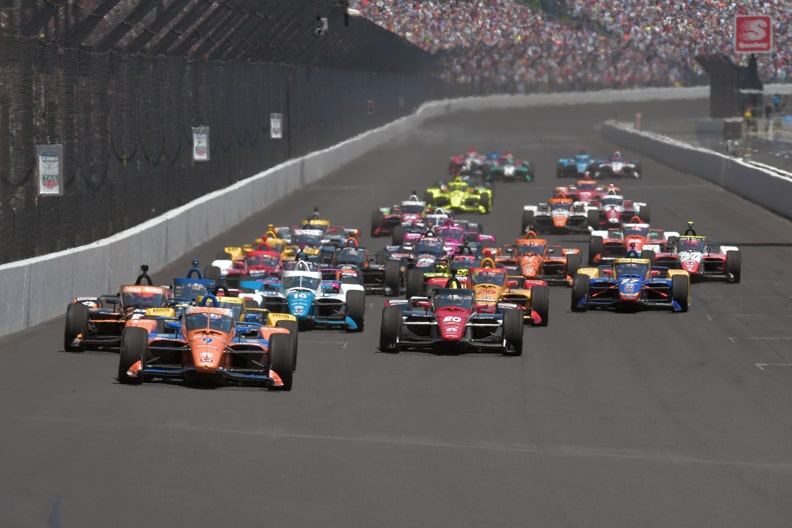
After crossing the double checkered flags, Castroneves performed his signature climb of the fence at start/finish and kissed the famed yard of bricks, then accepted congratulations from the entire INDYCAR community before finally ascending to Victory Lane. It took almost 15 minutes to get him to the planned celebration as he ran up and down the front straight saluting the 135,000 fans who were the largest public gathering for a sporting event since the COVID-19 pandemic began in March of 2020.
This year’s Indy 500 was the fastest 200 laps of IMS’ 2.5-mile historic oval in this race’s 105-year history, taking all of two hours, 37 minutes and 19.3846 seconds. The average speed of the field was 190.690mph and there were 35 lead changes among 13 drivers. Only two cautions slowed the field of 33 cars and both of those cautions were induced in the pits: Justin Wilson’s Andretti Autosport Honda/Dallara spun as he entered pit lane on the 34th lap; Graham Rahal’s Rahal Letterman Lanigan Honda lost a left-rear wheel and tire after his lap 118 pit stop and he crashed in the second turn after exiting the pits, ending a competitive race for Rahal, who led eight laps.

There were only 18 laps of caution: the first came at an inopportune time for some front-runners who had not yet called for initial pit stops and were penalized for emergency service. Both 2021 pole man and 2008 winner Scott Dixon, as well as 2016 winner Alexander Rossi ran dry and it was difficult to restart them in the pits on the 45th lap, but they weren’t alone in needing an emergency fill-up on fuel, joined by JR Hildebrand (A.J. Foyt Racing Chevy), Marcus Ericsson (Chip Ganassi Honda), Simon Pagenaud (Team Penske Chevy), Conor Daly (Ed Carpenter Racing Chevy) and Harvey, all of whom had to start at the rear of the field after caution ended.
Such a clean race meant there were a lot of follow-the-leader mid-race laps as teams and their drivers manipulated to be at the right place at the right time – in the front pack, fully fueled with 20 laps remaining. While the winner led only 20 laps (Conor Daly led the most with 40 laps at the front), the sage Castroneves knew where he needed to be and when.
Castroneves traded the lead with Chip Ganassi Racing’s Alex Palou before the Spaniard finally ceded on the penultimate lap and accepted the runner-up slot, after leading 35 laps. Palou lagged Castroneves by a scant -.4928 seconds at the close, about half a car-length. Pagenaud, the 2019 winner of this race finished third after starting 26th, followed by Arrow McLaren SP Chevy driver Pato O’Ward in fourth after leading 17 laps, and Ed Carpenter’s Chevy in fifth place.
Part-timer Santino Ferrucci, driving for Rahal Letterman Lanigan, brought his Honda home sixth (from 23rd on the grid) as a one-off and led two laps, Sage Karam’s Dreyer & Reinbold Chevy took seventh place and led a couple of laps. Karam passed more cars than any other driver as he can from 31st grid spot. Rinus VeeKay finished eighth after leading 32 laps for Ed Carpenter Racing (Chevy), Juan Pablo Montoya took ninth for Arrow McLaren SP (Chevy) and Kanaan completed the top 10, the latter driving the No. 48 Ganassi Honda wheeled by seventh-time NASCAR champ Jimmie Johnson on all road/street courses.
Andretti Autosport’s Ryan Hunter-Reay was the final driver on the lead lap in 22nd place and there were only three retirements: Wilson, Rahal and Paretta Autosport’s Simona De Silvestro, who also had trouble getting onto pit lane for her final call to the pits.
Palou’s battle to second place, after winning the first race of the season at Barber Motorsports Park, showed the fans that this is a driver they can get behind in the future, and Pagenaud’s run from 26th to third was another extraordinary drive by a racer who is, again, in a contract negotiation year.
It’s important to note that six of the top 10 drivers are not full-timers on the INDYCAR trail (Castroneves, Carpenter, Ferrucci, Karam, Montoya and Kanaan). A.J. Foyt Racing’s JR Hildebrand was the top finisher of three entries in 15th , while favorites Dixon (17th), Colton Herta (P16) and Alexander Rossi (P29) had great misfortunes in this race.
Meyer Shank Racing team co-owner Michael Shank has now been the winning team owner of two very special racing contests: the 50th annual Rolex 24 at Daytona i 2012 and this year’s 105th Indianapolis 500.
In IMSA racing, the team has earned victory at Petit Le Mans (2016) and was the 2019 and 2020 IMSA GTD class champion, using Acura NSX machinery. Meyer Shank Racing initially ran the Indy 500 in 2017 as a one-off and became a part-time team in 2018. The team’s first full-time NTT IndyCar Series campaign came in 2020, with 2021 marking the first time the Columbus-Ohio based organization has fielded a two-car INDYCAR squad – in addition to racing a single, full-time Acura ARX-05 IMSA entry.
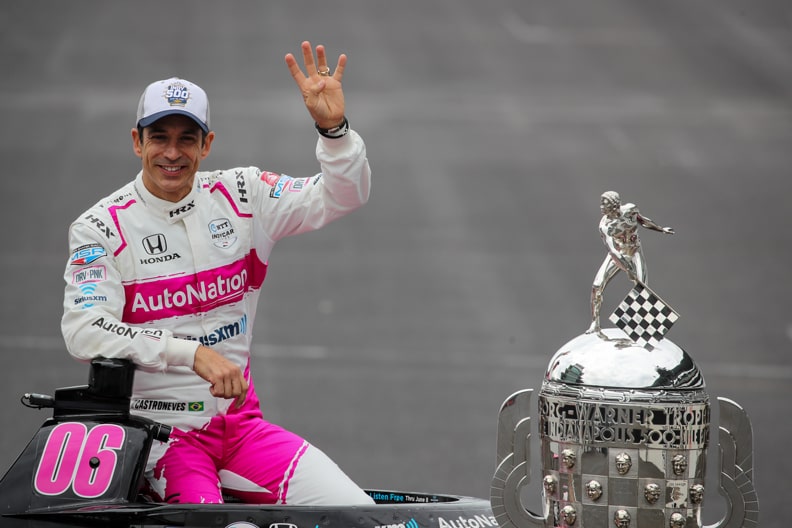
As he pointed out post-race, Castroneves learned from the times he finished second at Indy (2003, 2014, 2017) while still racing full-time for Team Penske. In the years 2018-2019 Castroneves raced only at Indianapolis with Team Penske, as he moved to sports car racing in IMSA. “The car was so good, so I just had to make sure that I stayed there in the end. I lost too many races in second place here,” he said. “I was, like, this is not going to be the day” when he lived with another close loss at the Brickyard.
“I decided just to wait for the right opportunity. So I did a couple of tries to see if I would cross the finish line first, and I did,” he said with his dimpled smile. “My strong corners were both two and four,” Castroneves explained. As the race drew to its inevitable, green-flag closure, “When I saw the traffic, I’m like, that’s it. I’m not going to wait because I need that traffic to pull me so I can get the same speed. When I made the move, I said, ‘that’s it.’” While he had to make sure Alex Palou wouldn’t “dive and bomb me,” Castroneves’ final move on the penultimate lap was, as he called it, “perfect.”
Former Atlantic series racer Shank was over the moon with his driver’s result. “I don’t even know where to start,” he said after joining Castroneves on the front straight fencing. “Hello drove an incredible race – his experience in this race was there for all to see. I’m so proud to have the partnerships that we’ve built to get to this point. That starts with Jim [Meyer] who has made such an impact on this organization since coming on-board in 2017, and goes to AutoNation and SiriusXM, and, of course, Honda and the folks at HPD. This is going to take a long time too soak in, but right now I am at a loss for words to be standing here right now after winning the Indianapolis 500.”
Meyer Shank Racing, which raced in Indianapolis for the Indy Grand Prix two weeks ago and IMSA’s Mid-Ohio sprint race on the same weekend, will do another double in less than two weeks. This time, the NTT IndyCar Series has its Duals in Detroit, the Chevrolet Detroit Grand Prix doubleheader on June 12-13 at Belle Isle, just as IMSA contests the Chevrolet Sports Car Classic, a sprint race for the DPi, GTLM and GTD classes near sunset on Saturday, June 12.
Great story, Anne!