





![[Gallery] Mecum Kissimmee Auction 2026](https://www.racingjunk.com/news/wp-content/uploads/2026/03/DSC_0717-e1774629242515-376x206.jpg)
![[Gallery] Cruisin’ One Daytona](https://www.racingjunk.com/news/wp-content/uploads/2026/03/DSC_0538-e1774027057404-376x206.jpg)
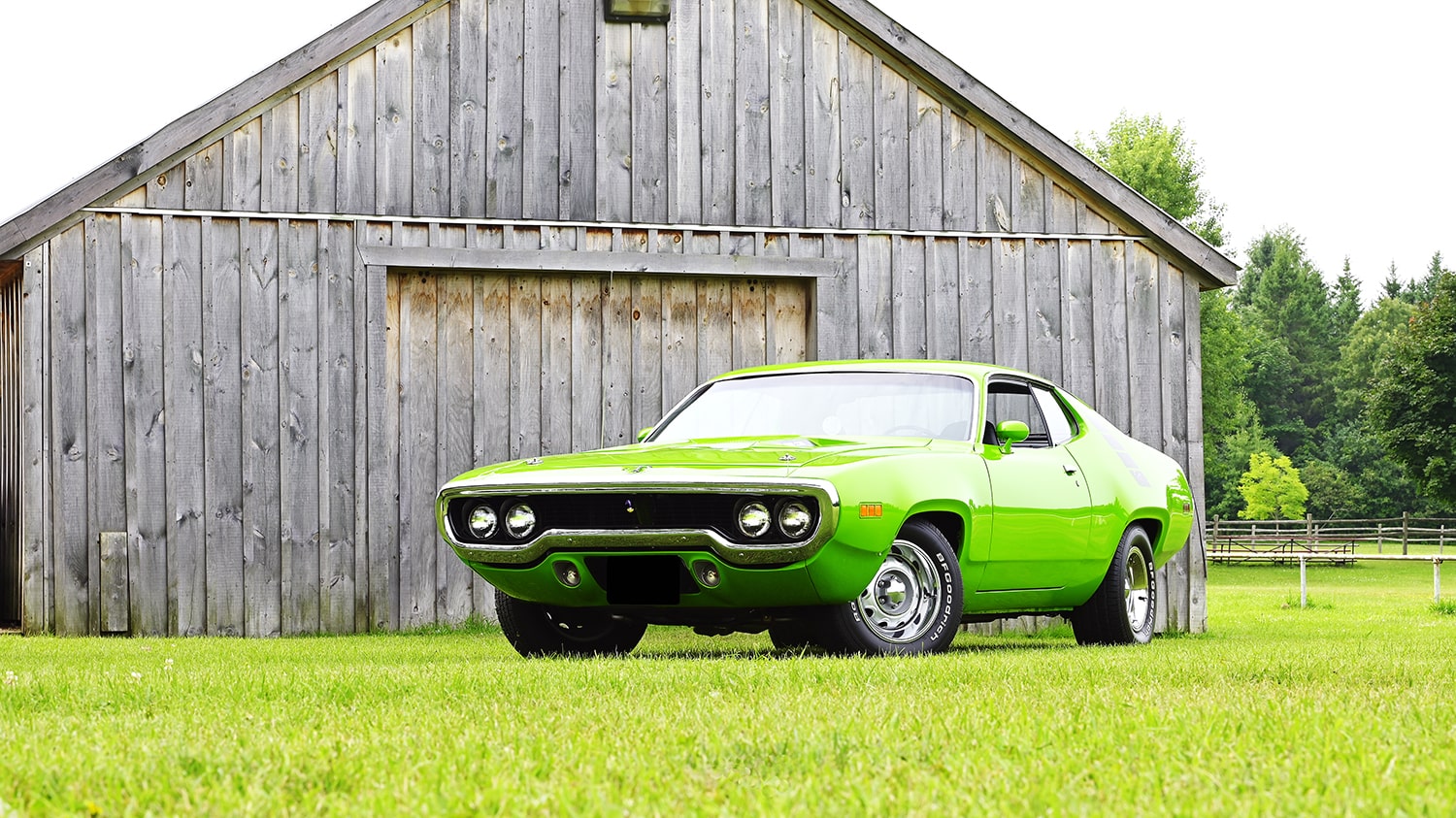
THE BEST GREEN ENERGY: Mike Bailey's 1971 Plymouth Roadrunner
Click Here to Begin Slideshow
You know why cars are so expensive today? Digital components. And most, if not all of these digital components, we don’t need. They are a distraction. If something goes wrong digitally, everything follows. You can have its cheap glow, pesky chirps and diarrhea data spillage. Scrap away the digital nonsense and you could drop the price by half (or more) and still have a great car without a laptop for an engine. These days, it takes a computer to fix a computer. Digitalization is a curse. Insurance is more expensive because digital cars are so complicated to maintain and repair. The moment such a car is bought, it devalues dramatically. Digitization is convenient, but it doesn’t mean it’s better. And in the future, it will be A.I. cars.
Oh, what a joy. What are we thinking? I hate how convenience (mainly because we’ve become so lazy) has usurped common sense. This is why I admire cars like the 1971 Plymouth Road Runner. It is mesmerizing at first glance, powerful with a rumble reminiscent of Mount Etna about to erupt, and unique in its shape. If I were to modify it to today’s standards, I would design it. Hence, it’s wider (for balance), upgrade the interior, especially the gauges, upgrade the suspension and brakes (better roadworthiness), and possibly get better fuel consumption, but otherwise, I wouldn’t touch it. Some may say, in a smug response, that I’ve just retouched everything. Charles Kettering, former head of research at General Motors, once said: “People are very open-minded about new things – so long as they are exactly like the old ones.”
I reiterate I don’t think we need digital domination. To prove a point, Mike Bailey owned a 1970 Duster 340 for 36 years, clocking 110,000 miles. “I basically grew up in that car, raced hundreds of quarter-miles and had the time of my life,” he remembers. “Without a doubt, I had just about every nut and bolt out of that car at one time or another. I rebuilt the engine eight times and modified the car until I got it just the way I wanted it. It always ran strong and was well known in the Brockville area. I eventually sold it in 2009 and I still believe it was one of the worst decisions I ever made.” I doubt that having GPS, a movie screen, or Siri voice commands were essential criteria for Mike’s decision to buy. Since 2021, he has owned a 1971 Plymouth Road Runner. “The car’s appeal is easy: it’s pretty impressive to look at; it has a great stance; it’s a beautiful colour; it runs strong, sounds good and is a head turner almost anywhere I go. I’ve won some “Best in Class” awards at shows. Kids love it, too,” Mike confirms with a nod. But I think the real reason for choosing the ’71 Road Runner was an emotional one. “When I sit behind the wheel of this car, it takes me back to the ’70’s, when everything was about horsepower, fast cars and quarter-mile drag racing,” reminisces Mike. He would hang out with a group of friends who were equally enamored by speed: fast cars and drag racing. “Hanging out, having fun and bragging rights were a big thing back then. I know it’s all nostalgia, but that’s where my mind goes. I guess I still have some of that kid left in me.” The car was as popular as a mullet with skinny tires up front and fat rubber in the rear.
No matter where you drove, be it Carling Avenue or Van Nuys Boulevard, in the ‘70s it was all about cruisin’ the boulevards every Saturday night looking for some fast action. Bragging rights were king. Mike was a common sight at the dragway strip and few could beat him on the quarter-mile stretch. “One competitor was a friend, who sadly, passed away recently. He owned a “hemi orange” 1970 Road Runner with a 383, 4-speed. I remember liking his car, so I thought, when I looked for a car to replace the Duster, maybe I could find one like his, something different but also something I could appreciate as much as my Duster. Determined, I went on the search,” Mike says confidently.
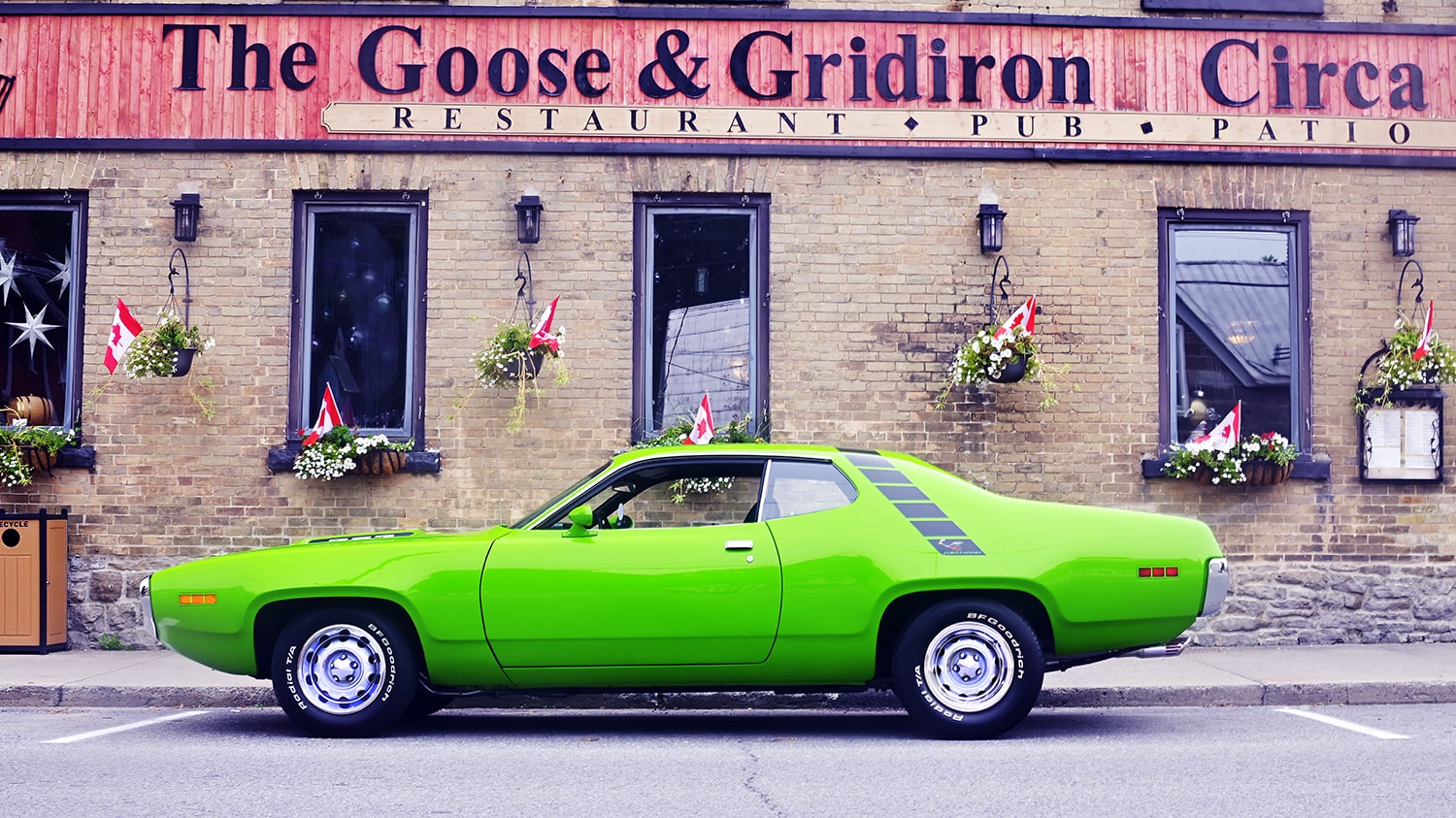
“For about two months, I looked all over Canada and the US for an orange 1970 Road Runner 383, 4-speed but there were none to be found. There were a few that needed a total restoration, and at my age (70), I really didn’t want to spend that much time on a car before I could actually drive it. I wanted something that was at least a daily driver that I could fix up and enjoy at the same time. That’s when I saw the ad for Larry Dagenais’ Road Runner in LaSalle, Ontario. I jumped at the opportunity.” What is so uncanny is that Mike was never keen on the body style of the ’71 Road Runner, but the neon green was like a magnet, gravitating his attention. “It was the same sassy grass green as my Duster with the same engine proportions,” Mike comments emphatically. Once he saw the car, he knew he wanted it. “Though the car was 17 feet long (2 feet longer than the Duster), it didn’t take long for that curvaceous body style to grow on me. Now, I actually like it better than the 1970 model.”
The ’71 Plymouth Road Runner, and its sister, the GTX, definitely were a departure from their predecessors, but one could argue these were the best B-Bodies to date. Its unconventional look was so far ahead of its time that the unbending Mopar enthusiasts of the era refused to accept it resulting in a polarization between the admirers from the detractors. Chrysler was well aware of this tug-of-war but its raison d’être was swayed by a growing public demand for a change: rounder, more luxurious cars with pop-up hoods, upholstered panels, and sleek consoles. The ’71 Road Runner answered their quest. The ‘fuselage’ body design had a futuristic imprint with its integral bumper/grilles, down-swooping curved panels and blending sail panel treatments. Styling feature lines gave the impression of the mid-body wrapping over the lower body.
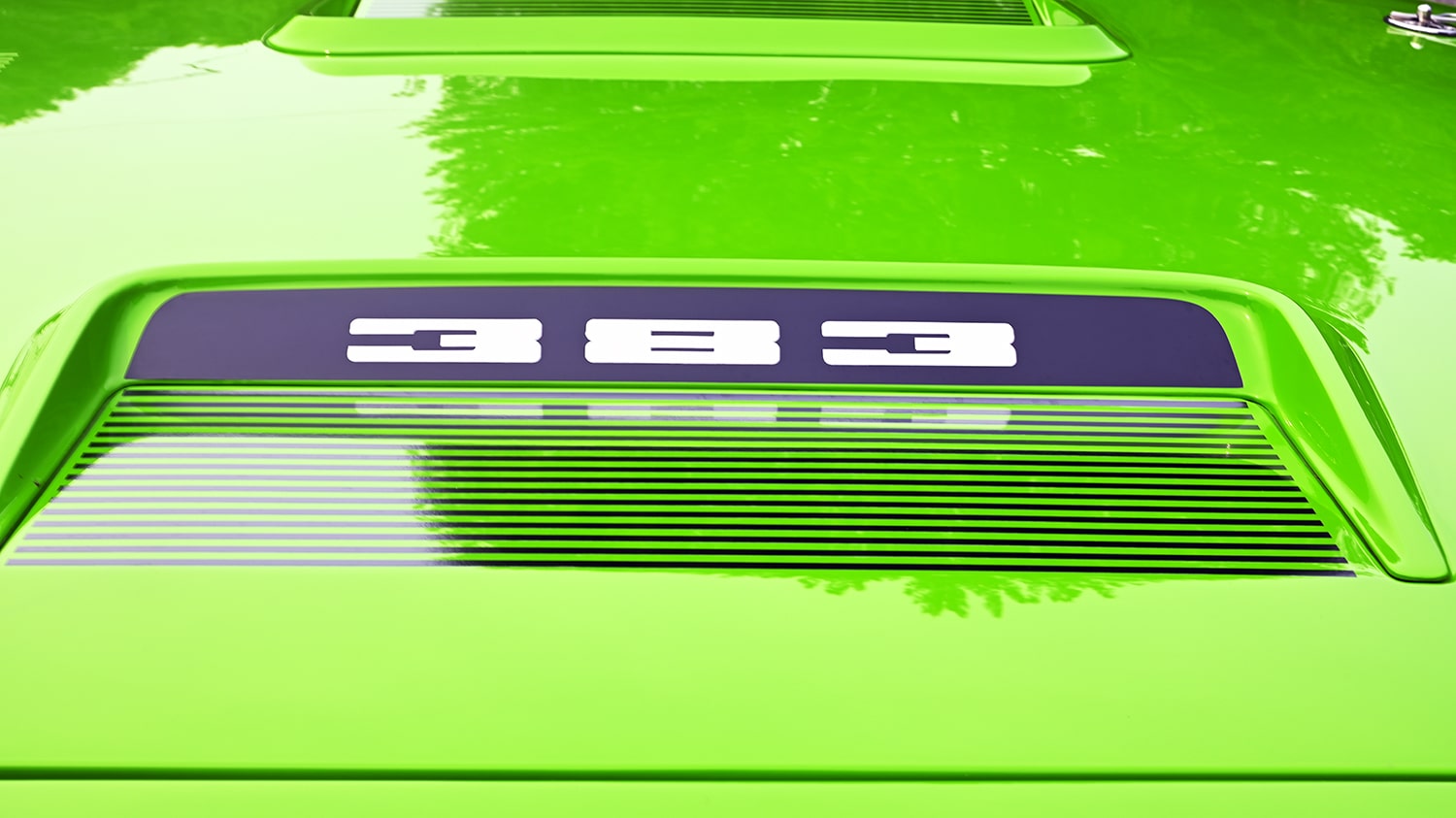
The Road Runner was equipped with floor-shift and heavy-duty shocks. The car is as deceiving as a burka. Under the hood housed 383 cubic inches of V8 high-performance with a 4-speed transmission, which doesn’t need much translation in terms of power. Its out-of-control, shaking hands-with-the-devil speed was the best kind of medicine. It advertises its imposing V8 magnitude like a billboard on the front fenders and hood scoops. Larry Degenais has owned Wet Paint Auto Painting in Windsor for over 45 years. “I give Larry all the credit for the body and paint,” admits Mike. “The car looked amazing and ran great when I first saw it. He replaced the front frame rails with ones he fabricated out of better and thicker metal, tied the frame rails together and added additional support in the quarter panels to strengthen the car. He said it took him a year-and-a-half to do the restoration and painted it “sassy grass green” because he had one that color when he was 18. He also had the original 383, 4-speed transmission refreshed and rebuilt, including porting and polishing of the heads.”
The engine had some light modifications, nothing too radical but quick enough to raise the proverbial eyebrow. Also included were a mild cam, Edelbrock 750 cfm carb and intake, Pertronix ignition system, and headers. In addition, it has a 3:91 sure-grip in the rear end, while the interior fashioning was the work from Year One.
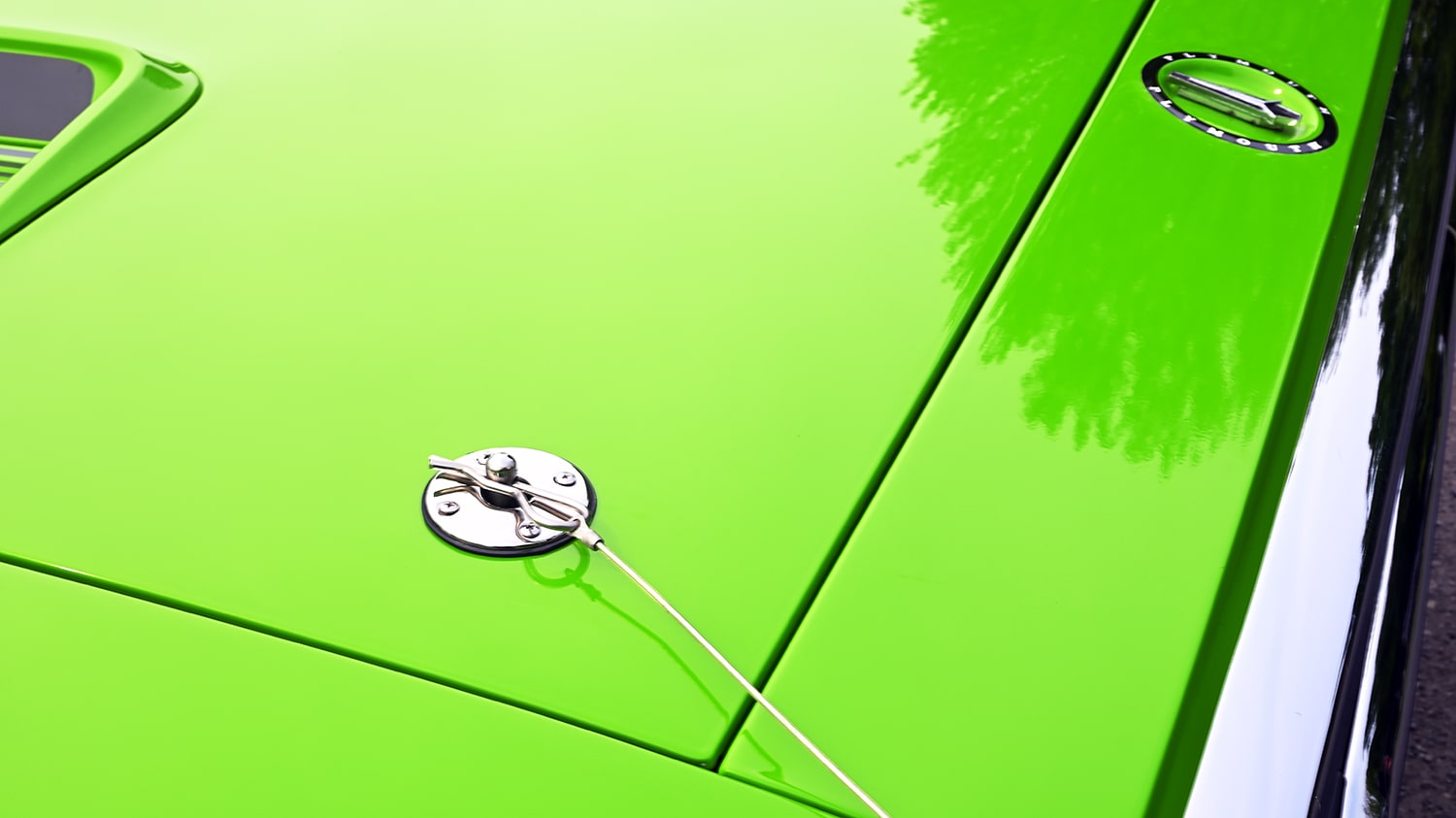
Since I purchased it, I’ve replaced the master brake cylinder, the rear axle seals, the float in the gas tank, the radiator, all the rear lighting, the ignition switch and numerous other things. I think my wish list for repairs was around 84 things, most of which I have now completed on my own. There are still a few things that need to be done to make it right for me. I managed to pick up a “new to me” dash that is in perfect condition to replace the old one that has a crack and I am looking for an original radio that I can send away to have retrofitted with Bluetooth and other accessories. I hope to install both of them over the winter,” Mike says with a confident tone in his voice. Of course, to add a little Tabasco sauce to the mix is the Plymouth’s rear wing and front spoiler package, giving the performance a little spice. Other visual points to whet the appetite are the hood tie-down pins, color-matching sports mirrors, and raised white-letter BF Goodrich Radical T/A tires.
“The best part about this car is that it’s an amazing car to drive. It surprisingly rides quite smooth and has plenty of power to move when I want it to, which is probably more often than I should.” Not bad for a car that is 53 years old and has clocked over 123,500 miles. “In fact, I really have to resist the temptation to open it up and see what it will do. Sometimes I forget that though, and find myself pushing it to its limit. Who could resist that? It’s too much fun. The other day, I was checking out gas mileage. The Road Runner gets about 14 miles per gallon. That’s as good as my new Ford truck,” Mike states. “The only real issue I have with it, which I believe is inherent to all old Chrysler products, is the lack of good grounds for the electrical systems. It seems I’m always fixing the ground somewhere. Oh, and air conditioning would be nice, too!” adds Mike as an afterthought. “But the real pleasure of owning such a car is being able to re-establish a few old friendships and meet many new people with the same interest.”
I ask Mike about the future of muscle cars. “I really don’t know what the future will be for classic cars with all the hype about carbon production and the pushing of EVs. It will be a sad day indeed if the government manages to follow through on its current agenda. I don’t want to get into politics but it will be interesting to see what the availability and price of gas will be in the next 10-20 years. I can’t imagine what will happen to all these beautiful cars. The only good thing is I probably won’t be around to see it. Maybe everyone should move to Alberta!” Mike hesitates momentarily. “The only thing I really know about restoring old vehicles is that if anyone is thinking about restoring one, or even just keeping a classic car in good condition, they better have lots of time, money and skills.” And as far as his Road Runner goes? “I will probably keep it forever unless someone comes with a crazy, ridiculous amount of money. I’m not really one to let things go once I have them. I prefer to keep them and look after them. So, I will spend part of every winter trying to make things better and every summer out cruising and showing it off.” And with that, I watch Mike drive off with a rumble that stops everyone in their tracks.
Click Here to Begin Slideshow
You know why cars are so expensive today? Digital components. And most, if not all of these digital components, we don’t need. They are a distraction. If something goes wrong digitally, everything follows. You can have its cheap glow, pesky chirps and diarrhea data spillage. Scrap away the digital nonsense and you could drop the price by half (or more) and still have a great car without a laptop for an engine. These days, it takes a computer to fix a computer. Digitalization is a curse. Insurance is more expensive because digital cars are so complicated to maintain and repair. The moment such a car is bought, it devalues dramatically. Digitization is convenient, but it doesn’t mean it’s better. And in the future, it will be A.I. cars.
Oh, what a joy. What are we thinking? I hate how convenience (mainly because we’ve become so lazy) has usurped common sense. This is why I admire cars like the 1971 Plymouth Road Runner. It is mesmerizing at first glance, powerful with a rumble reminiscent of Mount Etna about to erupt, and unique in its shape. If I were to modify it to today’s standards, I would design it. Hence, it’s wider (for balance), upgrade the interior, especially the gauges, upgrade the suspension and brakes (better roadworthiness), and possibly get better fuel consumption, but otherwise, I wouldn’t touch it. Some may say, in a smug response, that I’ve just retouched everything. Charles Kettering, former head of research at General Motors, once said: “People are very open-minded about new things – so long as they are exactly like the old ones.”
I reiterate I don’t think we need digital domination. To prove a point, Mike Bailey owned a 1970 Duster 340 for 36 years, clocking 110,000 miles. “I basically grew up in that car, raced hundreds of quarter-miles and had the time of my life,” he remembers. “Without a doubt, I had just about every nut and bolt out of that car at one time or another. I rebuilt the engine eight times and modified the car until I got it just the way I wanted it. It always ran strong and was well known in the Brockville area. I eventually sold it in 2009 and I still believe it was one of the worst decisions I ever made.” I doubt that having GPS, a movie screen, or Siri voice commands were essential criteria for Mike’s decision to buy. Since 2021, he has owned a 1971 Plymouth Road Runner. “The car’s appeal is easy: it’s pretty impressive to look at; it has a great stance; it’s a beautiful colour; it runs strong, sounds good and is a head turner almost anywhere I go. I’ve won some “Best in Class” awards at shows. Kids love it, too,” Mike confirms with a nod. But I think the real reason for choosing the ’71 Road Runner was an emotional one. “When I sit behind the wheel of this car, it takes me back to the ’70’s, when everything was about horsepower, fast cars and quarter-mile drag racing,” reminisces Mike. He would hang out with a group of friends who were equally enamored by speed: fast cars and drag racing. “Hanging out, having fun and bragging rights were a big thing back then. I know it’s all nostalgia, but that’s where my mind goes. I guess I still have some of that kid left in me.” The car was as popular as a mullet with skinny tires up front and fat rubber in the rear.
No matter where you drove, be it Carling Avenue or Van Nuys Boulevard, in the ‘70s it was all about cruisin’ the boulevards every Saturday night looking for some fast action. Bragging rights were king. Mike was a common sight at the dragway strip and few could beat him on the quarter-mile stretch. “One competitor was a friend, who sadly, passed away recently. He owned a “hemi orange” 1970 Road Runner with a 383, 4-speed. I remember liking his car, so I thought, when I looked for a car to replace the Duster, maybe I could find one like his, something different but also something I could appreciate as much as my Duster. Determined, I went on the search,” Mike says confidently.
“For about two months, I looked all over Canada and the US for an orange 1970 Road Runner 383, 4-speed but there were none to be found. There were a few that needed a total restoration, and at my age (70), I really didn’t want to spend that much time on a car before I could actually drive it. I wanted something that was at least a daily driver that I could fix up and enjoy at the same time. That’s when I saw the ad for Larry Dagenais’ Road Runner in LaSalle, Ontario. I jumped at the opportunity.” What is so uncanny is that Mike was never keen on the body style of the ’71 Road Runner, but the neon green was like a magnet, gravitating his attention. “It was the same sassy grass green as my Duster with the same engine proportions,” Mike comments emphatically. Once he saw the car, he knew he wanted it. “Though the car was 17 feet long (2 feet longer than the Duster), it didn’t take long for that curvaceous body style to grow on me. Now, I actually like it better than the 1970 model.”
The ’71 Plymouth Road Runner, and its sister, the GTX, definitely were a departure from their predecessors, but one could argue these were the best B-Bodies to date. Its unconventional look was so far ahead of its time that the unbending Mopar enthusiasts of the era refused to accept it resulting in a polarization between the admirers from the detractors. Chrysler was well aware of this tug-of-war but its raison d’être was swayed by a growing public demand for a change: rounder, more luxurious cars with pop-up hoods, upholstered panels, and sleek consoles. The ’71 Road Runner answered their quest. The ‘fuselage’ body design had a futuristic imprint with its integral bumper/grilles, down-swooping curved panels and blending sail panel treatments. Styling feature lines gave the impression of the mid-body wrapping over the lower body.
The Road Runner was equipped with floor-shift and heavy-duty shocks. The car is as deceiving as a burka. Under the hood housed 383 cubic inches of V8 high-performance with a 4-speed transmission, which doesn’t need much translation in terms of power. Its out-of-control, shaking hands-with-the-devil speed was the best kind of medicine. It advertises its imposing V8 magnitude like a billboard on the front fenders and hood scoops. Larry Degenais has owned Wet Paint Auto Painting in Windsor for over 45 years. “I give Larry all the credit for the body and paint,” admits Mike. “The car looked amazing and ran great when I first saw it. He replaced the front frame rails with ones he fabricated out of better and thicker metal, tied the frame rails together and added additional support in the quarter panels to strengthen the car. He said it took him a year-and-a-half to do the restoration and painted it “sassy grass green” because he had one that color when he was 18. He also had the original 383, 4-speed transmission refreshed and rebuilt, including porting and polishing of the heads.”
The engine had some light modifications, nothing too radical but quick enough to raise the proverbial eyebrow. Also included were a mild cam, Edelbrock 750 cfm carb and intake, Pertronix ignition system, and headers. In addition, it has a 3:91 sure-grip in the rear end, while the interior fashioning was the work from Year One.
Since I purchased it, I’ve replaced the master brake cylinder, the rear axle seals, the float in the gas tank, the radiator, all the rear lighting, the ignition switch and numerous other things. I think my wish list for repairs was around 84 things, most of which I have now completed on my own. There are still a few things that need to be done to make it right for me. I managed to pick up a “new to me” dash that is in perfect condition to replace the old one that has a crack and I am looking for an original radio that I can send away to have retrofitted with Bluetooth and other accessories. I hope to install both of them over the winter,” Mike says with a confident tone in his voice. Of course, to add a little Tabasco sauce to the mix is the Plymouth’s rear wing and front spoiler package, giving the performance a little spice. Other visual points to whet the appetite are the hood tie-down pins, color-matching sports mirrors, and raised white-letter BF Goodrich Radical T/A tires.
“The best part about this car is that it’s an amazing car to drive. It surprisingly rides quite smooth and has plenty of power to move when I want it to, which is probably more often than I should.” Not bad for a car that is 53 years old and has clocked over 123,500 miles. “In fact, I really have to resist the temptation to open it up and see what it will do. Sometimes I forget that though, and find myself pushing it to its limit. Who could resist that? It’s too much fun. The other day, I was checking out gas mileage. The Road Runner gets about 14 miles per gallon. That’s as good as my new Ford truck,” Mike states. “The only real issue I have with it, which I believe is inherent to all old Chrysler products, is the lack of good grounds for the electrical systems. It seems I’m always fixing the ground somewhere. Oh, and air conditioning would be nice, too!” adds Mike as an afterthought. “But the real pleasure of owning such a car is being able to re-establish a few old friendships and meet many new people with the same interest.”
I ask Mike about the future of muscle cars. “I really don’t know what the future will be for classic cars with all the hype about carbon production and the pushing of EVs. It will be a sad day indeed if the government manages to follow through on its current agenda. I don’t want to get into politics but it will be interesting to see what the availability and price of gas will be in the next 10-20 years. I can’t imagine what will happen to all these beautiful cars. The only good thing is I probably won’t be around to see it. Maybe everyone should move to Alberta!” Mike hesitates momentarily. “The only thing I really know about restoring old vehicles is that if anyone is thinking about restoring one, or even just keeping a classic car in good condition, they better have lots of time, money and skills.” And as far as his Road Runner goes? “I will probably keep it forever unless someone comes with a crazy, ridiculous amount of money. I’m not really one to let things go once I have them. I prefer to keep them and look after them. So, I will spend part of every winter trying to make things better and every summer out cruising and showing it off.” And with that, I watch Mike drive off with a rumble that stops everyone in their tracks.
Click Here to Begin Slideshow




Leave a Reply