



More playoff drama brings the format’s legitimacy into question yet again.
Foolishly, I thought we would be able to get through the last couple weekends of the 2024 NASCAR Cup Series schedule without any additional controversy. Given the year we’ve had, I’m not sure why I was expecting things to run smoothly. Before we dive into the meat and potatoes of the Chevrolet and Toyota situation, though, it’s important to give credit where credit is due.
It’s no secret that short track racing – which, in the Gen 6 era, was well on its way to becoming the most beloved aspect of the sport – has suffered badly since the introduction of the Next Gen car. NASCAR and Goodyear have been working hard on a solution for the short track package, and judging from last Sunday’s penultimate race of the season, they’ve landed on something good. The racing was incredible all day long, with passing, pit strategy, and good old-fashioned muscle having an impact on the quality of the race.
In the end, defending Cup Series champion Ryan Blaney punched his ticket to Phoenix with an incredible drive that reminded everyone watching why he was a champion in the first place. In addition to his grit, determination, and skill behind the wheel, Team Penske has proven time and time again that they know how to execute when it really matters. However, all of the goodwill that NASCAR may have garnered with the great racing throughout the day was undone by the actions of the Chevrolet and Toyota drivers in the waning laps of the race.
As they ran, Christopher Bell and William Byron had the most playoff points of drivers who hadn’t won. With Blaney – who had been comfortably below the cut line heading into last weekend – leading comfortably, it was clear that only one of these drivers would advance. With just a few short laps to go, these two drivers were separated by just a handful of points. Bell was trapped a lap down, unable to gain much ground, but Byron was struggling mightily. As he gradually gave up track position, it seemed like Bell would point his way in. However, as the #3 of Austin Dillon and #1 of Ross Chastain made it to Byron’s rear bumper, the rearward momentum seemed to stop, despite traffic stacking up behind them. It was clear to anyone watching that these two Chevrolets were effectively blocking for Byron to ensure that at least one Chevrolet would make it into the Championship 4.
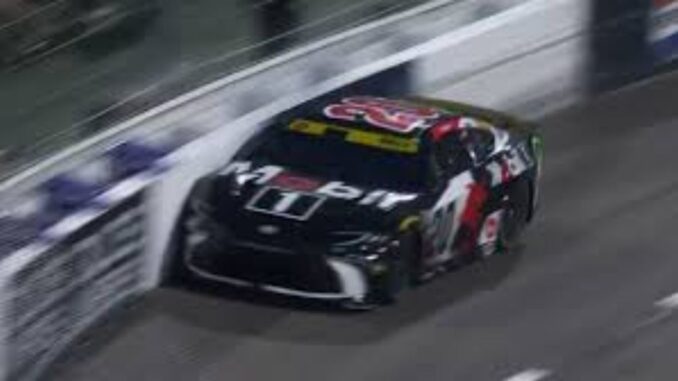
At the same time, the #23 of Bubba Wallace, also one lap down, told his spotter that he had a tire going down, and faded quickly. This allowed Bell to pass Wallace, gaining one spot – and a one-point lead above the cut line. However, to pass Wallace, Bell overcooked it into the corner, resulting in a wall-ride situation eerily similar to Chastain’s famous – and now outlawed – “Hail Melon” maneuver. Eventually, NASCAR would rule against the move, despite the fact that, unlike Chastain’s move, Bell collided with the wall mid-corner and drove away.
This would lock Byron into the playoffs, but it raises questions about the contrived nature of the playoff system. There’s no secret that the NASCAR playoffs were implemented to manufacture excitement for the fans. However, most fans find the playoff system to be confusing and nonsensical. Ironically enough, the season wins leader, Kyle Larson, won’t have a shot at the championship, despite wining twice as many races as the next winningest driver. That’s controversial enough on its own. More controversial, however, is the fact that both Toyota and Chevrolet colluded with drivers and teams to change the outcome of the race. This is blatant cheating, and blatantly wrong – but blatantly incentivized by this insane playoff format.
I can’t tell you if I’ve met a single fan who favors the playoff system, let alone one who could explain how it works to an outsider in 30 seconds or less. NASCAR has already penalized the teams involved, but it might be too late. In many fans’ eyes, the playoffs are just getting worse and worse every year with no end in sight. How long will these fans stick around?
Image: Speedcafe.com
Leave a Reply