





![[Gallery] Mecum Kissimmee Auction 2026](https://www.racingjunk.com/news/wp-content/uploads/2026/03/DSC_0717-e1774629242515-376x206.jpg)
![[Gallery] Cruisin’ One Daytona](https://www.racingjunk.com/news/wp-content/uploads/2026/03/DSC_0538-e1774027057404-376x206.jpg)
John Lepage's 1967 Pontiac Le Mans: A class of its Own
Names. What’s in a name? There are names that could lead a generation and names given that could lead to years in therapy. Take car names. I’ve often enjoyed thinking of new car names, such as Current for the next small EV, or Thrust One for some amphibious military vehicle that can scale desert sand dunes and crush small towns. It would also replace Air Force One. Perhaps Suzi Q for the latest Mini, Fiat, or Miata because it sounds cute, sassy and fun.
Most car names, that aren’t based on acronyms, are usually related to the car company’s founder or country of origin. Aston Martin, for instance, was inspired by founder Lionel Martin and the town of Aston which held the Aston Hill car races. Rolls-Royce combined its two founders, Charles Stewart Rolls, a wealthy motorist and aviator, and engineer, Henry Royce. Other obvious names are Henry Ford, Louis Chevrolet, Enzo Ferrari, Soichiro Honda, Ransom Eli Olds, André Citroen, Louis Renault, and Dunbar Buick. For the more unconventional marques, some are affiliated with family ties. The name Mercedes-Benz was an alliance between one of the company founders, Emil Jellinek, whose daughter was called Mercedes, and Karl Benz, who was the architect behind the company in 1883. Ford’s Edsel was named after Edsel Bryant Ford, the son of company founder, Henry Ford, honouring Edsel as the company’s former president and heir who unexpectedly died in 1943 at a relatively young age.
On another note, there are the euphemistic titles that give a car its persona, such as GT (Gran Turismo), an Italian phrase for “Grand Touring”. It articulates high-performance, luxurious automobiles designed for covering long distances in comfort and style. John Delorean, chief executive and engineer at Pontiac, and reputedly the “father of muscle cars,” needed a name for his latest Pontiac (the Pontiac Tempest/LeMans were already in the market), chose GT (part of the GTO acronym for Gran Turismo Omologato) as a prestigious marque to elevate the reputation of the Pontiac brand and to homologate the muscle car species. The marketing scheme was conceived by using a performance-oriented, European-sounding name to give the next Pontiac a more daring, dashing dynamic for the youth market than just another American car. Based on the Ferrari 250 GTO sports car, Delorean, one to always contravene the rules, capitalized on trademarking the GTO moniker since it had not been done in the United States by Ferrari. This infuriated Ferrari but there was little they could do legally. It certainly gave the Pontiac GTO panache even though I couldn’t really imagine driving such a long and muscular vehicle along the mountainous Amalfi coastline. It was more suited for infinitely straight desert highways that vanish into the heat waves.
If that wasn’t audacious enough, it is important that a name represents the product precisely. I’m thinking of the Pontiac LeMans. Named after the rural French town of Le Mans that houses the most renown endurance race. Can you imagine this Pontiac mastering such a feat by enduring harrowing speeds with the agility to navigate a multitude of curves and corners for 24 hours? Muscle cars, with the exception of those that raced in the CAN-AM series, felt more comfortable at the drag strip emitting power that Cape Canaveral would envy. Though the Pontiac LeMans didn’t have the same bragging rights as its bigger brother, the Pontiac GTO, it was a bit like comparing The Archies’ Betty with Veronica, but it was a good cruiser with comfort, style, handling and enough speed to raise the proverbial eyebrow. Considering that it is categorized as a muscle car, as it is known now, the first LeMans had engines straight out of an economy car, but that wasn’t a deterrent for it was the most popular mid-size Pontiac in 1967, selling just under 80,000 units.
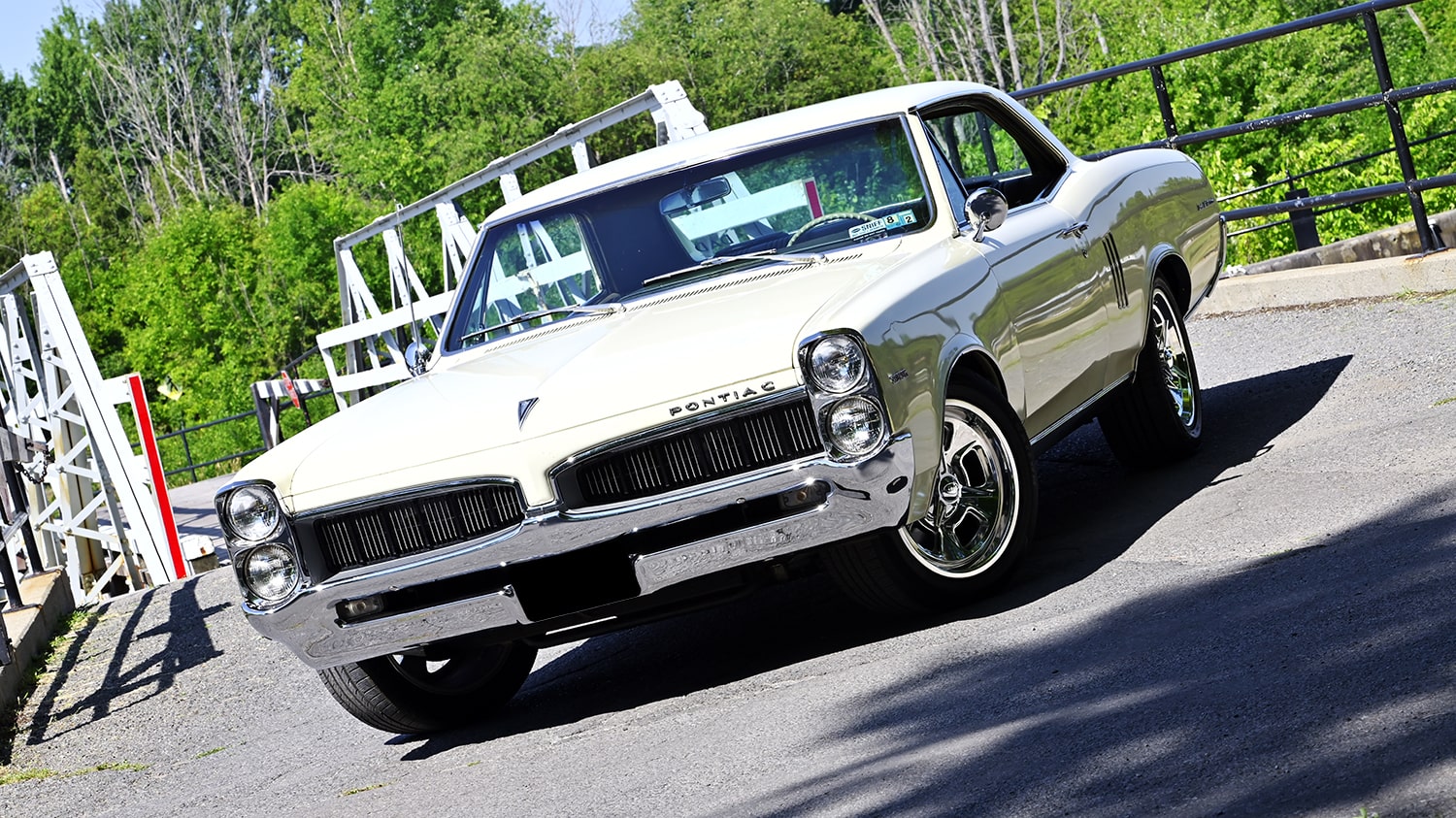
It wasn’t until 1965 that the LeMans incorporated a more flamboyant and intrepid look. And by 1967, the look became almost menacing garnering stacked headlights, a peaked “eagle” nose, clean unadorned sides, judicious use of chrome, a tail worthy of the sculptured nose, and a cohesiveness that would rarely be achieved again. Sharing a platform with the Chevrolet Chevelle and the Olds Cutlass, it allowed the LeMans access to a wide array of engine options, including V8s and transmissions. Buyers had a field day. John Lepage has an original Montego cream-coloured 1967 Pontiac 326 cubic inch V8. It is accompanied with a Rochester 2-barrel 250 hp engine which runs like a sewing machine. “I have always liked the ‘coke bottle’ shape and the stacked headlights,” announces John about his 2-Door Hardtop. “The moment I sit behind the wheel, my immediate thoughts are how proud I am of the car and what it looks like. I just wish that my dad was still alive to be in the car with me. He was the one who influenced me.” In fact, John’s daughter made a sticker that was placed in the back window in memory of her grandfather. When John looks in the rearview mirror, it still reads ‘Dad’. There is something reassuring about it, and as John puts it, “I feel that he is always riding with us.”
When John bought his LeMans in January 2011 after seeing it on Kijiji two months prior, the car had only eclipsed 23,500 miles. “Unfortunately, I wasn’t able to meet up with the owner. The advertisement was taken down but luckily reappeared online on the day of my birthday in January,” remembers John. “What is so desirable about the LeMans is that there aren’t many left. There are many GTOs, but not LeMans. It’s a fun car to drive and easy to work on. If there is a con, it would be the headlights. There is no comparison to the headlights of today’s cars. I try to avoid driving at night because of this.” John made arrangements with the owner to go see the car in storage in Bowmanville. “The car was in excellent shape when I bought it with only a few patina marks here and there.” Pretty amazing when you consider that it is a almost 35 years old.
John’s car did a Mille Miglia sort of trek of ownerships. Built in March, 1967 in Kansas, the LeMans was registered in Meza, Arizona, only to be later registered in Texas when the first owner moved there in 1982. The car ended up in Whitby, Ontario with the second owner who purchased it in mid-2000. Eleven years later, it settled with John in Ottawa. Not one to avoid hard work, John got his hands dirty with his project. “The car was in good running condition when I bought it. I removed all of the 1967 undercoating and re-painted the under carriage (that was a dirty job).” A nice feature is that the A/C still works today after John repaired it in 2012. “I installed a bigger front sway bar and rear bar.” John also upgraded the disc brakes with Wilwood products in the front to get rid of the antiquated four drum system for more reliable braking. “I changed the exhaust and cleaned up the engine bay. New wheels and tires have been replaced this year.” Always one to be curious, John is consumed by how things work. “I always enjoyed taking stuff apart, rebuilding and repainting things. Bikes, cars, you name it. As a kid, I had to make my toy vehicles a little different and personalize them. By 12, I was helping my dad on cars. I can remember changing the oil on my dad’s ’69 Impala.”
The 1967 Pontiac LeMans stands as a testament to American automotive ingenuity, a vehicle that seamlessly blended muscle car brawn with the elegance of a sedan. “It drives like a dream. Smooth and comfortable. Surprisingly, it holds the corners on curvy and winding roads. I absolutely love it, especially since I updated the brakes as the old drum brakes would lose their effectiveness once heated up,” John remarks. When he looks at kids today, he hopes that the future generations will continue to be attracted to “classic” cars sixty years from now. “Of course, back in 1967, I’m sure many people thought the same about the cars of their era. By the time they reach my age, they will be sentimental about the cars they grew up with. But I can tell you that the pleasure in driving an old vehicle, that still turns heads, is unique. I love receiving a ‘thumbs-up’ from complete strangers. Also, being able to work on the vehicle and not having to deal with computers is a relief. Old school rules. I have driven a few electric cars, and I must admit, am not a big fan. I believe they will get better with time, but currently, they are not for me.”
The 1967 Pontiac LeMans remains an enduring symbol of an era when cars were as much about personality as they were about transportation. It’s a vehicle that offers a glimpse into a pivotal moment in automotive history - a time when power and poise went hand-in-hand on America’s roads. As for the generational shift, it means the hobby (car restoration or collecting) is evolving, not withering. “Few people who are 75 are adding to their collections, more likely they are selling. The median age to today’s hobbyist is in the upper 50s. That’s the bad news,” suggests Dan Feeney, publisher of the Hagerty Price Guide. “The good news is, if you go to cars-and-coffee gatherings in the suburbs, the median age is in the 30s. And they are talking about Ford and Chevrolet performance cars from the 1980s. Cars that caught their attention when they were kids.” If John is to give advice to those interested in restoring a classic car, he recommends picking something within your abilities to repair and to understand the costs incurred. “Some people can get in over their heads with both. It’s not as easy as it looks, and finding and purchasing replacement parts can be a challenge.” But the rewards are worth hanging on to. It must be for his odometer already reads almost 36,000 miles on it. It’s been a good ride.




Leave a Reply