





IMSA celebrated its 50th year of operation in 2019, after producing five decades of sports car competition that gave the group nascent credentials around the globe. Begun by “Big Bill” France, together with John and Peggy Bishop, they enticed the best sports car drivers, teams and manufacturers to join them on their journey. Today IMSA is a powerhouse in its chosen arena and has tentacles that reach worldwide.
It’s appropriate, then, for this sanctioning organization to promote a Hall of Fame. The first class of inductees was announced once IMSA’s WeatherTech SportsCar Championship completed its season at Michelin Raceway Road Atlanta in Braselton, GA in mid-October. IMSA held its 26th annual Petit Le Mans, which initially was either a 10-hour or 1,000-mile contest, now held strictly as a 10-hour enduro, less than half the length of the French Le Mans race for which it is named.
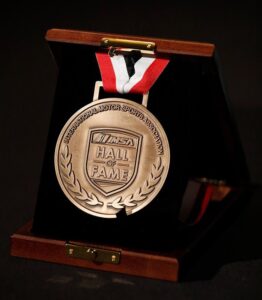
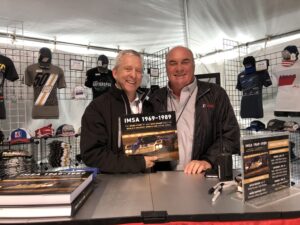
In naming its first Hall of Fame, IMSA went to its familial past, and the Bishop and France families, initially naming John and Peggy Bishop, together with Bill France Sr as initial inductees. Jim France, the son of “Big Bill” and Anne France recalled how much his parents loved sports car competition. “When my dad designed Daytona Speedway,” he said, “he put a road course in there. He named it the Daytona International Speedway when, in 1959 there was nothing international about NASCAR,” the France family’s first racing endeavor.
John Bishop had been executive director of the Sports Car Club of America (SCCA) which was producing both amateur and professional events. Bishop wanted the professional events to take precedence and was met with disagreements. He left that post and was invited to Florida by France Sr., to “drink some scotch, smoke some cigars and go fishing,” said Bishop’s son Mitch. “They didn’t do any fishing, but when he got back, he was excited.” France offered to provide financing if the Bishop family ran the operation, which they did for 30 years, from top to bottom with the aid of their children.
Some of its most successful drivers and cars were also placed on the Hall of Fame pedestal: the late Peter Gregg and Hurley Haywood, who teamed to drive for Brumos Racing in a variety of Porsche cars. While Gregg died in 1980 by suicide, Haywood continued racing until his 2012 retirement and is a five-time Rolex 24 at Daytona victor. Well after Haywood attained that rank, Scott Pruett earned a fifth Rolex 24 at Daytona watch for his five overall victories, making this duo stellar drivers in the mid-winter classic.

Al Holbert, the Pennsylvania Porsche specialist was able to race most any type of car, successful in IMSA, NASCAR and finishing fourth in 1984 Indianapolis 500. Holbert, too, is recognized in this initial Hall of Fame class. He is widely regarded for having earned multiple victories in the informal sports car “Triple Crown” of the Rolex 24 at Daytona, Mobil 1 12 Hours of Sebring and 24 Hours of Le Mans. Holbert recorded 49 IMSA wins before perishing aboard his privately owned plane, shortly before his 42nd birthday in September of 1988.
IMSA is recognizing some of the racing cars that put it on the map during its first 54 seasons of competition. The star of IMSA’s first Grand Touring Prototype (GTP) era, the Porsche 962 is one of four cars that made the first inducted class in IMSA’s Hall of Fame. The winner of 54 of 148 1980s-era GTP races, this Porsche model secured five Rolex 24 at Daytona wins and three consecutive driving and manufacturer championships with drivers Holbert and Chip Robinson. “The relationship with Al Holbert was absolutely important,” said Alwin Springer, one of the founders of ANDIAL, the firm that’s prepared Porsche race cars since the 1970s. “With him, on the chassis side, on the management side, on the driving side and on the engineering side – and ANDIAL on the engine side – it was a perfect combination.”
As the initial GTP era ended and IMSA morphed to the World Sports Car racing, Ferrari’s 333 SP brought the scream of the marque’s V-12 Formula 1 engine to resonate around the walls and hillsides of the tracks where IMSA raced. As IMSA senior director of competition Mark Raffauf noted, “The sound, the noise, the design, the impact of it everywhere we went was just phenomenal. The car worked and won right out of the box. It won all the way well into the early 2000s. It was a magical piece of equipment,” he said. “It was beautiful!”
It was the Chevrolet Corvette C5-R that in 1999 brought Corvette Racing into the IMSA fold, a reign that ended at this year’s Petit Le Mans with the C8.R competition coupe. Over six years, Corvette’s C5-R won 31 races and finished on podium 50 times in 55 contests. In its Le Mans GTS class, the C5-R won the 24 Hours of Le Las in 2001, finishing 1-2 in class. “The C5 was born to race,” remarked Herb Fishel, the longtime executive director of GM Racing. “The aerodynamic features, the hydro-form frame rails gave it a stiffness ideal for a race car. And, of course, it had power by the most universally-tested racing engine in the world: the small-block Chevrolet V-8.”
It’s no accident that specialty ear plugs were developed around the same time Mazda’s RX-7 GTU race car was running in IMSA during the 1980s. Mazda introduced the RX-7 during the Rolex 24 at Daytona in 1979 and the car was a loud winner right off the truck. This was the car that gave Scott Pruett his initial racing successes and he cited the RX-7 for being, “affordable and reliable, more so than anything else. Especially as a young driver working his way in,” Pruett said. “You couldn’t over-rev ‘em, you couldn’t hardly hurt them, they were durable, they were affordable, a lot of teams had them.”
Now that it has launched its Hall of Fame, IMSA will conduct its 55th season of competition, beginning with the 62nd Role 24 at Daytona on the 27th and 28th of January, 2024.
Leave a Reply