




![[Gallery] Mecum Kissimmee Auction 2026](https://www.racingjunk.com/news/wp-content/uploads/2026/03/DSC_0717-e1774629242515-376x206.jpg)
![[Gallery] Cruisin’ One Daytona](https://www.racingjunk.com/news/wp-content/uploads/2026/03/DSC_0538-e1774027057404-376x206.jpg)
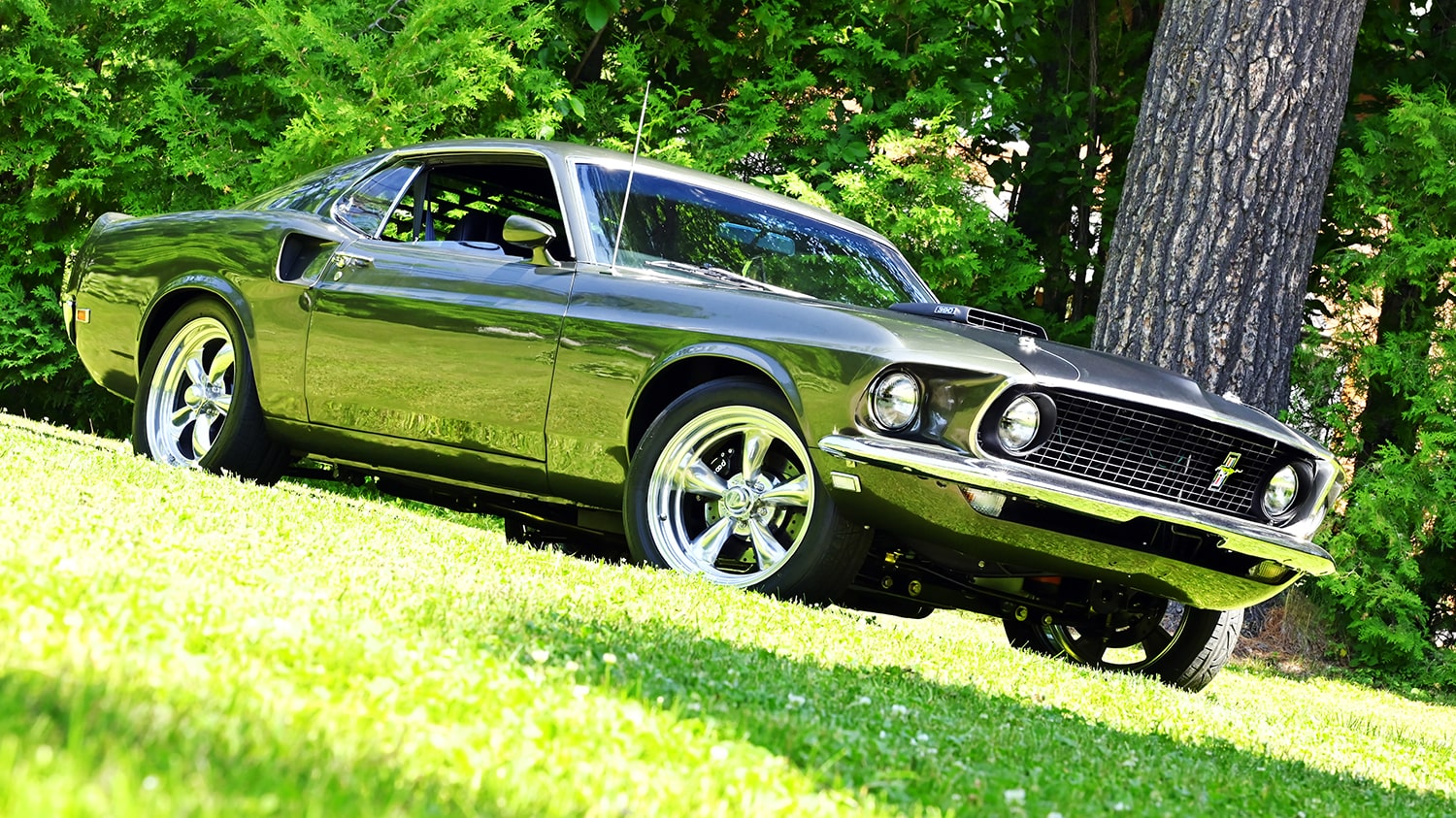
Glen Hagar's 1969 Mustang Mach 1 390 S-Code
Click Here to Begin Slideshow
It’s quite remarkable how an amorphous-shaped piece of metal can be curved, stretched and pounded into sculptured art that can cause divorces, get dates, scare the local pets, infuriate the police, inherit praise, change laws and insurance, and institute itself as an American icon. I’m talking about the muscle car. In 1969 Ford Mustang maintained its reputation with a gallery of striking examples of unquestionable speed and performance. Ford hit an all-time high of eleven optional engines from the standard six-cylinder to the colossal 428 Cobra Jet big-block. One of the more impressive versions was the Mach 1, an appropriate name that replaced the snivelling GT as the new boy in town. Only a meagre 5,396 1969 GTs were built, and as a result, it would be 13 years before the GT’s emblem emerged on the side of a Mustang.
At Ford, 1969 was ripe for subterfuge from the upper echelon down to the guy working on the assembly line. Vice-President, Lee Iacocca seemed the likely choice to inherit the reigns of president, but Henry Ford III was suspicious and felt threatened by Iacocca’s popularity in the company and unexpectedly recruited Semon ‘Bunkie’ Knudsen from General Motors. This was a first. To hire from the enemy was akin to treason. It almost caused a mutiny within the ranks. Bunkie, was initially given a sense of entitlement and immediately hired Shinudo, another GM specialist, as Ford’s principle designer. Although there was acrimony, few could argue how desirable Shinudo’s talent was when he unravelled the Mach 1 and the Boss 302 and 429. Though the team of Bunkie/Shinudo produced some of the most exciting Mustangs by expanding the car’s girth, length, prowess, and performance, Bunkie’s term only lasted 18 months. His lust for performance was understandable. Ford stood unchallenged as the leader of the pack, but by ’68/69 the company was sharing the pie with its competitors. Bunkie wanted to prove that Mustang could out-muscle anyone. The reasons for his dismissal were numerous. His actions were more empirical (he assumed the tire-melting, gas-guzzling muscle era would last forever), he didn’t have Ford’s integrated foresight (sales over performance), ignored the economy’s growing financial debacle (stratospheric insurance premiums and soaring gas prices), and worst of all, he showed a lack of reverence for Henry Ford III, which was akin to the Eighth Deadly Sin. Regardless of what Iacocca thought, muscle remained king of the road in ’69 and on the circuit. It was hard to beat Mustang during the late 1960s through to the mid-1970’s in the Trans-Am series - a key series in selling American muscle.
As for the Mach 1, underneath the menacing matte-black hood was a 351 cid V8, a small-block engine with 250 hp standard, but Glen Hagar felt deprived. This wasn’t quite what he wanted. He saw an ad in Kijiji and couldn’t believe it. “I was looking for a car that was rarer than a 351 Mustang and noticed a 1969 ’S’ code 390 Mach 1 for sale in the Greater Toronto Area (originally sold by Bonaventure Ford in Hull, Quebec). There was a little over 10,000 ’69 ’S’ coded Mustangs, making it rarer than a ’69 428 car. “I have read that Ford sold zero 1970 Mustangs with the 390 as it was no longer offered though it was still being used in their trucks,” mentions Glen. “The reason this particular Mach 1 was being sold was because it was completely rotted out,” continues Glen. “The only thing keeping the seats in place was the rug. In the end, about all that I could salvage from the original car was the roof, outer rockers, upper Cowell, and the Dutchman panel. The car had 97,000 miles advertised on its odometer, and god knows if that was accurate.” What raises the preverbal eyebrow is its ’S’ code. This was a designated package for a powerful 390 cubic inch (6.4L) V8 engine; a potent big-block option that made the Mustang a true muscle car. Rare and collectible, the package was often found in the GT or Mach 1 trims from 1967-1969, prized for its combination of high performance and upscale features. Before you had a pop-gun, with the ’S’ code, you now had a cruise missile.
As Glen recounts the car’s history, its longevity started with its birth in Metuchen, New Jersey in 1969 and did a circuitous journey throughout Ontario. “The first owner was based in Mallorytown, Ontario and used the car as a daily driver to commute from his town to Montreal - a 2.5 hour drive each way! Over the years, the car, pock-marked with rust, had been parked for ten years before being sold (in 1979). The next owner kept the Mach 1 and later bought a ’66 Mustang convertible to add to his existing collection of Mustangs. The eldest of two sons received the Mach 1. Though the car ran well, they only put a few miles on it by driving around the farm; otherwise, it sat in solitude in a barn for about 30 years. Though the barn was damp without much air movement, it wasn’t as bad as being left outside with his other Mustangs where they slowly deteriorated from the natural elements,” says Glen shaking his head. “The sons finally decided to sell the Mach 1 since neither of them wanted to restore it. By now the car was about as attractive as an abyss tooth. “A family friend convinced them to sell it to him claiming he was going to do a complete restoration only to later discover that the family friend had the car for sale on Kijiji. I bought the car in 2019 and told the son that I was planning on restoring it to its full authentic look,” explains Glen. “I was interested in the history of the car and, if he liked, that I would send him photos during the restoration. He seemed pleased with the fact that I was going to restore the car and showed enthusiasm to stay updated.”
“I’ve had a few Mustangs growing up, but the 1969 Mustang fastback was always my favourite model; the four headlights, the rake of the windshield, and the wide chunky quarter panels with scoops were irresistible to me. It just looked aggressive and sexy. Arguably the nicest of all Mustangs.” It’s uncanny, but Glen can’t think of anyone in particular that got him keen on cars. “It was more of an event, actually,” he confesses. In 1965, I was with my father at McPherson High School in Vancouver. There was an orange ’65 Mustang fastback with a black interior that held my eye. The car was married to a manual shifter sticking up through the rug, accompanied by a pair of bucket seats. It was the coolest thing I had ever seen.” One who has always loved building, Glen informs me that as a kid he would assemble anything from gas model airplanes and rockets to GoKarts. Gradually his fascination proceeded in repairing cars, more out of necessity because he couldn’t afford to pay to have his car repaired. “I worked as an industrial millwright which taught me to study equipment more closely before disassembly, such as taking notes, measurements, and photos. You also needed to be able to stick some metal together with a welding machine. Though I’m not a welder, I learnt a valuable skill.” Not one to shy away from hard work, Glen has owned and improved other classics, including a ’59 MGA, a 1967, ’69 and ’70 Mustang, a 1968 Firebird convertible, and a 1972 Datsun 240 Z, but he restored his 1968 and 1969 Mustangs. “I am currently working on a 1952 Mercury short-bed pick-up, a 1969 Boss 302 and, of course, final touches to my ’69 Mach 1 - my favourite of the bunch. This one is a keeper.” My oldest and dearest friend, Debbie, helped me restore the ’68 Mustang, but tragically passed away at the youthful age of 55 just before I started restoring my Mach 1. She learnt how to weld by watching me. Her loss was devastating. I know she would have enjoyed seeing the entire restoration and for us to go together on numerous rides,” says Glen remorsefully.
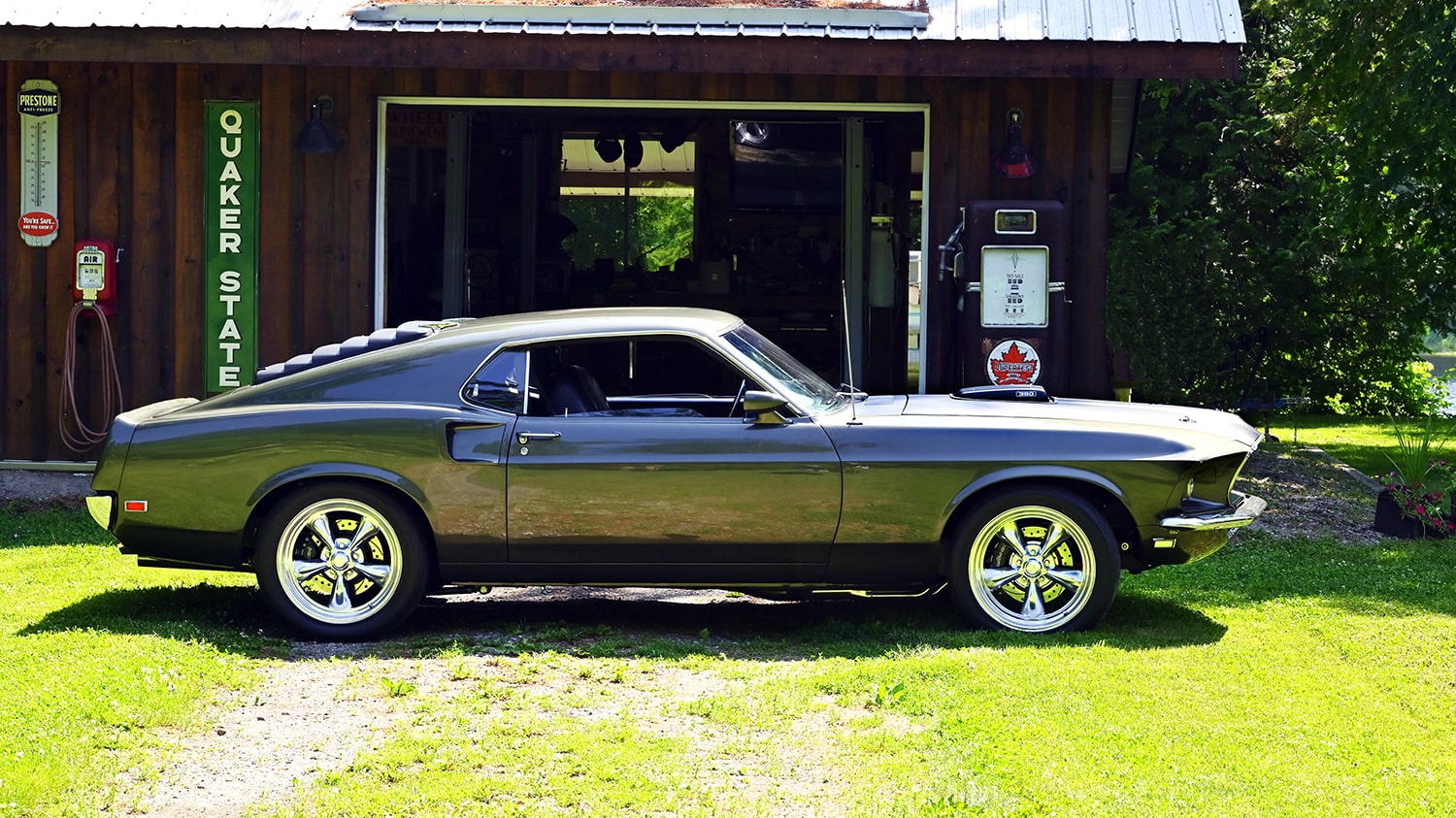
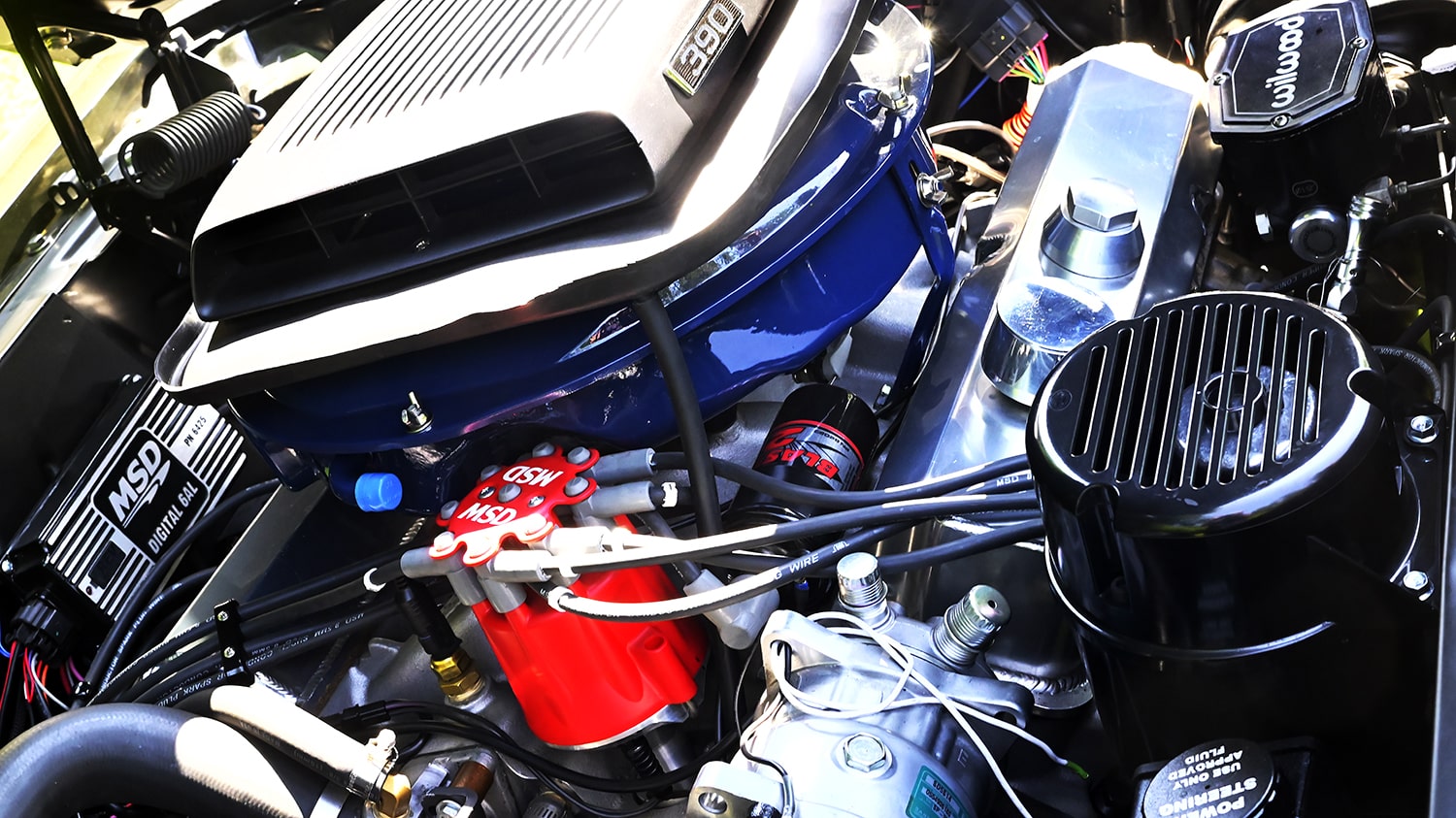
Ford’s ’69 Mach 1’s design had the roof lowered with a more expressive rear spoiler, side scoops derived from the Ford GT40 race car, unique reflecting stripes and Goodyear Polyglas GT tyres with sexy embossed white lettering. Accessorized with NASCAR-inspired hood latches that reinforced the racer’s edge, it gave the impression of a car that could be driven placidly to the supermarket or aggressively flat out down the drag strip. It was also adorned with a simulated hood scoop while racing mirrors housed in body-coloured fairings to cheat the wind. Dual exhaust tunnels emerged tantalizingly as though about to spit out flames, and a grille that furnished inserted lights. The quad round headlights were only incorporated for the 1969 models. The rationale behind the Mach 1 was to qualify for both NASCAR and Trans-Am racing. There was a prerequisite ordained by a racing committee, such as NASCAR, that the car manufacturer had to produce 500 replicas for the public (without the extreme performance adjustments and roll-bars) in order to qualify for any race series. Having met these requirements, needless to say, Ford produced the most powerful Mustang, at the time, in the 429 hemi-head V8. But it was the Mach 1 that ignited a public surge for the new Ford. This was a very different beast with the two-barrel 351 ci (5.7-litre) Windsor V8, with a four-barrel 351 and the 390 and 428 Cobra Jet engines as options. It was the year of the new ‘shaker’ hood in which a scoop mounted to the air cleaner protruded through a hole in the hood and vibrated ominously with the engine. The 390 used the ‘shaker’ scoop plus a modified crankshaft and stronger connecting rods for better high-rpm durability, as well as an engine oil cooler that decreased the lubricant temperature by 30 degrees. This car could spin the wheels in fourth gear. According to Car and Driver magazine, if there was any default, it was that there was too much weight over the front wheels and caused noticeable understeer. All this conjecture didn’t seem to bother customers who bought over 70,000 units during its debut year.
It took four years to restore the car, but with the help of a couple of neighbours, Linda, Pauline and Mike. They stripped the car down to its birthday suit - in this case, bare metal bones. “I did all the metal work at home in my shop”, admits Glen proudly. To stress a salient point, when restoring, everything has a domino effect, so you have to have enormous patience. Glen decided at that point to change direction and cut out the shock towers to install a rack-and-pinion crossmember with coil overs. “Now it drives like it’s on rails since I don’t have to wrestle with an archaic 50-plus year old steering mechanism.” What Glen did in restoring the car sounds as complex and exhausting as listening to an IBM seminar on tax files. He primed with base and clear coats and painted both the underneath and the engine bay. “There was a ton of metal work to do: front frame rails, aprons and shock towers, radiator core support, front torque boxes, frame extensions, firewall, upper cowl, inner rockers, A&B pillars, full floor pan, transition pan and full quarter panels, just to name a few. I added new 31 spline axles and a centre section in the 9-inch differential with upgraded Willwood disc brakes. New leaf springs were required while the old rubber bushings became current Del-a-lum control arm bushings to achieve greater suspension control and performance.” To complete the portrait, rear window louvers had been added. It may obstruct a certain amount of visibility but added greater racy authenticity. “I remember I had to wait ages for new components to replace ancient ones,” recalls Glen. “It is agonizing.”
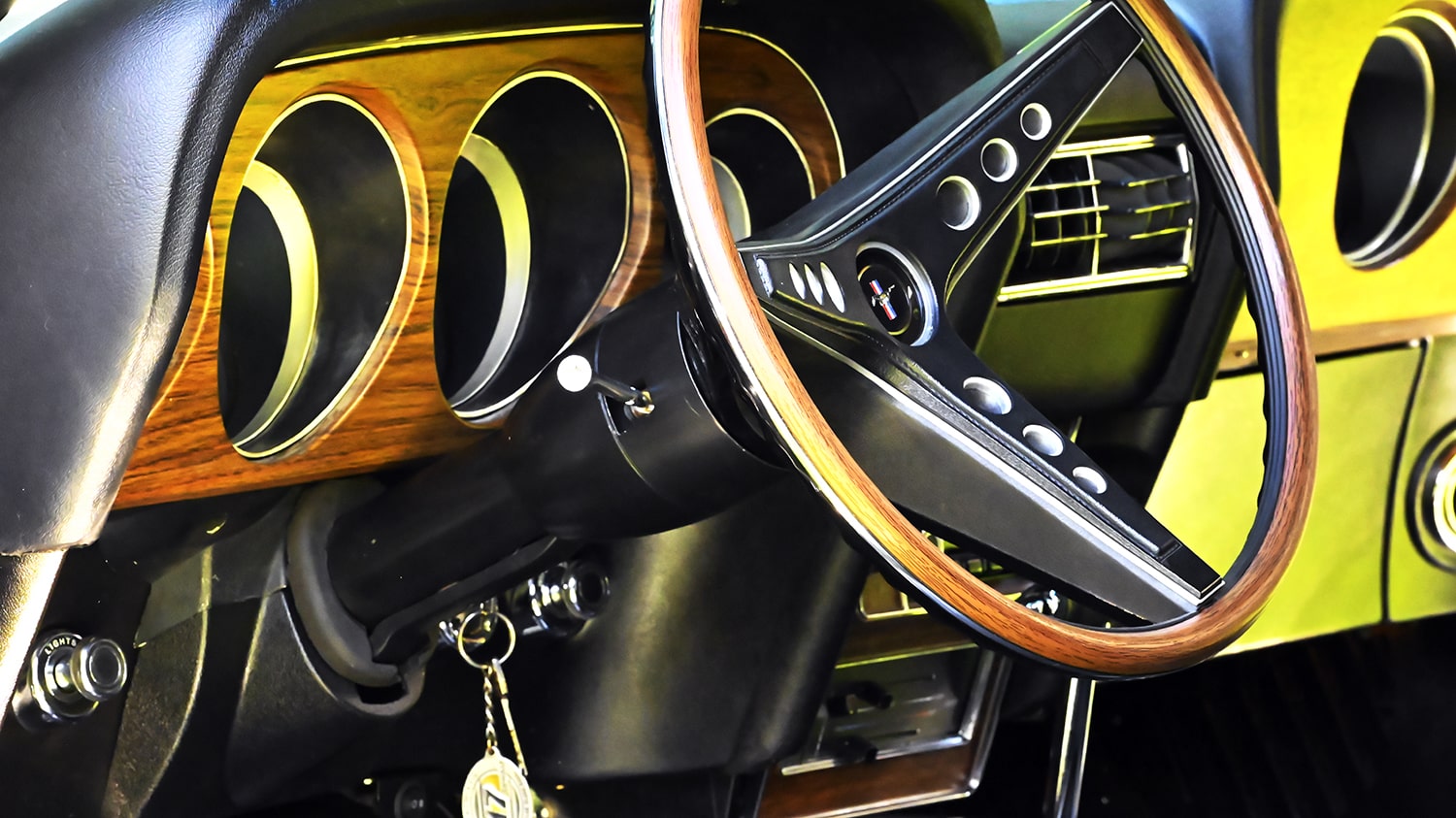
“Finally, I sent the car off to be painted a black jade - its original appearance. Upon its return, I assembled all the interior and installed the engine and transmission. I finished up with the under hood work, including Holly, sniper, American Auto wire, wiring harness, conical Dakota digital gauges, and vintage air. Four years of blood and sweat, but it drives like a track car.” The engine was built by Kirk Silbermann of Kawartha Engines. “Naturally, it hates holes in the road, but once on a strip of surface as smooth as a baby’s bottom, and with no interference from speed cameras, it’s just smiles for miles. Believe me, it has loads of power - 455 hp and 495 lb/ft of torque to be exact. If pushed it can hit 120 mph or zero to 60 in 5.7 seconds,” Glen says impressively. This is a prime example of what perseverance, skill and determination can achieve. “When the ignition is turned on to a stentorian sound, that is the reward for all those years.” When I first saw the car, I confess, I almost wet myself. It’s a piece of nirvana. If Glen’s happiness can be derived from simply gazing at it in his garage, you can understand how proud he gets when driving it.
“I don’t know what the future holds for classic cars,” comments Glen. “I do see some younger people at shows with vintage vehicles which is encouraging, but not the numbers that match the older crowd. I’ve also seen the past couple of years a number of young women bringing their classic cars to shows, which is overdue. However, if you plan on restoring a car, I would suggest that you find a car that is a personal favourite. If you are unable to do a lot of the work yourself, you should probably look for a vehicle that doesn’t require too much metal work. That becomes costly and you will be upside down pretty quickly. Some say it’s cheaper to buy one already done, but that’s subjective. It all depends on your objective and budget. If we can convince future generations to become interested in the cars from the 1960s, 1970s and even the 1980s, through film, car shows and comparisons, then they will have a continued future on the road. There is nothing like driving a classic.”
Click Here to Begin Slideshow
It’s quite remarkable how an amorphous-shaped piece of metal can be curved, stretched and pounded into sculptured art that can cause divorces, get dates, scare the local pets, infuriate the police, inherit praise, change laws and insurance, and institute itself as an American icon. I’m talking about the muscle car. In 1969 Ford Mustang maintained its reputation with a gallery of striking examples of unquestionable speed and performance. Ford hit an all-time high of eleven optional engines from the standard six-cylinder to the colossal 428 Cobra Jet big-block. One of the more impressive versions was the Mach 1, an appropriate name that replaced the snivelling GT as the new boy in town. Only a meagre 5,396 1969 GTs were built, and as a result, it would be 13 years before the GT’s emblem emerged on the side of a Mustang.
At Ford, 1969 was ripe for subterfuge from the upper echelon down to the guy working on the assembly line. Vice-President, Lee Iacocca seemed the likely choice to inherit the reigns of president, but Henry Ford III was suspicious and felt threatened by Iacocca’s popularity in the company and unexpectedly recruited Semon ‘Bunkie’ Knudsen from General Motors. This was a first. To hire from the enemy was akin to treason. It almost caused a mutiny within the ranks. Bunkie, was initially given a sense of entitlement and immediately hired Shinudo, another GM specialist, as Ford’s principle designer. Although there was acrimony, few could argue how desirable Shinudo’s talent was when he unravelled the Mach 1 and the Boss 302 and 429. Though the team of Bunkie/Shinudo produced some of the most exciting Mustangs by expanding the car’s girth, length, prowess, and performance, Bunkie’s term only lasted 18 months. His lust for performance was understandable. Ford stood unchallenged as the leader of the pack, but by ’68/69 the company was sharing the pie with its competitors. Bunkie wanted to prove that Mustang could out-muscle anyone. The reasons for his dismissal were numerous. His actions were more empirical (he assumed the tire-melting, gas-guzzling muscle era would last forever), he didn’t have Ford’s integrated foresight (sales over performance), ignored the economy’s growing financial debacle (stratospheric insurance premiums and soaring gas prices), and worst of all, he showed a lack of reverence for Henry Ford III, which was akin to the Eighth Deadly Sin. Regardless of what Iacocca thought, muscle remained king of the road in ’69 and on the circuit. It was hard to beat Mustang during the late 1960s through to the mid-1970’s in the Trans-Am series - a key series in selling American muscle.
As for the Mach 1, underneath the menacing matte-black hood was a 351 cid V8, a small-block engine with 250 hp standard, but Glen Hagar felt deprived. This wasn’t quite what he wanted. He saw an ad in Kijiji and couldn’t believe it. “I was looking for a car that was rarer than a 351 Mustang and noticed a 1969 ’S’ code 390 Mach 1 for sale in the Greater Toronto Area (originally sold by Bonaventure Ford in Hull, Quebec). There was a little over 10,000 ’69 ’S’ coded Mustangs, making it rarer than a ’69 428 car. “I have read that Ford sold zero 1970 Mustangs with the 390 as it was no longer offered though it was still being used in their trucks,” mentions Glen. “The reason this particular Mach 1 was being sold was because it was completely rotted out,” continues Glen. “The only thing keeping the seats in place was the rug. In the end, about all that I could salvage from the original car was the roof, outer rockers, upper Cowell, and the Dutchman panel. The car had 97,000 miles advertised on its odometer, and god knows if that was accurate.” What raises the preverbal eyebrow is its ’S’ code. This was a designated package for a powerful 390 cubic inch (6.4L) V8 engine; a potent big-block option that made the Mustang a true muscle car. Rare and collectible, the package was often found in the GT or Mach 1 trims from 1967-1969, prized for its combination of high performance and upscale features. Before you had a pop-gun, with the ’S’ code, you now had a cruise missile.
As Glen recounts the car’s history, its longevity started with its birth in Metuchen, New Jersey in 1969 and did a circuitous journey throughout Ontario. “The first owner was based in Mallorytown, Ontario and used the car as a daily driver to commute from his town to Montreal - a 2.5 hour drive each way! Over the years, the car, pock-marked with rust, had been parked for ten years before being sold (in 1979). The next owner kept the Mach 1 and later bought a ’66 Mustang convertible to add to his existing collection of Mustangs. The eldest of two sons received the Mach 1. Though the car ran well, they only put a few miles on it by driving around the farm; otherwise, it sat in solitude in a barn for about 30 years. Though the barn was damp without much air movement, it wasn’t as bad as being left outside with his other Mustangs where they slowly deteriorated from the natural elements,” says Glen shaking his head. “The sons finally decided to sell the Mach 1 since neither of them wanted to restore it. By now the car was about as attractive as an abyss tooth. “A family friend convinced them to sell it to him claiming he was going to do a complete restoration only to later discover that the family friend had the car for sale on Kijiji. I bought the car in 2019 and told the son that I was planning on restoring it to its full authentic look,” explains Glen. “I was interested in the history of the car and, if he liked, that I would send him photos during the restoration. He seemed pleased with the fact that I was going to restore the car and showed enthusiasm to stay updated.”
“I’ve had a few Mustangs growing up, but the 1969 Mustang fastback was always my favourite model; the four headlights, the rake of the windshield, and the wide chunky quarter panels with scoops were irresistible to me. It just looked aggressive and sexy. Arguably the nicest of all Mustangs.” It’s uncanny, but Glen can’t think of anyone in particular that got him keen on cars. “It was more of an event, actually,” he confesses. In 1965, I was with my father at McPherson High School in Vancouver. There was an orange ’65 Mustang fastback with a black interior that held my eye. The car was married to a manual shifter sticking up through the rug, accompanied by a pair of bucket seats. It was the coolest thing I had ever seen.” One who has always loved building, Glen informs me that as a kid he would assemble anything from gas model airplanes and rockets to GoKarts. Gradually his fascination proceeded in repairing cars, more out of necessity because he couldn’t afford to pay to have his car repaired. “I worked as an industrial millwright which taught me to study equipment more closely before disassembly, such as taking notes, measurements, and photos. You also needed to be able to stick some metal together with a welding machine. Though I’m not a welder, I learnt a valuable skill.” Not one to shy away from hard work, Glen has owned and improved other classics, including a ’59 MGA, a 1967, ’69 and ’70 Mustang, a 1968 Firebird convertible, and a 1972 Datsun 240 Z, but he restored his 1968 and 1969 Mustangs. “I am currently working on a 1952 Mercury short-bed pick-up, a 1969 Boss 302 and, of course, final touches to my ’69 Mach 1 - my favourite of the bunch. This one is a keeper.” My oldest and dearest friend, Debbie, helped me restore the ’68 Mustang, but tragically passed away at the youthful age of 55 just before I started restoring my Mach 1. She learnt how to weld by watching me. Her loss was devastating. I know she would have enjoyed seeing the entire restoration and for us to go together on numerous rides,” says Glen remorsefully.
Ford’s ’69 Mach 1’s design had the roof lowered with a more expressive rear spoiler, side scoops derived from the Ford GT40 race car, unique reflecting stripes and Goodyear Polyglas GT tyres with sexy embossed white lettering. Accessorized with NASCAR-inspired hood latches that reinforced the racer’s edge, it gave the impression of a car that could be driven placidly to the supermarket or aggressively flat out down the drag strip. It was also adorned with a simulated hood scoop while racing mirrors housed in body-coloured fairings to cheat the wind. Dual exhaust tunnels emerged tantalizingly as though about to spit out flames, and a grille that furnished inserted lights. The quad round headlights were only incorporated for the 1969 models. The rationale behind the Mach 1 was to qualify for both NASCAR and Trans-Am racing. There was a prerequisite ordained by a racing committee, such as NASCAR, that the car manufacturer had to produce 500 replicas for the public (without the extreme performance adjustments and roll-bars) in order to qualify for any race series. Having met these requirements, needless to say, Ford produced the most powerful Mustang, at the time, in the 429 hemi-head V8. But it was the Mach 1 that ignited a public surge for the new Ford. This was a very different beast with the two-barrel 351 ci (5.7-litre) Windsor V8, with a four-barrel 351 and the 390 and 428 Cobra Jet engines as options. It was the year of the new ‘shaker’ hood in which a scoop mounted to the air cleaner protruded through a hole in the hood and vibrated ominously with the engine. The 390 used the ‘shaker’ scoop plus a modified crankshaft and stronger connecting rods for better high-rpm durability, as well as an engine oil cooler that decreased the lubricant temperature by 30 degrees. This car could spin the wheels in fourth gear. According to Car and Driver magazine, if there was any default, it was that there was too much weight over the front wheels and caused noticeable understeer. All this conjecture didn’t seem to bother customers who bought over 70,000 units during its debut year.
It took four years to restore the car, but with the help of a couple of neighbours, Linda, Pauline and Mike. They stripped the car down to its birthday suit - in this case, bare metal bones. “I did all the metal work at home in my shop”, admits Glen proudly. To stress a salient point, when restoring, everything has a domino effect, so you have to have enormous patience. Glen decided at that point to change direction and cut out the shock towers to install a rack-and-pinion crossmember with coil overs. “Now it drives like it’s on rails since I don’t have to wrestle with an archaic 50-plus year old steering mechanism.” What Glen did in restoring the car sounds as complex and exhausting as listening to an IBM seminar on tax files. He primed with base and clear coats and painted both the underneath and the engine bay. “There was a ton of metal work to do: front frame rails, aprons and shock towers, radiator core support, front torque boxes, frame extensions, firewall, upper cowl, inner rockers, A&B pillars, full floor pan, transition pan and full quarter panels, just to name a few. I added new 31 spline axles and a centre section in the 9-inch differential with upgraded Willwood disc brakes. New leaf springs were required while the old rubber bushings became current Del-a-lum control arm bushings to achieve greater suspension control and performance.” To complete the portrait, rear window louvers had been added. It may obstruct a certain amount of visibility but added greater racy authenticity. “I remember I had to wait ages for new components to replace ancient ones,” recalls Glen. “It is agonizing.”
“Finally, I sent the car off to be painted a black jade - its original appearance. Upon its return, I assembled all the interior and installed the engine and transmission. I finished up with the under hood work, including Holly, sniper, American Auto wire, wiring harness, conical Dakota digital gauges, and vintage air. Four years of blood and sweat, but it drives like a track car.” The engine was built by Kirk Silbermann of Kawartha Engines. “Naturally, it hates holes in the road, but once on a strip of surface as smooth as a baby’s bottom, and with no interference from speed cameras, it’s just smiles for miles. Believe me, it has loads of power - 455 hp and 495 lb/ft of torque to be exact. If pushed it can hit 120 mph or zero to 60 in 5.7 seconds,” Glen says impressively. This is a prime example of what perseverance, skill and determination can achieve. “When the ignition is turned on to a stentorian sound, that is the reward for all those years.” When I first saw the car, I confess, I almost wet myself. It’s a piece of nirvana. If Glen’s happiness can be derived from simply gazing at it in his garage, you can understand how proud he gets when driving it.
“I don’t know what the future holds for classic cars,” comments Glen. “I do see some younger people at shows with vintage vehicles which is encouraging, but not the numbers that match the older crowd. I’ve also seen the past couple of years a number of young women bringing their classic cars to shows, which is overdue. However, if you plan on restoring a car, I would suggest that you find a car that is a personal favourite. If you are unable to do a lot of the work yourself, you should probably look for a vehicle that doesn’t require too much metal work. That becomes costly and you will be upside down pretty quickly. Some say it’s cheaper to buy one already done, but that’s subjective. It all depends on your objective and budget. If we can convince future generations to become interested in the cars from the 1960s, 1970s and even the 1980s, through film, car shows and comparisons, then they will have a continued future on the road. There is nothing like driving a classic.”
Click Here to Begin Slideshow


Leave a Reply