



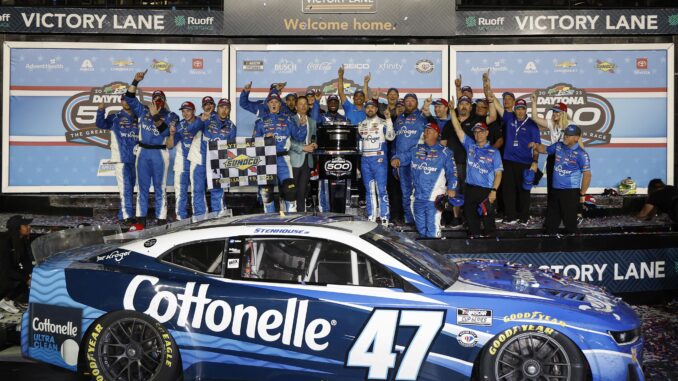

Black History Month had a rather unexpected triumph this past weekend during the Daytona 500, which starts the 2023 NASCAR Cup Series’ campaign to crown a new champion after a 10-race playoff competition ends at Phoenix Raceway November 5th.
When Ricky Stenhouse Jr. took the yellow and checkered flags to end the longest Daytona 500 on record, going 12 laps past the scheduled distance, he claimed the win for JTG Daugherty Racing, owned in part by former Cleveland Cavaliers’ center Brad Daugherty, it was the first time a Black owner has won NASCAR’s biggest race of the year. The JTG team has operated since 1995 and its sole prior win came Ian 2014 with former INDYCAR standout A.J. Allmendinger at Watkins Glen.
When this story made press, someone responded, “The color of his skin is and should remain irrelevant,” something that hasn’t happened yet. But for Daugherty, along with co-owners Tad Geschickter and his wife Jodi, this victory is one they’ve worked towards and worked towards for nearly 30 years. Neither Daugherty nor the Geschickter family ever gave up on their driver, Stenhouse Jr., who came from the open wheel ranks and still participates in open wheel racing when he’s able.
While Daugherty, who had eye surgery recently, wasn’t able to be on pit road due to the brightness of lights, he did manage to get into some trash talking with fellow NASCAR co-owner Michael Jordan, a partner in 23XI Racing, where Bubba Wallace and Tyler Reddick hold sway. Wallace, the winner of two Cup Series races – so far – has overcome biases in his NASCAR career because of the color of his skin. Last year and into this season, Wallace’s stock has risen as his consistency in the Cup Series has improved.
Wandering the breadth of the Cup Series garage, it’s never unusual to see Black personnel working on the cars or working with NASCAR’s tech division, and that’s a credit to the increased STEM courses and encouragement by people like Brad Daugherty, Michael Jordan, Bubba Wallace and NASCAR itself, which is taking big steps to increase interest in the sport for anyone willing to do the work necessary.
To increase participation, the African American Racers Association (AARA), led by Christopher Harris brought its story to SEMA last fall, after starting its activities in 2020, noting the lack of proper equipment that most Black racers have had to deal with, as well as the lack of diversity at the executive level. That there are only two Black co-owners on the Cup level is quite sad, he noted. The objective is to increase awareness, education and provide a platform for the many successful Black racers to tell their stories.
Harris noted the exploits of James “Bubba” Stewart (why are so many Black racers named Bubba?), who won every race, every moto in the 2008 AMA Motocross season. Stewart is second in all-time Supercross victories with 50 and amassed more than 98 wins during his professional racing career. Five years after his last race, Bubba Stewart entered the AMA Motorcycle Hall of Fame in his first year of eligibility. He currently hosts “Bubba’s World” podcast, begun last year.

Racers of Black ancestry have been many. You haven’t heard much about them because that’s how the system works. In fact, Black racers were around at the turn to the 20th century, starting with Charlie Wiggins, known as the “Negro Speed King,” who was born in Evansville, IN in 1897 and won races as both a driver and mechanic. The Wiggins Special, his homemade race car, won the Indianapolis Gold and Glory Sweepstakes competition four times between 1926 and 1933. His career ended when a “big one” racing accident caused him to lose his right leg.
Anecdotally, we’ve heard of Rajo Jack and Jack DeSoto, the nicknames of Dewey Gatson, one of America’s first Black racers. He had to work the outlaw circuits because, well, segregation barred him from sanctioned AAA events including the Indianapolis 500.
As Harris explains, the emphasis in the Black community is on stick-and-ball sports, because that is where most white people believe Black athletes can thrive. That Black men and women can and do participate and win auto and motorcycle races, either behind the wheel, working the handlebars and/or carrying jacks and tires on pit stops, has become Harris’ passion and gives him the will to explain the excitement of racing to younger Black fans and bring them into the fold.
And it’s important for the sport to recognize the importance of gamers, some of whom have made it all the way to Le Mans after their online exploits interested manufacturers. Included among those making the switch from the keyboard to the steering wheel is Rajah Caruth, a 20-year-old current competing in NASCAR’s Craftsman Truck Series in the No. 24 Wendell Scott Foundation Chevrolet Silverado RST. After a full-time season in 2022 with the ARCA Menards Series, the full-time junior at Winston-Salem State University in North Carolina is working his way to prime time, just as Wendell Scott would have wanted to, had the segregation tables not turned on him.
The avid sim racer, who competes on the iRacing platform, has been a fan since he saw his first NASCAR race at age 14. Richmond Raceway, with its tight corners and unforgiving walls in a 3/4-mile oval, entranced the youngster to the point where he decided, at that moment, racing would be his life. Everything he’s done since then has been aimed towards getting to race in NASCAR. And now, with his full-year entry in the truck series and his part-time experience in NASCAR’s Xfinity Series, he might soon join Bubba Wallace in the Cup Series, provided his GMS team in truck competition is able to lift his career upwards.
In INDYCAR, the first Black driver was, of course Willy T Ribbs, whose 17 victories in the Trans-Am series, wins in other sports cars and stock cars gave him an entree to the Indianapolis 500, where he was the first Black driver to qualify and race in the Greatest Spectacle in Racing, as long ago as 1991.
The most recent Black INDYCAR racer was George Mack, who competed in 2002. That apple hasn’t fallen far from the tree as Mack Motorsports entered 13-year-old Jayda Mack, who proceeded, in her first Bandalero competition in Las Vegas, to finish 3rd on Friday and held sixth her second night in the class.
INDYCAR is working to promote more Black drivers, including Myles Rowe and Ernie Francis Jr., both of whom compete in the ladder series like USF2000 and INDY NXT (formerly Indy Lights) that allows drivers to show their capabilities before driving the powerful Indy cars. Force Indy strives and excels at diversity, and is in the INDY NXT Series by Firestone and promotes the activities of Black, White, Women, bi-racial racers within its teams.
With Myles Rowe’s 2021 victory in the USF2000 series in New Jersey, only his second race in the series, he started to gain a following. Rowe’s Force Indy team moved to what is now the INDY NXT Series by Firestone in 2022, leaving the driver without a team. a GoFundMe campaign gave the driver sufficient funds to sign with Pabst Racing, where he crashed in his first race with the team and won his second race – all on the same, campaign-starting race weekend in St. Petersburg, FL. Added funding from INDYCAR Series owner Roger Penske allowed Rowe to complete the 2022 campaign and he’s back with Pabst Racing this year in what’s now called USF Pro 2000 Championship.
After a dismal, no-win 2022 Formula One season with Mercedes AMG, Lewis Hamilton looks primed to resume his attack on Red Bull and Max Verstappen this year. While remaining sole Black driver in the upper echelon of racing, Hamilton’s success has buoyed others now in starter series and looking to emulate his success. Hamilton has been called a once-in-a-generation competitor; maybe the next generation of F1 drivers will possess his capabilities undaunted by the color of their skin. There are many in F1 that aren’t lily white; that’s good news.
NHRA and, indeed, most straight-line racing embraces the qualities of a racer regardless of the color of their skin. Of course the first look is at three-time champion Antron Brown, who now owns his Top Fuel team and is looking to promote younger Black drivers who are ready to move up in drag racing. There’s 2018 Funny Car champ J.R. Todd, the first Black driver to win his category.
While there aren’t that many drag racers on the track who happen to be Black, a look through the pits will show off crew members and fans of color backing the play of those in the cars and on the motorcycles. One would hope Michael Phillips’ success in assisting those that could easily be his competitors – like Reed Motorsports – rewards him, and cousin Malcolm, with more success in the Pro Stock Motorcycle category. And let’s bring back Peggy Llewellyn, who rode magnificently in this class until the money ran out, a common issue.
There is always the hope, as time goes on, that there won’t be a reason to proclaim one month a Black History Month, or a Women’s History Month – or any month differentiating one racer from another. Until that time comes, we celebrate the success of Black racers – and next month with Women racers. Christopher Harris recounted the last message that needs to be stated over and over again. Originally spoken by the great Carroll Shelby who said, “Motorsports is a unifying thing.” Let’s all make sure ol’ Shel was right.
ETA: This article originally stated Jayda Mack’s age as 14. That has been corrected.