What’s Next for NHRA Funny Car Tethers?


Funny Car tethers are the latest issue that the NHRA Mission Foods Drag Racing Series tech department has to look into. With some exceptional explosions occurring in the class and tethered bodies causing drivers to be blinded when their massive bodywork cascades upward, everyone in the class agrees something has to be done .
Explosions in nitro classes happen fairly regularly. Since crew chiefs are constantly striving to extract the most horsepower they can while keeping the car’s engine together through the burnout, backup and race down the 1,000-foot track, sometimes they succeed; sometimes they fail. In the latter case, bodies have nowhere to go while tethered to the chassis, other than upward interfering with the cabin portion of the car.
This year during the DENSO NHRA Sonoma Nationals, Jim Dunn Racing pilot Buddy Hull was injured when the engine exploded on his Dodge Charger and impacted his hand as the bodywork entered his cabin. That incident occurred in late July and Hull hasn’t been able to race since as he recovers. Similar issues, including explosions the same weekend for Daniel Wilkerson’s Ford Mustang, have caused crew chief discussions about tethering to become louder, with everyone examining ideas they think could work.
Tethers have been part of the NHRA Funny Car scene since John Force Racing’s Robert Hight had an engine explode during the April 2013 four-wide race at zMAX Dragway in Charlotte, NC. After the body catapulted off the car, going outside the racetrack, NHRA decided it was a safety measure to install dual front-latch tethers on these machines. The use of Funny Car tethers has, since then, been an on-and-off affair, as they were required through the end of the previous decade and then off the cars for a bit before being returned to mandatory use.


At the Sonoma race in 2013, Johnny Gray (working with Don Schumacher Racing) suffered a similar issue with an engine explosion, and with tethers installed, the bodywork rose and came back towards him. Unable to see the car he was attempting to stop, Gray was fortunate in that he wasn’t injured and that he finally came to a halt. Tethers had been mandated a race earlier, for Bandimere Speedway as Sonoma was the second of three Western Swing NHRA dates. Gray’s incident occurred one-third into his 1,000-foot run; as the tethers brought the body back down, it blew the firewall up over the windshield and made it impossible for the driver to exit through the roof, which is the customary departure route.
Twelve years ago, Johnny Gray considered himself the NHRA’s “60-year-old guinea pig” for the new tethering anchors to Funny Car bodies. Since then, there have been plenty more incidents, including the ones occurring this summer, twelve years after tethers were mandated.
Massive fiberglass bodies hurtling into the driver cage is not an optimal look for NHRA, but it’s being smart in letting the crew chiefs come up with a variety of solutions before they all get together – hopefully after the season closer in mid-November – to find a logical solution that will work for the variety of bodies currently in use: Chevrolet SS (exclusive to John Force Racing at the current time), Dodge Charger SRT Hellcat, Ford Mustang/Shelby and Toyota GR Supra. With the latter manufacturer slated to leave NHRA at the close of this season, it’s unknown whether that body will be permitted to continue in competition without manufacturer support.
Some bright minds are lending their talents to fix this issue, which has been brought to the fore by news magazine CompetitionPlus. The magazine spoke with car owner/crew chief Jim Head, recognized as one of the more dedicated individuals to innovative safety in the NHRA pits. He’s been publicly joined by Tim Wilkerson, working with chassis designer/manufacturer Murf McKinney. John Force Racing’s fabrication shop is also looking into different ways to secure the body so that it doesn’t slam into the cockpit and hurt the driver; the fact that Buddy Hull still isn’t able to compete after suffering a hand injury shortly before Top Fuel’s Shawn Reed had his own accident that cost him a left index finger means safety needs to be more important than racking up points.

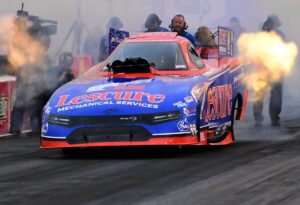
Being unable to see what’s ahead at 300+ speeds is a serious issue. While Hull’s issues have kept him out of the cockpit, there have been other explosions – notably Tony Stewart Racing Funny Car driver Matt Hagan’s Dodge Charger SRT Hellcat engine failure in the first Countdown to the Championship playoff race at Maple Grove Raceway. After the four-time champion’s explosion, noise about tethers grew louder and even more concerned. Of course prime directives are to keep fiberglass pieces away from the paying public as well as from the racers.
There are different ways of producing race cars and, depending on the manufacturer, burst panel sizing can be of varying sizes and locations. With different burst-panel sizes, a single solution just isn’t in the cards.
Every crew chief knows that tethering is essential, but as speeds have increased and lap times have gone down, a new look at the composition of tethers, their mounting places and the manner in which they deflect bodies from entering the cockpit and pushing towards the driver have to be reexamined. While tethering was removed from mandating at the start of this decade, they are essential safety items. They simply need some massaging to stop them from contributing to accidents in the class.
As we’ve seen, with current tethering, fixing the problem of bodies flying out of the realm of the two- and four-lane tracks is something that must be done, but it can lead to other issues. With the bodywork rising to the level of impeding driver visibility, leaving them blinded, the next big challenge is to find the right way to tether so that the bodies don’t rise and blind the driver, something NHRA has been dealing with since those pair of 2013 crashes for Hight and Gray.
The solutions are easier said than done.
When bodies continued to fly off cars in the latter stages of the previous decade, NHRA’s tech department allowed teams to remove their tethers. They could keep them or remove them; at that time no mandates were given.

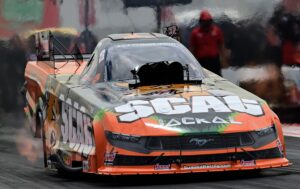
Among the solutions currently being offered are venting systems that could control where energy went after an engine explosion. A couple of years ago, as CompetitionPlus.com uncovered, Tim Wilkerson and Murf McKinney started talking about a venting system to control exactly where energy went when an explosion occurred. They produced a stove pipe that controlled the air around an explosion, directing air into the stove pipe that went halfway up Wilkerson’s Ford Mustang side window. The solution had an added benefit: Wilkerson’s Ford was quicker, with the window opened a bit to help vent that air. NHRA listened to teams that protested their invention and “made me close the windows, so the air couldn’t get through there anymore,” Wilkerson told competitionplus.com
The duo also produced a V-dash, which allowed a lower center of gravity and could hep keep visibility clear. On one occasion, he had a valve exit the head “and it coughed really bad, just like a normal explosion,” Wilkerson said. That incident blew out both side windows and a portion of the bodywork, but the body itself never left the chassis. He thinks that solution might help.
“We have to come up with a better system,” noted Jimmy Prock, crew chief to son Austin at John Force Racing, which is dedicating this time between races to working on the tethering issue at their Brownsburg, IN workshops. “We can’t take them off the cars because we can’t have bombs flying into the stands.” Prock knows some of the great minds in NHRA racing are looking into the issue and hunting for the right solutions. He thinks a new way to attach the dash nearer the firewall might be of assistance, but he also knows that, “Bottom line: when we have a massive explosion we have to find a way to contain it and keep the body out of the driver’s face. We just can’t raise the body to the point where a driver can’t see what’s ahead… “

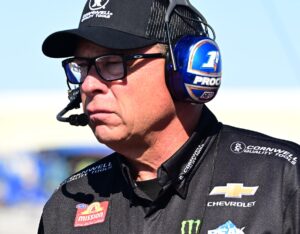
What’s been happening with all of this is, obviously, unintended circumstances. The driver has to be able to see what’s ahead and to the side of them, even though they can feel when their competitor is close. Prock wants to see more input on the location of the dash inside a Funny Car. “We could find a different way to attach the dash nearer the firewall, to hold the center down so it buckles in the middle. Just hold it down a little better in the center,” he mused. Would that be the V dash?
Whatever latching system the series decides to implement, it has to be operable and safe for both the driver and the spectators. Prock believes that massive explosions will continue due to a variety of indicators, whether they be performance oriented or not. “The bottom line is that we have to keep the body out of the driver’s face. We need to find a different way to attach the dash, whether it would be smarter to move it one direction or the other, left to right, or simply attach it closer to the firewall or to a window.
Because there are ideas out there, the best solution or solutions shouldn’t be activated during the remaining four Countdown to the Championship playoff races; rather, all the racers contacted believe that there needs to be a meeting of the minds to discuss this issue, once the current, 74th NHRA season has been completed in mid-November. But one thing in reaching a solution is essential: it can’t be done in an NHRA vacuum, where only the tech department has access to and rationales for a good conclusion to this issue. It has to be a community decision after careful, knowledgeable discussion.