Toyota Wins LeMans; IMSA Adds Cadillac to LMDh Lineup

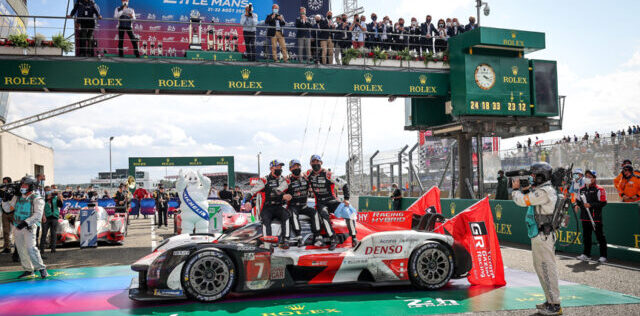
Toyota Gazoo Racing’s No. 7 Hypercar won the 24 Heures du Mans on the Le Mans Sarthe circuit last weekend, ushering in the new LMH (Le Mans Hypercar) era in style. It was the Japanese manufacturer’s fourth consecutive victory in the summer 24-hour classic, using the GR010 Hybrid prototype in the car’s Le Mans debut to also score their fourth-straight 2021 FIA World Endurance Championship (WEC) victory. Drivers were Mike Conway, Kamui Kobayashi and Jose Maria Lopez, their first time atop this prestigious podium.
The 2021 Le Mans race was run under difficult conditions with rain accenting the proceedings throughout. The Toyota Gazoo Racing No. 8 finished second while the Alpine Elf Matmut Hypercar finished third, silencing critics who were unsure the new LMH prototypes had the ability to withstand the rigors of this year’s late summer classic, held two months after its customary date, due to the pandemic that’s still shuffling both racing and everyday activities around the globe.
Just two days after that race was complete, there was news coming from the American side of the sports car world, as IMSA and Cadillac jointly announced that manufacturer would join Acura, Audi, BMW and Porsche in constructing a new LMDh entry for both IMSA and FIA WEC-sanctioned events. IMSA’s answer to the WEC’s Hypercar, LMDh is slated to run alongside the WEC entries beginning with the 2023 edition of the Rolex 24 at Daytona.


An agreement reached in July of this year between IMSA, the Automobile Club de l’Ouest (ACO) that sanctions Le Mans and the Federation Internationale de l’Automobile (FIA), LMDh cars will be sanctioned to compete alongside the Le Mans Hypercar (LMH) entries in the top-tier class of the WeatherTech SportsCar Championship and the FIA’s WEC. IMSA’s LMDh prototypes succeed the current Daytona Prototype international (DPi) class currently running at IMSA races. Starting in 2023, both LMDh and LMH will make up the top class of the WEC, allowing manufacturers to race in both series should they choose.
Cadillac has chosen to compete in both the WeatherTech and FIA WEC once its cars are completed. “We are excited to compete at the top level of international motorsport in the LMDh class, beginning in 2023,” said Rory Harvey, Cadillac global vice president. “Like motorsport, Cadillac is making the transition into a future driven by alternative propulsion. The hybrid nature of the LMDh rules will help us to bridge our technology transfer to our all-electric future.”
Harvey also noted that the technology transfer from motorsports to road-driven, production vehicles is the paramount rationale for joining both series. “We have had great success with the championship-winning Cadillac DPi-V.R. and look forward to building on that record into the future, with the next generation Cadillac LMDh.”
Development of the Cadillac LMDh chassis, together with constructor Dallara, who have built and developed the current DPi-V.R, is beginning. Cadillac swept driver, team and manufacturer championships in 2017 and 2018, earned four straight wins in the Rolex 24 at Daytona from 2017 through 2020, and leads the current DPi manufacturer battle on the strength of four race wins thus for in a season that continues through to the Motul Petit Le Mans, scheduled November 11-13, the traditional season finale.
Cadillac’s LMDh squadron will be led by two current Cadillac DPi teams Chip Ganassi Racing and Action Express Racing. “The IMSA LMDh category is looking to be very competitive with multiple manufacturers,” noted Gary Nelson, Action Express team manager. “We’ve had a lot fo success running the Cadillac DPi-V.R. as one of the original teams since 2017, and we are looking forward to being a part of the next chapter of Cadillac Racing,” he said. Chip Ganassi remarked that he is “looking forward to the new international prototype formula and running the Cadillac LMDh. We have had a great relationship across three different racing disciplines with GM and we are looking forward to developing the car with Cadillac and Dallara over the next year and a half.”
There are four approved LMDh chassis constructors, authorized to build cars for the now-five engine entrants: Acura, Audi, BMW, Cadillac and Porsche: Dallara, Ligier, Multimatic and ORECA. The engine manufacturers will be designing and constructing their own branded engines and their brand-stylized bodywork. Both cars and engines are cost-capped by IMSA; engines are intended to generate more than 670 horsepower (500 kW) from the combined output of an internal combustion engine and a hybrid powertrain. Bosch, Williams Engineering and Xtrac are working in concert to provide the spec hybrid powertrain system for all LMDh cars.
“Cadillac’s decision to continue its successful IMSA prototype program further validates the LMDh platform” declared John Doonan, IMSA president. “The combination of cost-effectiveness, technical relevance and the ability to compete for overall victories in the world’s most important endurance races, has clearly resonated with five manufacturers so far, with even more expected in the future.
“Cadillac already owns a tremendous legacy in sports car racing, especially over the past four years in the WeatherTech championship,” Doonan emphasized. “If the launch of Cadillac’s DPi program in 2017 is any indication we’d expect that the new Cadillac LMDh prototype will be a top contender right from the first race at Daytona in 2023.”
IMSA’s own endurance contests at Daytona International Speedway, Sebring International Raceway and Michelin Raceway Road Atlanta are expected to join the WEC calendar in 2023 and its six-hour race on the Watkins Glen International road course could fold into that schedule as well, adding prestigious contests on the North American continent to those occurring worldwide under the FIA auspices, including Le Mans, which will note its 90th running in 2022.