Reciprocal Knowledge

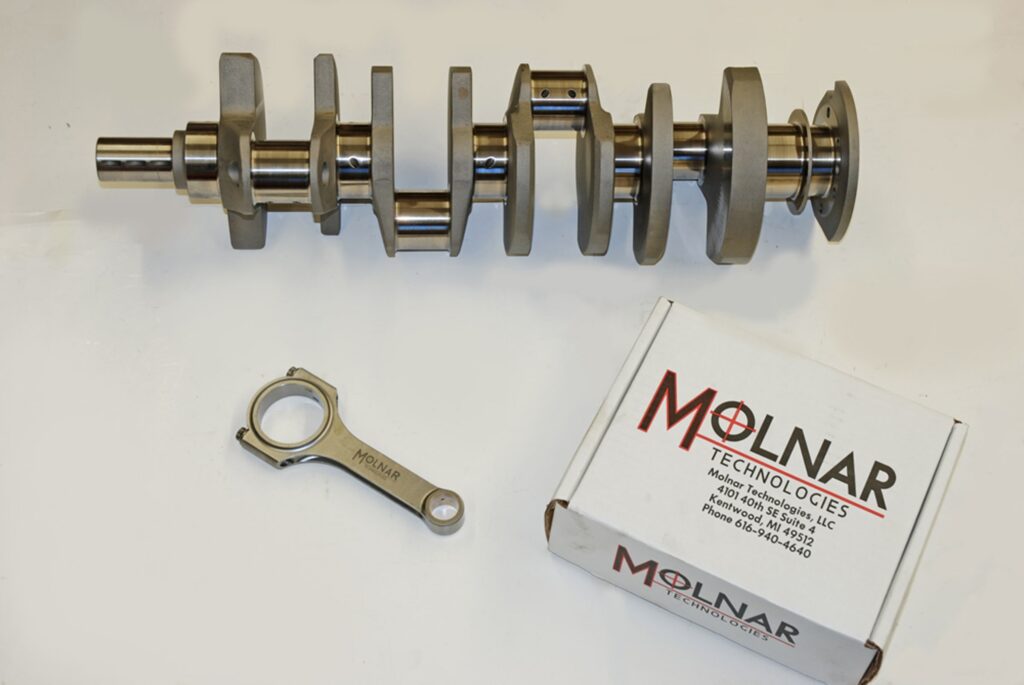
Two Dozen Fast Facts About Cranks & Connecting Rods – Part 1
There’s a ton of info out there on crankshafts and connecting rods. And thanks to the World Wide Web, there’s even more info than we ever thought possible. But there’s also a chance some of that info is wrong (no surprise we’re sure). In the “pages” that follow we’ll dig into reciprocating component information, and thanks to crank and connecting rod guru, Tom Molnar (Molnar Technologies www.molnartechnologies.com) we’ll also dispel some misconceptions and mistakes. Check it out:
(1) Connecting Rod Chamfer: Most know this but it’s worth repeating. Closely look at the big end of a connecting rod. One side will have a generous radius. The other side will not. The side with the deep chamfer faces the fillet radius (outside edge) of the crank. The less generous chamfers on the rods face each other.
(2) Connecting Rod Side Clearance: There has been plenty written and discussed with regard to rod side clearance. In fact some very well respected engine builders will tell you that excessive side clearance will result in lower engine oil pressure. Wrong. Rod side clearance has little to do with engine oil pressure. Tom notes: “When you have .0025”-.0030” of clearance between the crankshaft and bearing shells, the .018” of side clearance certainly will not hold back any pressure. You need side clearance to let the oil out to help keep the bearing cool and fresh oil in.”
(3) Crankshaft Material Matters: Most OEM cranks will be manufactured from 1010, 1018, 1045 and 1053 steel alloys. The majority of OEM forgings have a large content of carbon in the alloy but they lack the chrome and nickel found in more expensive materials such as 5140, 4130 and 4340. 5140 alloy was once pretty widespread in crankshafts but today; higher strength 4130 and 4340 alloy crankshafts are more common. There‘s more too: According to Tom: “Typically, a 4340 part heat treated to the 36-37 Rc range will have a tensile of 165,000 to 170,000 PSI. If you want, we could get into “tensile” a little: Tensile does not mean “strength” or stiffness. If you had two dimensionally identical parts made out of the same carbon / iron material with one at 22Rc (116,000 PSI tensile) and one at 38Rc (176,000 PSI tensile), both would bend or stretch the same amount at the same load. What the higher tensile does is allow the part to be bent or stretched farther before it takes a permanent set and does not return to its original length or straightness. This is important to know especially with rod bolts. A bolt with a higher tensile number does not necessarily mean it is stronger or better, in fact to get to a higher tensile number means the material must be heat treated to a higher hardness which can bring along with it, other problems such as stress corrosion and hydrogen embrittlement. To take this a step further, if these two identical parts were bolts and dimensionally the same but different tensile due to the heat treatment and both stretched the same amount, as long as they were not stretched to the point of yielding, both would provide the same clamping force.”
(4) What Alloys Mean: Molnar provides insight regarding alloys: “The last 2 digits of the AISI number designates the amount of carbon in the steel. 4130 steel has .30% carbon and 4340 material has .40% carbon. In the forging process a bar of steel is heated in a furnace, pulled out with tongs and placed between the forging dies and pressed into the desired shape. When the hot steel is removed from the furnace, it is exposed to the oxygen in the air we breathe which burns off some of the carbon on the outside surface. This creates what is called a decarb layer due to the lower carbon content. A certain amount of decarb is allowed in forgings however if you think about it, the outside layer of a forged 4340 part is not really 4340 due to the lower carbon content. Since most cracks in a part start on the outside fibers of the part, this lower carbon surface is a place where a crack can start. 5140 steel also sees use in connecting rod applications. While 5140 has the same amount of carbon as 4340 (see above regarding AISI numbers). It the other elements that are missing or added that make it less strong than 4340.”
(5) Non Cross Drilled Cranks: Cross drilling was somewhat common in the 60’s and 70’s but fell out of favor somewhere around the late 80’s. As RPM in racing engines went up, cross drilling can lead to oil starvation of the rod bearings. Molnar has never cross drilled cranks for this reason.
(6) Chamfered Crank Oil Holes: Once the oil holes on the rod and main journals are drilled, they often have sharp edges and the odd burr. The holes shown in the photos is an image of a Molnar-built crank. The oil holes are clean and nicely chamfered.
(7) Why Aftermarket Cranks Must Be Balanced: The vast majority of custom crankshafts such are shipped to the consumer non-balanced. Why not? It’s simple. The crank manufacturer doesn’t know what weight piston-rod-ring-wrist pin combination you’re using and they need the exact parts in hand in order to balance the engine.
(8) Are Two Piece Forgings Superior? Tom Molnar tells us that some companies claim their rods are made from two-piece forging which, results in an improved grain flow but this is actually a myth. While is it true a forging has grain flow that improves strength, if the part is properly heat treated as a connecting rod should be, this is no longer the case. In 4340 materials you are looking for a fine grain martensitic structure, which is much stronger than the as-forged structure. The heat-treating process changes and refines the grain structure and the grain flow is no longer present.
(9) Is An I-Beam Rod Really Stronger Than An H-Beam Rod? Molnar Technologies offers all sorts of forged steel connecting rods (in the examples shown in the photos, a rod for a big block Chevrolet). Molnar’s connecting rods are of an H-bearm design but they are different than many of the others and have features that puts more of the mass under the wrist pin where it needs to be for strength and to make them stronger than an I-beam.
(10) Bearing Clearances: When you purchase an aftermarket crankshaft, you must check the bearing clearance! Molnar recommends 0.001-inch clearance for every 1.000-inch diameter of the main journal as well as the rod pin journal, measured at the crown of the bearing surface. Tom notes: “This means that a crankshaft with a rod pin diameter of 2.100-inch must have a minimum of 0.0021-inch of oil clearance”
(11) Wrist Pin Bushings: In contrast, all connecting rods manufactured by Molnar are fitted with bronze bushings. These are all sized correctly for proper wrist pin clearance (provided the wrist pin diameter is correct).
(12) Mr. Clean: When you receive a new crankshaft and connecting rod set, they must be cleaned. Typically, before the manufacturer bags and seals the components, they are protected with lubricant to prevent corrosion. Rods must be disassembled and cleaned and in addition to an overall cleaning, all oil passages in crankshafts must be thoroughly cleaned.
###
That’s a wrap for this issue. Down the road, we’ll present Part 2. We’ll even dig into the somewhat controversial practice of placing horsepower ratings on specific parts. And yes, some of what you learn might surprise you. Watch for it!


