RACK EM UP: Inside Steering Racks Part 2


When we last left you, we covered the basics of how a now vintage recirculating ball box worked. It’s actually a rather complex piece of equipment. Plus they can prove rather heavy and they’re clearly bulky. In contrast is the rack and pinion steering arrangement(s) now common today. Not only are they rather simple, they’re also light.
Rack and pinion steering was initially intended for use in compact cars, although a number of sports cars were quick to adapt the system. These were cars which had limited space in the engine compartment, and in many cases, had no substantial framework on which to mount a heavy steering box.
The way a rack and pinion system works is in sharp contrast to the mechanics found inside a conventional steering box. Basically, the steering wheel and steering shaft are connected to a pinion gear. The pinion gear is in mesh with a straight shaft that has gear teeth machined into one side. This toothed shaft is called (appropriately) a “rack”. When you turn the steering wheel, the pinion gear turns. This, of course, causes the rack to move. This movement, in turn, is connected to a linkage that directly moves the front wheels.
The rack-and-pinion gear is mounted inside a rack housing assembly (typically cast, although there are some billet models available). The steering linkage consists of two inner tie rods and two tie rod ends. The inner tie rod ends are attached to the steering rack ends. The outer tie rod ends are attached to the suspension arms on the steering knuckles. Rubber boots or rack “bellows” are used to envelope and protect the inner tie rod assemblies from road grime (a semi-exploded view of a vintage Cam Gear rack and pinion assembly is shown elsewhere).
As you can see, the rack and pinion system proves very simple, straightforward and light. Given the layout, there’s no need for a plethora of associated steering pieces, since the linkage bits are already part of the rack and pinion. And since there are fewer moving parts, there is less chance for wear. A rack will typically feel “tight” and precise at high speeds. In turn, this provides you with considerably more road (or race track) “feel”.
Perhaps the real beauty of incorporating a rack and pinion system in a modified car is that it eliminates many of those previously mentioned moving parts. It’s also possible (and very common) for the rack to be installed in a “front steer” layout. This way, the steering linkage is ahead of the front axle centerline. This frees up considerable space under the engine for things like the oil pan and headers. And of course, there’s the issue of weight. As an example, a Flaming River Pinto rack and pinion system weighs a mere 12 pounds. In some cars, that’s less than the weight of steering linkage, not counting the box.
While the Pinto rack is the darling of drag racing, there are also other rack and pinion assemblies that can find a home in a street machine or other modified vehicle. For example, the folks at Flaming River Industries offer several different Mustang racks (replacements for manual rack Mustangs and Camaros, conversions from power to manual steering and so on), rear steer Omni racks, and even an MGB/Cobra replacement rack that weighs less than 10 pounds!
In some applications, the rear steer Omni-style rack might prove to be an easy installation. It’s commonly used in the street rod world, and is particularly useful in cars where something like a radiator or front suspension cross member might interfere with the steering shaft). This rear steer design mounts behind the cross member but still provides oil pan clearance. The overall length of this rack is 39.75-inches and it’s designed to accommodate Mustang II spindles and outer tie rods ends.
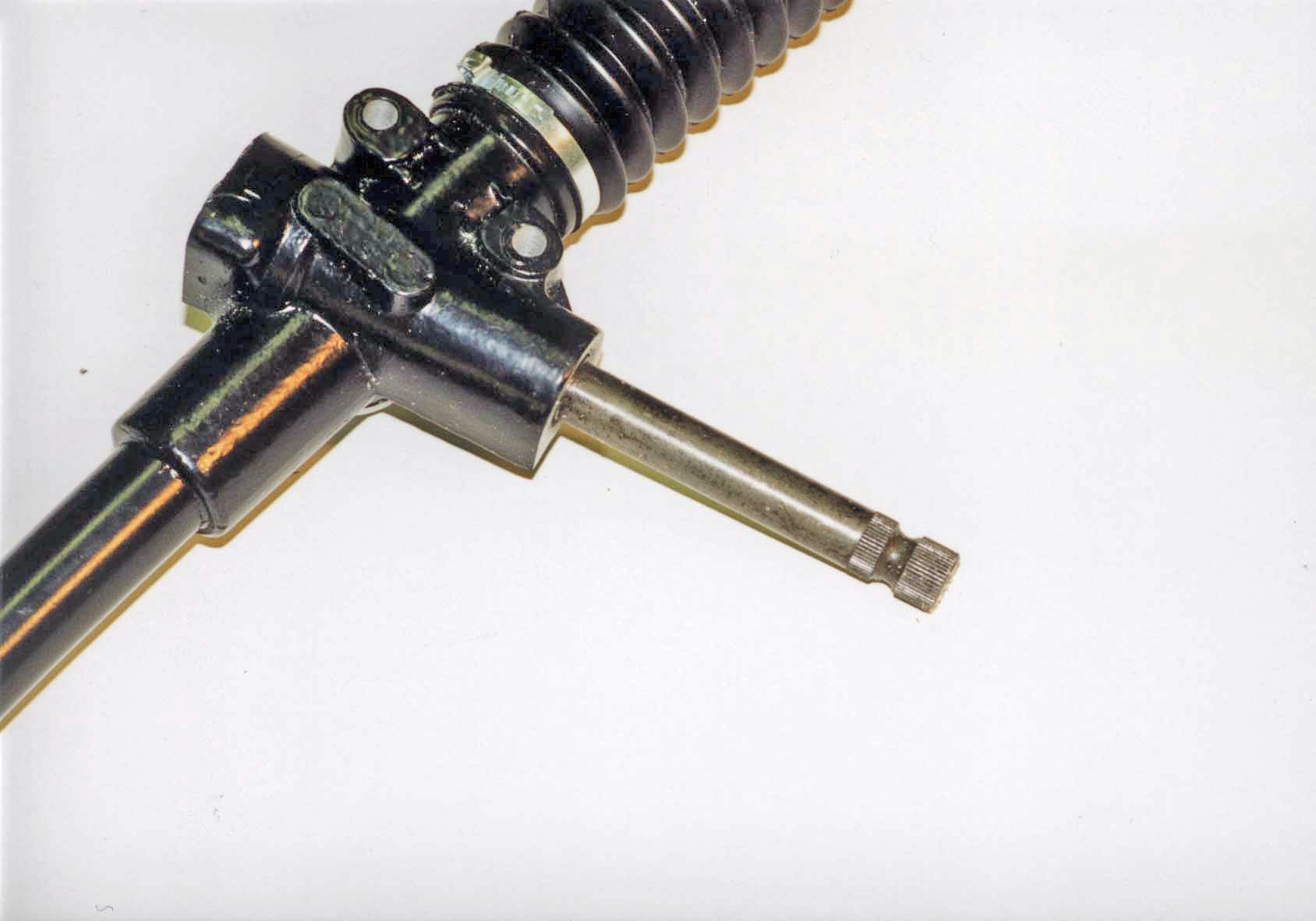
The MGB-Cobra rack (which is shown in the accompanying photos) from Flaming River is dimensionally interchangeable with the original MGB rack (or, believe it or not, the original rack and pinion for a Shelby Cobra). There is a difference though. Compared to the vintage Cam Gear rack used in those cars, it is constructed with modern materials, and as a result, it has a considerably smoother steering feel. The total length of this rack is 41-inches, while the inner end center distance is 24.9-inches. As mentioned previously, it weights a mere 9.65 pounds. The ratio is three turns lock to lock with 6.25-inches of travel. Spline size is 3/4-48.
There’s more too: Flaming River offers racks that are custom built to your specifications. Based upon the Mustang II rack, several custom shortened designs are available for Willys, Anglia and other custom chassis applications. They even offer direct replacement racks for all sorts of late model cars (conversions from power steering).
In the end, it’s easy to see why rack and pinion steering mechanisms have become the system of choice for both major automobile manufacturers and high-performance car builders alike. They’re simple. Reliable. And light. For a closer look, check out the following photos:
###