Norman Legualt’s 1966 Chevrolet II Nova
- Clive Branson

When introduced in 1962 as a compact, economic car to compete against the Japanese imports, the Chevy II was nothing to write home about. It was as riveting as an IBM seminar on tax rebates. The only thing redeeming about it was that it was the fastest newly developed car in history—from start to finish—in only 18 months. However, with time and some imagination, the Chevy II graduated to ‘Class Cool’ status, namely the aggressive SS V8s in 1968, especially once they were modified with aftermarket parts and qualified as muscle cars.
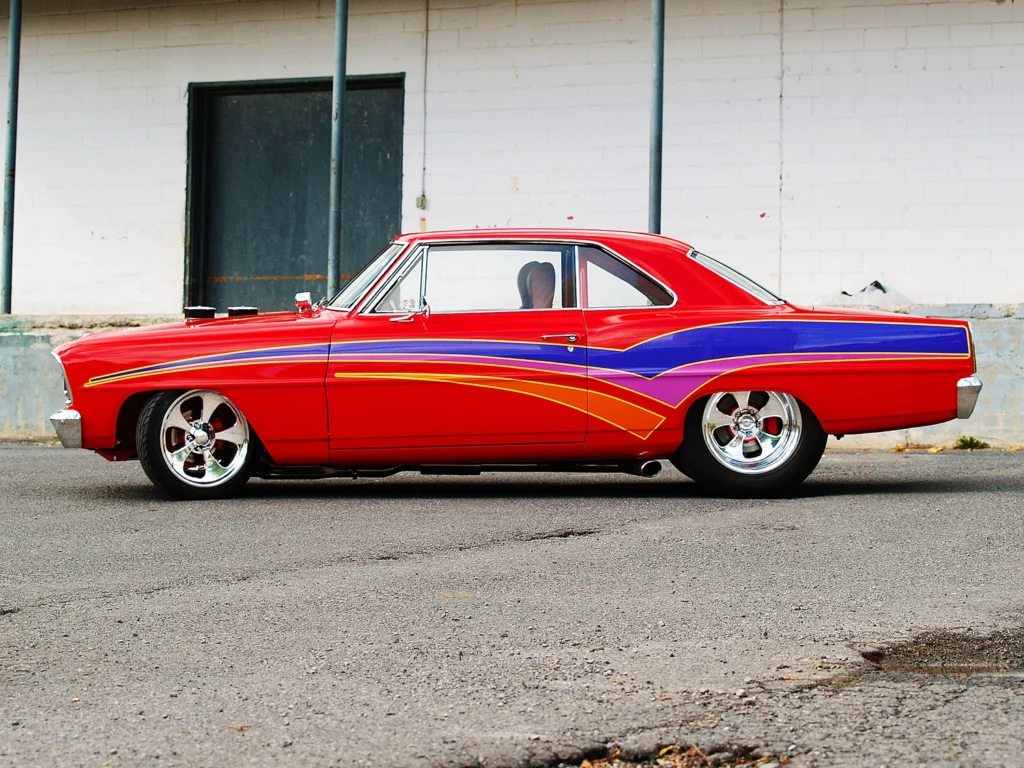
The SS developed a sharp-edged, streamlined makeover. The highlights were all cosmetic: squared proportions with a tighter, bolder look, a more aggressive angled grille, “humped” fenders, and a semi-fastback roofline. Its persona seemed to change overnight like the swish of a windshield wiper. But even this paled in comparison to Norman Legault’s vision. Norman is someone who can prove that curiosity frees us from bad things like mediocrity. He gave his ’66 Chevy II a complete nip-and-tuck operation that even Chip Foose would envy. The results were staggering: a rippled six-pack, chiseled looks, and an attitude.
I had to ask Norman what the condition of the car was like prior to the reconstruction. “I first discovered the car abandoned behind the owner’s house, who used it to travel to school. By the time I bought it, the car was a basket case; 90,000 miles and no engine. Everything had rotted away, holes through the floorboards and firewall, but the rockers were really nice,” Norman said judiciously.
I was curious to know why Norman was so impressed by the Jackie Mason of Chevrolets. Norman looked at the car fondly. “I’ve always liked the body style: short and stubby. It would make a nice pro street model. It has that intimidating stance.”
We stared at the candy-apple red of metal in front of us. I couldn’t divert my eyes from it—such vivid colors. “I had it painted twice,” continued Norman. “It had to be red with a purple engine. Both paint jobs had their own graphics—that’s the eye-catcher.”
That was more than obvious. The resplendent pattern swirled and led my eyes to the exposed chrome exhaust poking out from the side of the car like emerging torpedoes. A beautiful job by Donald Jackson and Jonathan Villeneuve. The graphics reminded me of an announcement that a circus was in town.
“How long did it take for you to restore it?” I asked. “It took four years to restore this car, then another ten years to perfect it to show standards.”
This, coming from a man who is an absolute precisionist. I shook my head and gave a low whistle.
“I don’t know where to begin,” I blurted. “Well, the owner, Todd MacIntyre, had put a small block in, so I got a 355 c.i. with a 350, a 9” Ford, and a 4.56 gear,” began Norman. “I took my first ride in September 1991 and drove it till 2001. By then, I realized it needed a complete makeover. It took seven-and-a-half years before it came back home from three body shops, and another year-and-a-half to finish it completely.” Norman paused. “You wanna go for a ride?”
Anticipation seized me. I heard the sound of our footsteps. The car’s silence, its menacing stance. The sound of the door opening. A cool sensation of the upholstery. The door shutting. A deeper silence, a hush as all sounds of the outside stilled before the key entered the ignition. The engine turned, and a rumble emerged from the bowels of the car. A sound that I’m sure could have been heard in the next postal code. It was alive, and I couldn’t turn off my grin. The car wobbled as it idled, ready to pounce. I noticed neighboring curtains move, and little kids were being rushed indoors. It was little wonder that children ran to catch up like it was some modern Pied Piper or a souped-up ice-cream truck. Teens and adults stopped whatever they were doing in mid-stride and stared with dumbstruck smiles on their faces.
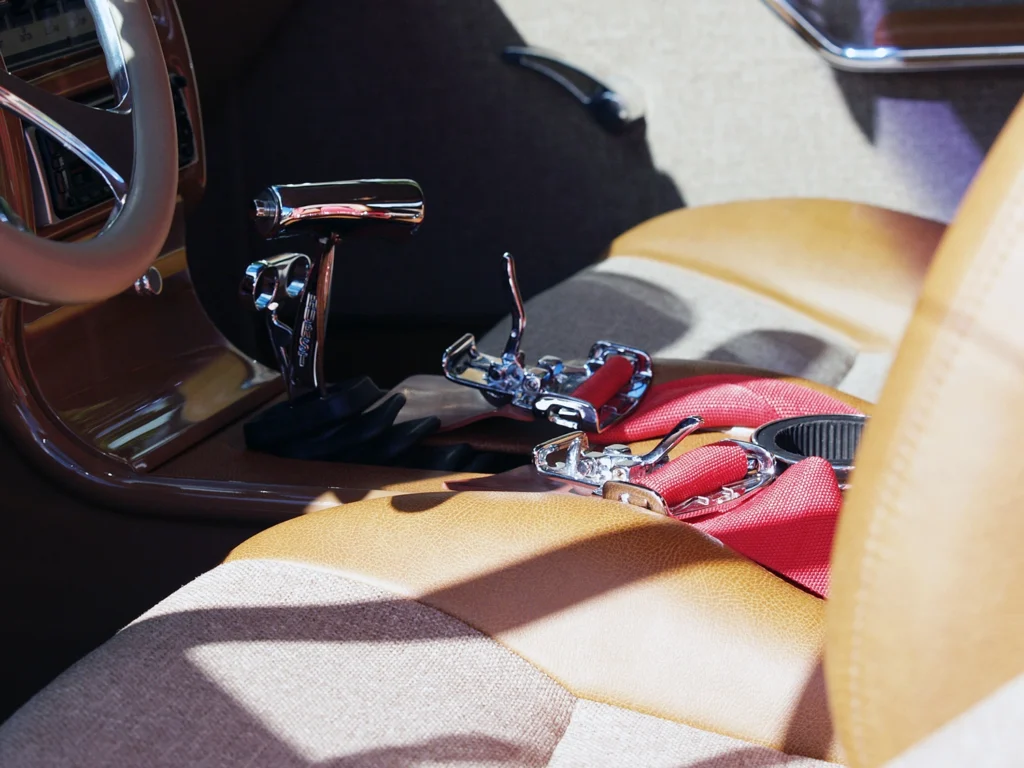
“Is it difficult to drive?” I inquired as I strapped on the 4-point harness. “People I take for a ride are always surprised that the car feels so smooth. I have a wheel alignment problem, but I’m working on it,” Norman shouted over the engine’s cacophony. We drove around, looking for ideal locations to shoot the car.
“Has the previous owner seen the work you’ve done on the car?” I asked. “I went to show the car to Todd years later. He was at an arena playing hockey. I waited for him, but he didn’t recognize me at first. I asked him if he remembered what his car looked like. When he saw the transition, he couldn’t believe his eyes,” remembered Norman, his tone ebullient like a vicar winning a new convert.
When Norman mentions the number of people who helped him, it comes across like a thank-you speech at the Oscars. “I have to mention Doug Brown, who taught me about all the mechanical work involved.” Others that Norman is indebted to are Carl Amyot for the welding of the frame and roll-bar/cage, Dalkeith Collision owner Gerald Lauictoire for the first paint job, and machinists like Mark Dewar. George Semlainoi took care of the electronics, while Mr. Cars’ Mark Cuiclerier did the mesmerizing second paint job. Bertrand Body Shop Supply in Cornwall sponsored some Dupont paint, while Rheal Seguin took care of the transmission. Interior fittings and coverings were done by Claude Mayer and John Gagnon, and the very affable Guillaume Bordeau for the engine’s fine-tuning. “Guillaume is such an amazing expert,” emphasized Norman. “Lest I forget, Lorraine for her patience and support.”
“What parts took the longest to restore?” I asked. “Everything I started was a long process because I’m too particular. I’m absolutely meticulous in what I do. A good job is a complete job. Every part was smoothed out seamlessly and easy for me to clean, even down to the brake pedals,” confirmed Norman. The engine is so immaculate and stunning, I could eat off it.
I inquired what the hardest part is to maintain. “The hardest thing to maintain is to keep it clean. It takes hours every week—all summer long! But it’s worth it.” And to prove it, Norman has collected trophies for Best Motor, Best Interior, Best Paint, Best of Show, Pro’s Pick, and the NSRA Pick. “That’s why I call her SHOW TIME.”
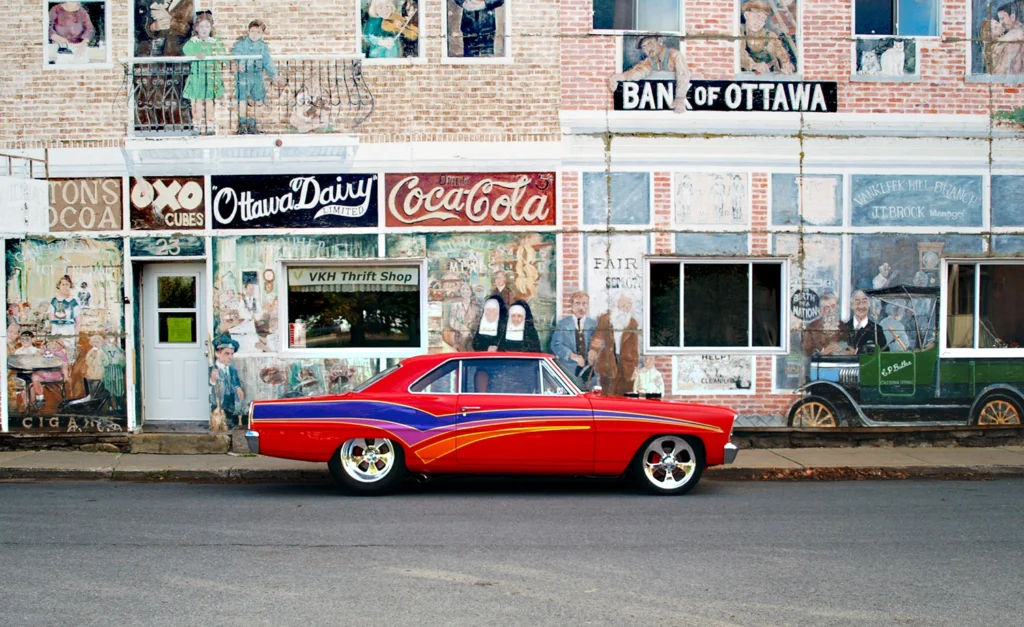
We parked by a wall mural because I noticed how all the people in the mural seemed to be looking at the car. “To have a car of this caliber is a dream come true. I even drove it to the East Coast Nationals in Moncton, New Brunswick, and to Lake George in Upper New York state,” Norman declared proudly. “The other satisfaction I get is the people it has enabled me to meet. I mean, we never would have met. Everywhere I go, people think that I put it on a trailer. I tell them that I drove it, and they are astounded. It’s the same when I tell them I do around 17 to 18 miles to the gallon with an engine that produces 590 horsepower. I’ve discovered that it’s more than nostalgia; it’s about having fun and meeting people.”
I really enjoyed Norman’s company, and he left me with the impression that passion is the freedom to live life as you choose. And Norman’s car is some passion worth living for.