NHRA mandates New Pro Stock Motorcycle Wearables Rules


Two accidents in the latter stages of the 2023 NHRA Countdown to the Championship playoffs have changed how NHRA approaches wearables in the Pro Stock Motorcycle class.
Angie Smith’s accident a St. Louis, the third consecutive playoff race – of six – resulted in broken feet and road rash that required extensive skin graft surgery. Separated from her Buell motorcycle after completing a full pass on Saturday morning in qualifying on World Wide Technology Raceway’s quarter-mile, she barrel-rolled across the dragstrip in the shutdown area.
Under “normal” conditions, we wouldn’t have seen Smith until the 2024 Mission Foods NHRA Drag Racing Series opened at Gainesville in March. She was in fifth place when this accident occurred and wanted to remain in the top 10 by the time the season was completed in November at Pomona.


No one expected to see Angie Smith suit up again, but there she was, qualifying 16th at Las Vegas the final weekend of October, albeit in the final, 16th position. She didn’t show up for her first-round match against eventual champion Gaige Herrera and his Vance & Hines Motorsports Suzuki Hayabusa3.
Two weeks later, she was at Pomona, again running her pink Buell. She qualified in two of the four sessions and was paired against Kelly Clontz’s Suzuki in the first round. Clontz had an accident on Saturday down-track on the In-N-Out Burger Pomona Dragstrip and was unable to compete; Smith took the win by staging and rode down the track. She then lost to veteran Steve Johnson in the quarterfinals, which kept her in the top 10 overall for the season, claiming eighth place once the racing was complete.
The motorcycle Angie Smith was riding when she had her accident was the same one occasional teammate Chip Ellis raced in competitions the two weeks before, where he recorded a runner-up position to Matt Smith at Reading and a quarter-final result, losing to eventual NHRA Rookie of the Year Chase Van Sant in Charlotte. It was a black Buell when she raced and fell in St. Louis.
What was noticeable after Smith’s bad fall was that her leathers couldn’t withstand the impact, nor could her race boots. In modern motorcycle racing outside straight-line competition, riders are required to wear padded suits and far more protective boots. Would NHRA adapt those?
The sanctioning body didn’t rush things, as they should not have, as there was more impact left in the season. Van Sant, who took over the lead Suzuki at White Alligator Racing when then-team owner Jerry Savoie found his plate full with business activities, had his own impactful incident on the track at Texas Motorplex in the first round of qualifying; he had fifth-place points coming into the fourth contest of the Countdown.
After pretty much using his left knee to stop his Suzuki from hitting the ground in the shutdown area of the Texas track, Van Sant was unable to compete for the balance of the season’s two remaining races and ended up ninth on the season behind Smith. Van Sant’s leathers didn’t hold up either and he suffered injuries to his knee and leg as a result of this accident.

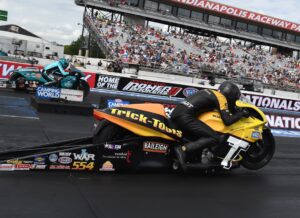
Just before the year-end, NHRA decided to change the rules concerning riders’ suits and boots. Starting March 1, 2024, “Leather suit thickness must be 3 ounces, with an additional layer of protection, consisting of a second layer of leather, separated by a layer of Kevlar (totaling 2 layers of leather and 1 layer of Kevlar) is mandatory in the following areas: shoulders, elbows, forearms, hips, butt and knees,” NHRA decreed.
Additionally, “CE Level 2-certified back protector is mandatory and leather riding boots are mandatory. Boots must be a minimum of 7” tall, measured at the heel from the ground. Boots must have additional protection area of hard composite, plastic or steel in the following areas: toe box, forefoot area and ankle area. Sole of boots must be sewn on.” Additionally, NHRA said leather gloves are now mandatory and must be Kevlar-lined or equipped with slide buttons.


Will these rules assist riders who have big falls like these two did during the latter stages of this year’s championship drive? It remains to be seen, but comments about the rules changes show that NHRA perhaps didn’t look far enough into the future to determine the proper fitment for their two-wheel competitors. In MotoGP, for instance, the sewn-on soles aren’t mandatory but the safest motorcycle racing boots used in MotoGP aren’t eligible for NHRA competition, nor are their leathers.
At the Performance Racing Industry (PRI) show in early December, Vanson showed its custom Air-Pro motorcycle racing suits that inflate in an accident. NHRA might have considered this type of protection but did not require it.