Click Here to Begin Slideshow
In an attempt to give us better racing, NASCAR makes changes to their rules packages every year, and this year is no different. This year’s changes include how many people can go over the wall during a pit stop, the “crash clock,” ride/spoiler height and a change to the penalty received if too many people go over the wall.
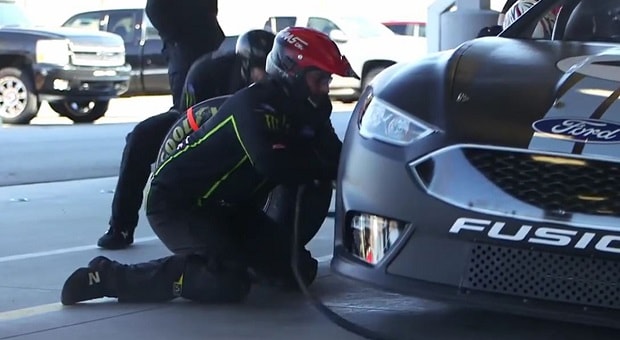
This was the teams’ first chance to try out the new pit crew rules of five people over the wall and the gas man being able to do nothing but fuel the car. Just under 17 seconds was the best pit time.
Last year there were six - gas man, jack man, front tire carrier, rear tire carrier, front tire changer rear tire changer. This year there are five - jack man, gas man, front tire changer, rear tire changer and a tire carrier. Although I didn’t see any 11 or 12 second pit stops yesterday (or even 13 or 14 seconds), some teams seemed to have already gotten a better grasp on the five-person over the wall crew, while others are still playing catch up. The Stewart-Haas Number 41 pit crew of Kurt Busch put in the best performance of the night with a put stop of 16.95 seconds, a full five seconds slower than the average stop last year.
Image courtesy nascar.com
Clash winner Brad Keselowski’s Crew Chief, Paul Wolfe, said, “A 16.9 is - obviously it’s quite a bit slower than what we’re used to. And that’s just it - we’re not sure what to expect yet. And speedways are different as well, from the mile and a half tracks. I mean, that’s pretty slow from what we’re used to, but you take one guy out of the equation, and some different (air) guns and things, and it all changes. I think, like I said, there’s going to be a lot of different departments studying film and trying to understand different ways and ideas, and I think we’ll see this evolve a lot. I would expect to be quite a bit faster when we come back to Daytona in July. I would expect you’d see a good second or two shaved off those times.”
Last year, Talladega and Daytona were the only tracks where the post-race inspection checked the ride height in the rear. NASCAR did away with that inspection point this year and the cars are pinned to the ground in the rear like never before. What this does is bring the top of the spoiler down out of the air moving around the car. This means there’s less downforce on the rear, so the cars, in the words of the driver of the Number 88 Alex Bowman, “drive worse. I was looser on entry, but it was kind of split.”
All three of the broadcast commentators mentioned that this was the lowest they’d ever seen cars.
Image courtesy chicagotribune.com
Last year’s 500 winner, Kurt Busch, said, “The way the cars will be pinned to the ground, it’s going to be the first time really that we’re looking at moving around nose weight and the balance of the car to adjust the handling. We haven’t done that really here in Daytona for eight years. They repaved it in (2010), so since then it has been no handling issues whatsoever. I’m really excited about this time around to hopefully see what the tire wear shows and how the balance of the car will shake out with the ride height rule.”
Check out how high Kurt Busch’s winning car was in 2017 at the Daytona 500.
Image courtesy youtube.com
Last year, teams had five minutes to get cars with wreck damage repaired to where they can meet a minimum speed around the track. Teams will now have six minutes to make the needed repairs. They still can’t take the car behind the wall or install new sheetmetal. They can also still go to the garage and come back out for mechanical repairs only.
Coupled with this rule is a change to the rule that got Matt Kenseth’s Number 20 Toyota taken to the garage after an extra man went over the wall to make crash repairs during a Chase race. This “benching” of Kenseth put the final screw in his attempt to win a championship before leaving the sport due to a lack of a ride this year. Now if an extra crew member goes over the wall while a car is on the crash clock, the car will be assessed a two lap penalty instead of being parked in the garage. Potentially, if early enough and on the right track, a driver could come back from such a penalty to score a top five finish, if not a win.