Acura, BMW tease IMSA GTP Designs
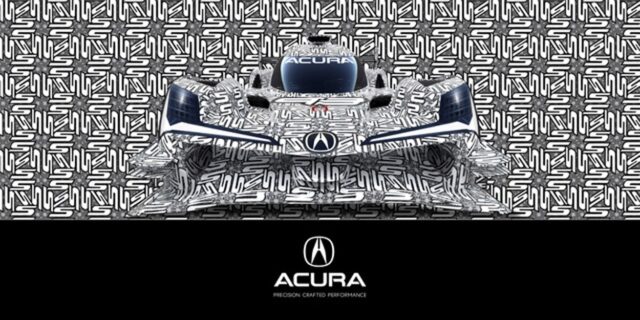

Acura was first to tease images of its ORECA-chassis ARX-06 competitor, which it hopes will be the next successful endurance prototype for Honda’s upmarket division, which began operation in 1986 and started to compete in 1991. Acura’s Design Studio, located in Los Angeles, California worked in conjunction with Honda Performance Development (HPD), the racing arm of Acura Motorsports, to design the new car that will replace Acura’s AARX-05 DPi competitor currently racing in IMSA’s top category.
Dave Marek, who is Acura’s executive creative director (and a super fun person to be around), explained the manner in which Acura proceeded to prepare for next year’s competition: “The process we used in creating the exterior design for the Acura ARX-06 is exactly the same as how we create a new Acura passenger vehicle,” he said. “The same world-class stylists that lead Acura production car design, created initial sketches, then pared those down to several potential designs.


“Next we created a scale model, did aero and wind tunnel model testing and brought HPD and our partner teams in for their feedback,” Marek continued. “The design continued to be refined throughout the testing and evaluation process, until we came up with a final treatment that met our performance goals, while maintaining all-important Acura styling cues. It’s been an exciting process.”
Acura began designing and racing prototypes in 1991. The current car that will commence competition at Daytona next year is based on the ORECA LMDh chassis. The ARX-06 will feature Acura-specific bodywork, aerodynamics and internal combustion power. The company continues with its two teams, Rolex 24 and championship-winning Wayne Taylor Racing and reigning 2022 Rolex 24 at Daytona victors Meyer Shank Racing, who will each campaign the hybrid-powered Acura entries in 2023.
BMW’s M Motorsport has its own LMDh prototype to tout and began to show its design on Monday, June 6th. Celebrating its 50th year in racing, M Motorsport is showing off its BMW M Hybrid V8, which one can easily see is a familial-looking prototype. In order to visually obscure performance-critical geometries, M Motorsport has shown the car in camouflage livery, but does have a new ‘MBEDDED’ episode that reveals more details about the new prototype (https://youtu.be/-G8DhowAGj8).
BMW Group Designworks was charged with celebrating the history of BMW M Motorsport in North America, while still defining a dynamic hybrid electric future for this race car. As expected the hallmark of this design is the treatment of BMW’s wide kidney up front. There’s also a nested 50th anniversary logo on the hood, twin BMW icon lights, dynamic body side renderings, Hofmeister kink window graphic, M ‘hook’ mirrors and the tail lamps.
The camouflage BMW is using for its M Hybrid V8 contains many elements from its five decades of successful competition in North America. The images of its iconic race cars – the 1976 BMW 3.0 CSL, 1981 BMW M1/C, 1978 BMW 320i Turbo, 1986 BMW GTP, in addition to the BMW M3 E36 GTS-2, BMW Z4 GTLM and the recent BMW M8 GTE. These images create a mosaic which obscures the shape of the new GTP car before its development testing.
“My team’s job was to make the BMW M Hybrid V8 look like a BMW and embrace every opportunity to make it also perform like one on the race track,” Michael Scully, BMW Group Designworks Global Automotive Director. “The design is rooted in BMW’s DNA of purposeful, efficient performance,” he noted. “The exterior’s bold, determined character invokes BMW’s frontiersman-ship of turbo power, now united with an optimized hybrid electric powertrain.
“The camouflage livery celebrates the 50 years of M by commemorating the great cars of BMW’s storied history in IMSA racing, while uniquely cloaking the BMW M Hybrid V8’s future-facing exterior geometry and technologies during the critical on-track development phase of the project.” Scully noted that the camouflage
celebrates the first purpose-built IMSA GTP car from 1981, the BMW M1/C but did note that BMW M Motorsport will “follow-up with a works livery that exemplifies the dynamism and excitement of hybrid electric-powered competition.”